
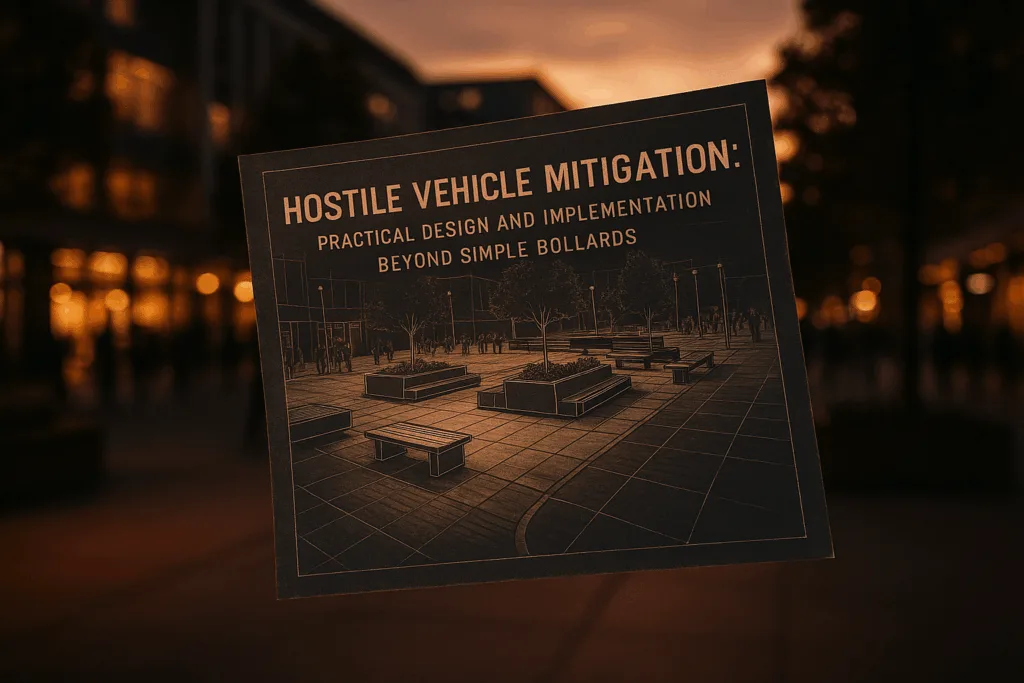
Vehicle attacks are simple, cheap, and devastatingly effective. The National Counterterrorism Center confirms they remain a primary tactic for extremist groups for exactly those reasons. For anyone in charge of protecting a public space, corporate campus, or major event, the question isn’t whether you need protection, but how you implement it without turning your property into a concrete fortress. The common answer, a line of steel bollards, is often the wrong one. It’s a blunt instrument for a problem that requires surgical precision. True Hostile Vehicle Mitigation is about smart, integrated design, not just brute force.
Effective HVM is a balancing act. You have to stop a multi-ton vehicle traveling at speed, but you also need to welcome thousands of people on foot every day. This is the core challenge for architects, planners, and security directors. The moment your security measures make a space feel hostile or unwelcoming, you’ve compromised its primary function. So, how do you balance the need for robust Hostile Vehicle Mitigation with aesthetic considerations and pedestrian flow?
The answer lies in integration. Instead of adding security as an afterthought, you build it into the very fabric of the environment. According to Department of Homeland Security guidelines, the best HVM strategies are often invisible to the public. They don’t scream ‘danger’; they blend in. Think about reinforced planters that are beautiful but can stop a truck. Consider large, heavy pieces of public art or sculpture strategically placed. Even simple street furniture like benches can be engineered and anchored to serve a dual purpose. The goal is to use the landscape itself as your primary line of defense. This approach maintains open, inviting sightlines and encourages natural pedestrian movement, all while providing a formidable barrier. It requires collaboration between security experts and designers from day one, ensuring that protective measures enhance the space rather than detract from it.
Understanding Your Arsenal: Beyond the Basic Bollard
Not all barriers are created equal. Relying on a one-size-fits-all solution is a fast track to failure. To build an effective Hostile Vehicle Mitigation plan, you need to understand the different tools at your disposal and, more importantly, the standards they’re measured against. The key here is understanding crash ratings like ASTM F2656, which isn’t just jargon. It’s a standardized way of telling you exactly what a barrier can stop. It rates a device based on the size of the vehicle, its speed, and how far it penetrates past the barrier. A ‘P7500’ rating, for example, tells you it can stop a 15,000-pound truck.
Let’s break down the primary types of barriers:
-
Static Barriers: This is the most common category, including the familiar fixed bollards. But it also includes more aesthetic options like reinforced planters, specialized street furniture, and landscape features like retention walls or berms. They are ‘always on’ and are best for defining a permanent perimeter where vehicle access is never required. Their main advantage is reliability and lower long-term maintenance costs. Their disadvantage is their inflexibility.
-
Retractable or Active Systems: These are your pop-up bollards, wedge barriers, and sliding gates. They are essential for access control points where you need to allow authorized vehicles to pass through. While highly effective, they are more complex and expensive. They require power, regular maintenance, and a human or automated system to operate them. A poorly maintained retractable system is just a hole in your defense.
-
Passive Landscape Barriers: This is where smart design truly shines. It involves using the natural and built environment to your advantage. A carefully designed series of terraces, a strategically placed water feature, or even a subtle but steep change in elevation can be incredibly effective at stopping a vehicle. These solutions are often the most aesthetically pleasing and can be integrated seamlessly into the urban plan, making them a preferred choice for public squares and pedestrian-focused zones.
The right choice depends entirely on your specific site, your threat assessment, and your operational needs. A stadium might need a combination of passive landscape barriers for the main plaza and active retractable systems at delivery entrances. A corporate campus might use reinforced planters along a sidewalk. There is no single correct answer, only the answer that is correct for your specific environment.
The Mistakes That Render HVM Useless
I’ve seen millions spent on Hostile Vehicle Mitigation systems that were practically worthless the day they were installed. The reasons are almost always the same, and they are completely avoidable. Getting the design wrong doesn’t just waste money; it creates a false sense of security that can be more dangerous than having no protection at all. Here are the most common mistakes I see in the field.
First is an incorrect standoff distance. Standoff is the space between your barrier and the asset you’re protecting. It’s not an arbitrary number. It’s calculated based on the type of threat and the potential for blast effects or vehicle penetration. Placing your anti-ram barriers right up against the building facade might stop the vehicle, but it won’t stop the damage from an explosion or the vehicle’s momentum carrying it partially inside. You must give the system room to work as designed.
Second is improper installation and foundation. A crash-rated bollard is only as strong as its foundation. I’ve seen bollards installed in shallow concrete that would be ripped out of the ground by a modest impact. The manufacturer’s specifications for footing depth and reinforcement are not suggestions; they are absolute requirements based on engineering and crash testing. Cutting corners on the installation to save a few dollars completely negates the entire investment.
Finally, and most critically, is failing to see the big picture. A perfect line of bollards across the front of a building is useless if there’s an unprotected side street or a weak access point a hundred feet away. Attackers look for the path of least resistance. A proper HVM plan considers the entire perimeter and all potential vehicle approach vectors. You must think like an attacker and identify the weak points in your design. If you don’t, they will.
Ultimately, Hostile Vehicle Mitigation is evolving. We’re moving away from the fortress mentality and toward a more intelligent, integrated approach. The future will likely see more ‘smart’ systems that use sensors and data to adapt in real-time, perhaps raising barriers automatically when a threat is detected. But the foundational principles will remain the same: understand your specific threat, use the right tools for the job, and design a system that protects people without making them feel like they’re in a prison. It’s about creating spaces that are both safe and open, secure and welcoming.
Secure your perimeter with intelligence. Our physical security experts can help you design a hostile vehicle mitigation strategy that is both effective and aesthetic.