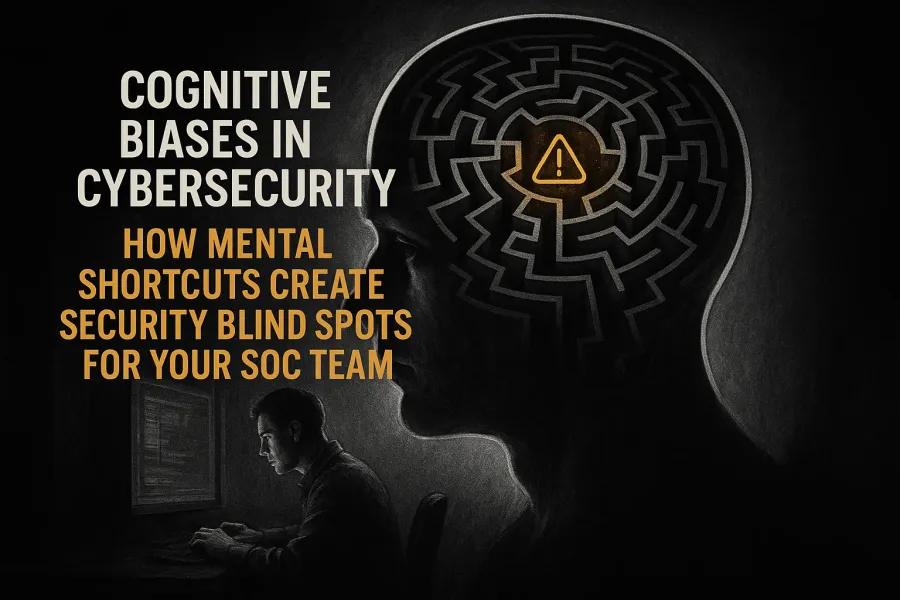
You’ve invested millions in state-of-the-art security tools. You have detailed playbooks for every conceivable incident. Yet, breaches still happen, and when you dig into the post-incident reports, you find a recurring, uncomfortable truth. A 2024 report by the SANS Institute noted that a significant percentage of these reviews identified ‘human factors,’ including flawed analysis, as a key contributor to breach severity. The vulnerability wasn’t in your technology: It was in the human mind.
Your Security Operations Center (SOC) is a high-stakes, high-pressure environment. In this setting, the human brain, brilliant as it is, relies on mental shortcuts to make sense of a constant flood of data. These shortcuts, known as cognitive biases, are the invisible architects of our decisions. And in a SOC, they can create dangerous security blind spots. Understanding and addressing the cognitive biases in cybersecurity isn’t a ‘soft skill’: It’s a critical operational imperative for any leader serious about building a truly resilient defense.
The Common Culprits: Biases That Undermine Your SOC
Cognitive biases aren’t a sign of weakness or incompetence. They are a fundamental feature of human cognition, hardwired to help us process information efficiently. The problem is that this efficiency can come at the cost of accuracy. Here are the three most common biases that I see affecting cybersecurity professionals every day::
1. Confirmation Bias: The Echo Chamber of Analysis This is the tendency to search for, interpret, and recall information that confirms pre-existing beliefs. Imagine an analyst who suspects an alert is a false positive from a specific internal application. They will subconsciously look for data that supports this hypothesis, like previous false positives from that same app, while potentially downplaying or ignoring data that points to a genuine, novel threat. It’s like only looking for evidence that proves you’re right, which is a disastrous approach when threat hunting.
2. Availability Heuristic: The Shadow of Recent Events This shortcut causes us to overestimate the likelihood of events that are more easily recalled in our memory. If your team just dealt with a major phishing campaign, they will be hyper-vigilant for similar attacks. This sounds good, but it can cause them to deprioritize alerts related to a different, less recent type of attack: like an insider threat or a novel malware variant. Their focus is skewed by what’s ‘top of mind,’ not necessarily what’s most critical in the moment.
3. Anchoring Bias: The Danger of the First Data Point Anchoring occurs when an individual depends too heavily on an initial piece of information to make subsequent judgments. The first alert an analyst sees in an investigation often becomes the ‘anchor.’ For instance, if the initial alert flags low-level unauthorized access from a specific IP address, the analyst might anchor their entire investigation on that user’s activity. This can cause them to miss the bigger picture, like the fact that the initial access was just a smokescreen for a much more sophisticated attack happening on a different part of the network.
From Theory to Threat: How Biases Create Real-World Failures
These mental shortcuts aren’t just academic concepts. They have a direct and damaging impact on your security posture. When an analyst, influenced by confirmation bias, prematurely closes a critical investigation, they are essentially leaving a door open for the attacker.
When the entire team, guided by the availability heuristic, focuses all their energy on last week’s threat vector, they create an opportunity for adversaries to exploit a different, unguarded flank.
High-stress environments amplify these effects. Cognitive science research shows that under pressure, our reliance on these heuristics skyrockets. The constant pressure to close tickets and meet metrics can push analysts toward the quickest conclusion, not the most accurate one. This leads not only to recurring errors but also to analyst burnout. They feel the weight of their decisions, and when mistakes happen despite their best technical efforts, it can be incredibly demoralizing. The problem isn’t their skill with the tools: It’s the unaddressed cognitive framework they are using to make decisions with those tools.
Building a Cognitively Aware SOC: Practical Strategies for Leaders
Mitigating cognitive biases in cybersecurity is not about trying to eliminate them. That’s impossible. It’s about building systems and a culture that recognize their existence and create checks and balances. Leaders can implement several practical strategies to make their teams more effective and resilient.
1. Implement Structured Analytical Techniques: Don’t leave analysis to intuition alone. Introduce structured techniques like the Analysis of Competing Hypotheses (ACH), where analysts must actively seek evidence against their primary theory, not just for it. Simple checklists for common investigations can also force a more methodical process, preventing analysts from skipping crucial steps.
2. Normalize the ‘Pre-Mortem’ and ‘Post-Mortem’: Before a major threat hunt or a red team exercise, conduct a ‘pre-mortem.’ Ask the team: “If this operation fails, what are the most likely reasons why?” This flips the script and forces them to identify potential blind spots and assumptions upfront. After every significant incident, a blameless ‘post-mortem’ is crucial. The goal isn’t to assign fault but to deconstruct the decision-making process. Studies in high-reliability fields like aviation show these techniques can reduce errors by over 50%.
3. Foster a Culture of Challenge: The single most powerful tool against bias is a diverse perspective. Leaders must create an environment of psychological safety where a junior analyst feels comfortable and empowered to question the conclusion of a senior analyst. Encourage phrases like, “What if we’re wrong about this?” or “Is there another way to look at this data?” Make challenging assumptions a core team value, not an act of insubordination.
Redesigning Training for Metacognition
Our current training models are insufficient. We drill our teams on tools and technical procedures but spend almost no time on the most critical tool they have: their own mind. We need to redesign training to build metacognition, which is the ability to think about one’s own thinking.
This means moving beyond simulations that only test technical responses. Training should include scenarios designed to trigger specific biases. Afterward, the debrief shouldn’t just be about the technical outcome. It should focus on the ‘why’ behind the decisions. Ask questions like: “What was the first piece of information you focused on?” or “Did you consider any alternative explanations?” This teaches analysts to recognize their own mental shortcuts in real-time and self-correct. By making the invisible process of thinking visible, we empower our teams to become more objective, critical, and ultimately, more effective defenders.
The human element is often cited as the weakest link in cybersecurity. But that’s a failure of our approach, not our people. By understanding the psychology of our teams and addressing the cognitive biases in cybersecurity, we can transform that perceived weakness into our most adaptable and resilient strength. As threats evolve, the technology will change, but the need for sharp, objective human analysis will remain constant. Preparing our teams for that reality is the future of security leadership.
Is your security team unknowingly creating blind spots? Contact Grab The Axe to develop a Behavioral Security program that strengthens your human firewall from the inside out.

With a dual background in I/O Psychology (PhD Candidate) and Business Management (MBA), Marie bridges the gap between clinical rigor and operational strategy. She oversees B2B relations, compliance, and the 'business' of risk management.