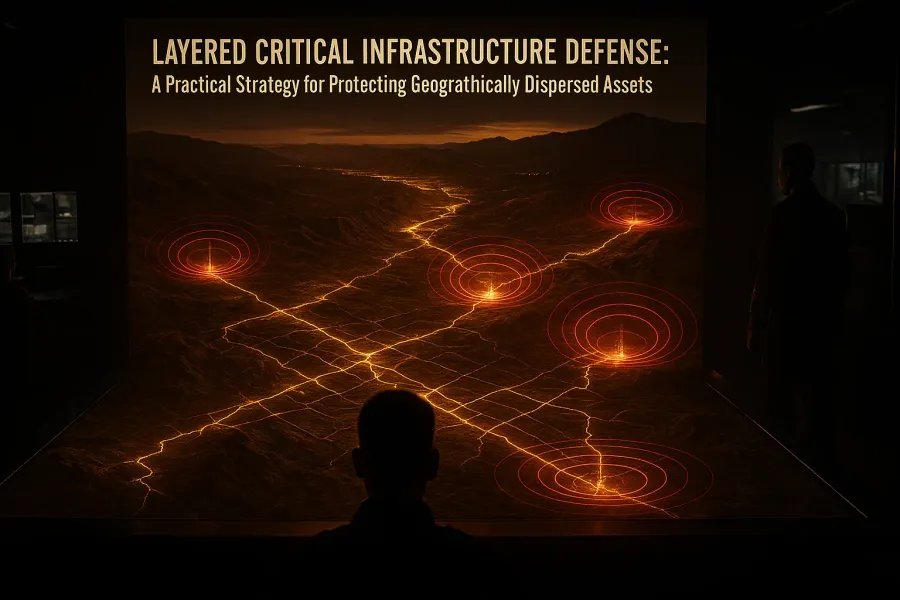
Did you know that physical attacks on the U.S. power grid hit an all-time high in 2023? That isn’t a headline to scare you. It’s a field report on the reality we face. For too long, we’ve relied on the idea that a tall fence and a padlock are enough to protect assets that span hundreds, sometimes thousands, of miles. That idea is broken. A simple fence is a suggestion, not a barrier, to a determined attacker. When your assets are remote substations, pumping stations, or pipelines, a breach isn’t just a local problem. A single point of failure in these networks can trigger cascading outages that affect millions of people. It’s time to stop thinking about a perimeter line and start thinking in layers. It’s time for a real, practical strategy for layered critical infrastructure defense.
Beyond the Fence: Designing Defense-in-Depth for Linear Assets
How do you secure something that’s not a single building but a line stretching across a map? You have to abandon the fortress model. A linear asset like a pipeline or power line can’t be put inside four walls. Your security posture has to be just as linear and distributed as the asset itself. This is the core of layered critical infrastructure defense.
The model is simple: Detect, Delay, Respond. Every layer you build should serve one of these functions.
Detection: This is your outermost layer. It’s not a fence. It’s an intelligent net of sensors designed to give you the one thing you need most: time. We’re talking about fiber-optic sensing cables that can detect the vibrations of digging or walking along a pipeline. We’re talking about wide-area acoustic sensors that can pick up the sound of a vehicle or a drone where it shouldn’t be. This layer’s only job is to send up a flag, telling you what is happening and where it’s happening, long before an attacker touches your asset.
Delay: Once an attacker is detected, the goal is to slow them down. This is where physical hardening comes in, but it must be strategic. A fence is a minor delay. A fence with anti-climb topping is a slightly better one. But what about reinforced enclosures for critical valves or transformers? What about using specialized locking mechanisms that require specific tools and knowledge to defeat? Every second an attacker is forced to spend trying to get through a barrier is another second your response team has to get there. The delay layer is about buying time, not promising impenetrable security.
Response: This is the action layer. Detection and delay are useless if you can’t do anything about the alert. Your response plan is the muscle behind the entire strategy. It determines whether a breach is a minor incident or a catastrophic failure. An effective response isn’t just about sending a guard. It’s a pre-planned, drilled sequence of actions tailored to the threat and location.
The Right Tools for the Job: An Effective Tech Stack for Remote Monitoring
What’s the best technology mix for watching over vast, empty spaces? It’s not about buying the most expensive cameras. It’s about creating a system where different technologies cover each other’s weaknesses. A cost-effective and powerful combination for layered critical infrastructure defense integrates three key elements.
First, you need passive, wide-area sensors. Think of these as your tripwires. Seismic, acoustic, or fiber-optic sensors are excellent for this. They use very little power, can cover huge distances, and are your first line of detection. Their job is to tell you that something is happening in a specific zone.
Second, once a passive sensor is triggered, you need to verify the threat. This is the job of long-range cameras, particularly thermal or pan-tilt-zoom (PTZ) cameras. The sensor alert automatically cues the camera to focus on the exact location. Now you can see if it’s an animal, a lost hiker, or a team of saboteurs. This visual verification is critical. It prevents false alarms and tells you what kind of response you need to mount.
Third, for true situational awareness, you need drones. Not just for surveillance, but as an integrated response tool. Modern drone-in-a-box systems can be stationed at remote locations. When an alert is verified by camera, the drone can launch automatically, fly to the location in minutes, and provide a live, overhead view of the situation. It can track suspects, assess damage, and inform your ground team before they even arrive. This combination, passive sensor, active camera, and aerial verification, gives you a powerful, scalable, and efficient monitoring capability without stationing personnel every five miles.
Closing the Gap: A Realistic Rapid Response Plan
An alert from a site 200 miles away is useless if your nearest security officer is three hours away. A realistic response plan is the most critical and often overlooked layer. You can’t bend the laws of physics, but you can plan for the reality of distance.
Your plan needs tiers. A Tier 1 response is immediate and automated. This is the drone. It launches, assesses, and acts as a deterrent. The mere presence of an autonomous drone can be enough to make an opportunistic thief or vandal think twice. Its feedback informs the next tier.
A Tier 2 response involves human action. This might not be your own team. It’s crucial to build strong partnerships with local and state law enforcement agencies. Provide them with access to your sensor data and live video feeds. When they get a call from you, they know it’s a verified, active threat, not a false alarm. This makes them far more likely to respond quickly. Your role is to provide the intelligence; their role is to provide the interdiction.
A Tier 3 response is your own specialized team. They are dispatched for specific situations, like when an attacker is delayed at a hardened node or when technical repairs are needed. They shouldn’t be the first ones called for every alert. This tiered approach conserves your most valuable resources and ensures the response matches the threat level.
Hardening the Nodes: Practical Delays for Attackers
Let’s talk about the specific points of failure: pumping stations, electrical substations, and cell towers. These nodes are the prime targets. An attacker who gets inside one of these can do maximum damage with minimum effort. Hardening them is about making that effort as difficult and time-consuming as possible.
Start with the enclosure. Is it a simple chain-link fence or a reinforced steel or concrete structure? Can the locks be cut with bolt cutters, or do they require specialized tools? Every component matters. This also applies to aerial threats. A drone can easily fly over a fence and drop a damaging payload on an unhardened transformer. Simple, cage-like roofing or standoff protection can mitigate this specific threat vector, forcing an attacker to get on the ground where your other layers are more effective.
Access control needs to be more than a simple key. Use multi-factor systems, even for remote sites. A keypad code combined with a registered mobile credential, for example, creates a much stronger barrier. Finally, think about internal compartmentalization. Even if an attacker breaches the perimeter, can they immediately access the most critical equipment? Or do they face another set of internal barriers and access controls? The goal of hardening is to create a series of obstacles that force the attacker to make noise and spend time. Time is the one resource you can use against them.
Your critical infrastructure is the backbone of our economy and society. Protecting it isn’t just a compliance issue; it’s a strategic necessity. A single fence is a hope, not a plan. A truly effective layered critical infrastructure defense strategy integrates detection, technology, smart response planning, and physical hardening into a single, resilient system. The threats are evolving, moving from simple theft to sophisticated, coordinated attacks. It’s time our defenses evolved too.
Review our framework for designing a cost-effective, multi-layered physical defense for your most critical and exposed assets.

A leader defined by a 'bias for action,' Dusten specializes in physical security assessments that impact profitability. He leverages high-logic strategies to pinpoint high-ROI vulnerabilities, ensuring defense measures actually scale with the business.