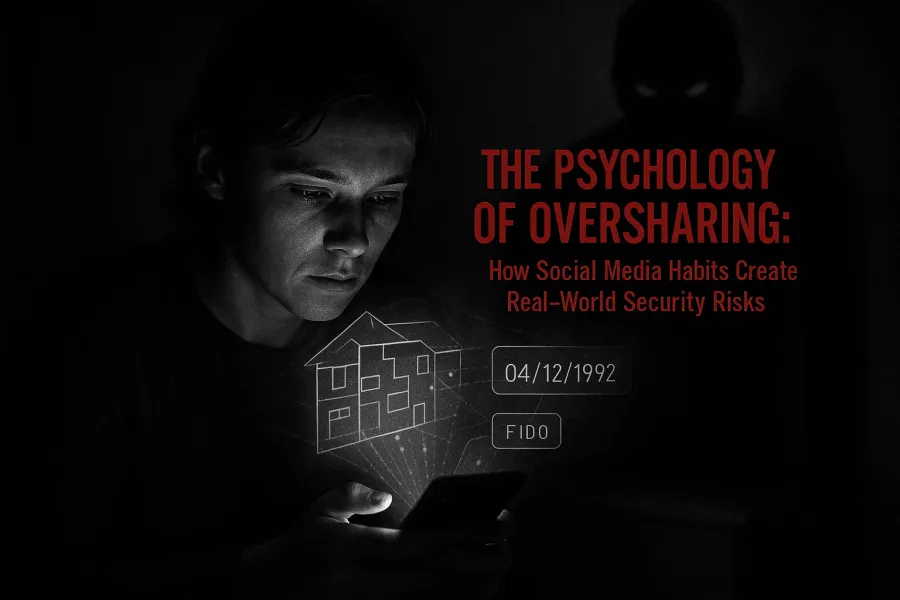
That little dopamine hit you get from a new like or a comment is a powerful thing. It’s a digital pat on the back, a sign of connection in a world that can feel isolating. We post a photo from a family vacation, announce a new job, or share a funny story about our first pet. These actions feel harmless, even positive. They are how we build community and share our lives. But what if each post is also a breadcrumb, leading someone with malicious intent right to your door? The modern paradox is that the very human impulse to connect is creating unprecedented security vulnerabilities, and it all comes down to the psychology of oversharing.
Most of us don’t think of ourselves as targets. We see our social media as a personal scrapbook, not an intelligence file for criminals. Yet, attackers don’t need a top-secret dossier to build a profile on you. They just need you to keep sharing. Studies show a huge number of social media users have public profiles that hand-deliver sensitive information like their full birthday, the names of their family members, and their current location. We are, in effect, doing the reconnaissance for them. Understanding this connection between our online habits and real-world risks is the first step toward building a stronger, more human-centric security posture for ourselves and our families.
From Vacation Photos to Target Profiles: How Attackers Exploit Your Data
How does an attacker turn your happy vacation photo into a weapon? It’s a process of digital aggregation. They aren’t looking at one post in isolation. They are building a mosaic of your life, piece by piece, until a clear picture of your vulnerabilities emerges. That seemingly innocent beach photo does more than just show off your tan.
First, there’s geotagging. Many people don’t realize that their smartphone camera embeds precise GPS coordinates into the metadata of every photo. When you post that picture with the geotag intact, you’re not just saying you’re in Hawaii. You’re broadcasting the exact coordinates of your hotel. More dangerously, if you post pictures from your home, you’ve just put a pin on a map for a potential burglar or stalker. Over time, a collection of geotagged photos reveals your patterns: where you work, where your kids go to school, your favorite coffee shop, and the times you are typically away from home. A post captioned “Two weeks of paradise!” combined with a geotag from another country is a public announcement that your house is empty.
Job announcements are another goldmine. A post celebrating a new role as “Senior Project Manager at Acme Corp” doesn’t just tell people you got a promotion. It tells a social engineer your job title, your employer, and likely your corporate email format. They can now craft a highly convincing phishing email pretending to be from your new IT department, asking you to set up your credentials on a fake portal. They might even use details from your public profile to build rapport, referencing a shared university or hobby to lower your defenses. They are exploiting your excitement to compromise your company’s security.
Even the most mundane details contribute to the profile. Quizzes that ask for your first pet’s name, your mother’s maiden name, or the street you grew up on are fun distractions. They are also a list of the most common security questions used to protect your bank accounts, email, and other critical services. Attackers collect these answers from your posts and comments over years, banking them until they have enough information to impersonate you and reset your passwords. Each detail you share, no matter how small, becomes another piece of the puzzle they can use against you.
The Human Need to Share: Understanding the Psychology of Oversharing
If the risks are so clear, why do we continue to overshare? The answer isn’t that we are careless. It’s that we are human. Our brains are wired for social connection, and social media platforms are expertly designed to tap directly into these deep-seated psychological drivers. Recognizing these internal pulls is key to becoming more mindful about what we post.
The most powerful driver is the desire for validation and belonging. Every like, share, and positive comment triggers a small release of dopamine in the brain, the same neurotransmitter associated with pleasure and reward. This creates a feedback loop. We post something, we get a positive social response, and our brain tells us to do it again. This cycle encourages us to share more personal and emotionally resonant content because it often generates a stronger response. We are trading our privacy for moments of perceived connection and acceptance.
There’s also the pressure of social proof and comparison. When we see our friends and colleagues posting curated highlight reels of their lives, we feel an implicit pressure to do the same. This can lead to “performative sharing,” where we post things not just to connect, but to construct a specific online identity. We share the fancy dinner, the exotic trip, and the professional achievement to keep up. In this race for an ideal online persona, security considerations often take a back seat.
Finally, there’s a cognitive bias at play known as optimism bias. We inherently tend to believe that negative events are less likely to happen to us than to others. We read stories about people getting hacked or burgled because of a social media post, but we think, “That would never happen to me.” This allows us to intellectually understand the risks without emotionally connecting to them, making it easier to ignore best practices. Attackers rely on this universal human tendency. They know that most people won’t take precautions until after something bad has already happened.
Taking Back Control: Your Three-Step Social Media Privacy Audit
Understanding the psychology of oversharing empowers you to be more intentional. You don’t have to delete your accounts and live offline to be secure. You just need to be mindful. Taking proactive control of your digital footprint is easier than you think. Here are three practical steps to conduct a privacy audit on your own social media history.
1. Review Your Public Profile from an Outsider’s Perspective
Log out of your account or use a private browser window to view your profile as a stranger would. What can you see? Is your full birthday visible? Your hometown? Your current city? Your list of family members? Go through your bio and public-facing information and remove anything that isn’t absolutely necessary. An attacker can use your date and place of birth to guess parts of your social security number. Remove it.
2. Scrub Your Historical Posts for Sensitive Data
This is the most time-consuming step, but it’s critical. Use the search functions within each platform to look for keywords that could reveal sensitive information. Search for your address, phone number, or even phrases like “on my way home” or “excited for vacation.” Look for photos of your driver’s license, passport, or credit cards, which people sometimes post in moments of excitement. Pay special attention to old posts where you may have answered those common security questions. Did you ever post a tribute to your first dog, “Sparky”? That’s a potential password reset answer. Delete these posts or change their privacy settings to “Only Me.”
3. Master Your Privacy and Security Settings
Spend 15 minutes navigating the privacy and security settings of each platform you use. This is your control panel. Make your default post audience “Friends” instead of “Public.” Turn on tag review, which prevents others from tagging you in photos or posts without your approval. This stops their lack of security from becoming your problem. Review the list of third-party apps connected to your account and remove any you no longer use. Each of these apps is a potential entry point for data harvesting. Finally, enable two-factor authentication (2FA) on every single account. This is one of the most effective single actions you can take to protect your accounts, even if someone does manage to get your password.
By consciously curating your digital identity, you are not becoming less authentic. You are simply being strategic. The goal is to continue sharing and connecting, but on your own terms, with a clear understanding of the line between personal expression and personal risk.
The impulse to share isn’t going away, and neither are the platforms that encourage it. As technology evolves, particularly with the rise of AI-powered tools that can scrape and analyze public data at an incredible scale, the risks associated with the psychology of oversharing will only grow. The breadcrumbs we leave today will be used to build hyper-detailed profiles tomorrow. Building mindful, security-aware habits is no longer just a good idea. It is an essential skill for navigating the modern world. It’s about treating your personal information with the same care you would your physical home, installing digital locks and alarms to protect what’s valuable.
Take control of your digital identity. Schedule a personal security consultation with Grab The Axe to learn how to protect yourself and your family in a connected world.

With a dual background in I/O Psychology (PhD Candidate) and Business Management (MBA), Marie bridges the gap between clinical rigor and operational strategy. She oversees B2B relations, compliance, and the 'business' of risk management.