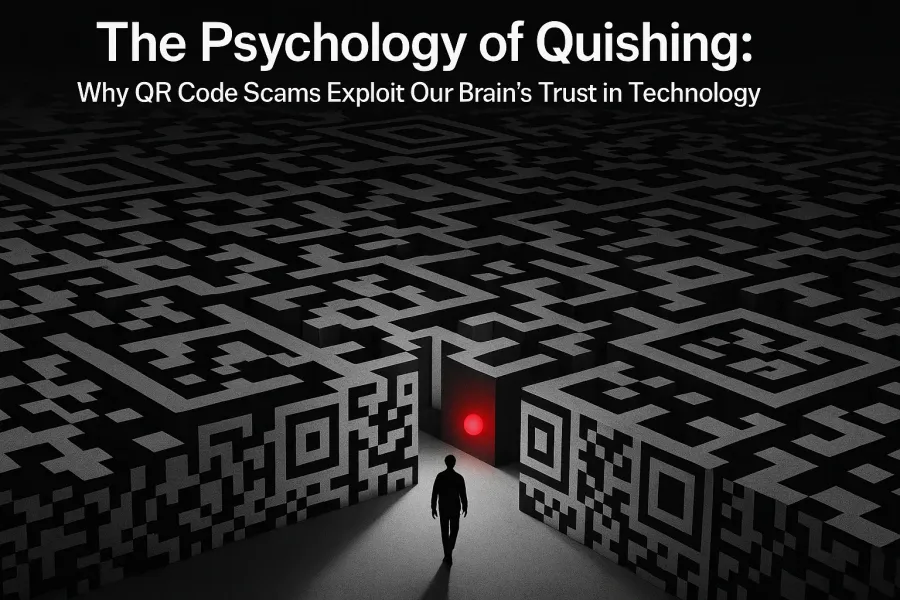
Have you ever wondered why that simple black-and-white square, the QR code, feels so harmless? You’re not alone. Our brains are conditioned to see them as helpful, efficient shortcuts. But what if that trust is the very vulnerability attackers are exploiting? A recent report showed a staggering 587% increase in quishing, or QR code phishing, attempts in just one year. This isn’t just another technical threat. It’s a direct assault on human psychology, preying on our cognitive shortcuts and our misplaced faith in a technology that has become ubiquitous. We see them on restaurant menus, parking meters, and event tickets. This constant, legitimate exposure has trained us to scan first and think later, a behavioral pattern that cybercriminals are now weaponizing with devastating success. The core issue isn’t a failure of technology but a misunderstanding of how our own minds work in a world where the physical and digital are completely intertwined.
The Anatomy of a Modern Threat: What is Quishing?
At its core, quishing is phishing with a new delivery mechanism. Instead of a deceptive text link in an email, the attacker embeds the malicious link within a QR code. When you scan it, your mobile device’s browser is directed to a fraudulent website designed to steal credentials, install malware, or trick you into making an illegitimate payment. The genius of this attack lies in its simplicity and its ability to bypass traditional security measures. Many sophisticated security tools that scan company emails for malicious links are completely blind to QR codes. To them, the code is just an image file, a benign attachment that sails right past the digital guards we’ve spent years building. Attackers know this. They are deliberately using a low-tech-feeling method to circumvent our high-tech defenses.
This bypass technique is particularly dangerous because it moves the point of compromise from a company-managed desktop to an employee’s personal mobile device. An employee might receive an email with a QR code for a ‘required multi-factor authentication update’. They scan it with their phone, which is likely outside the direct control of corporate security, and enter their credentials on a fake login page. The attacker now has the keys to your kingdom, and your security team has no record of a malicious link ever entering the network: The attack didn’t just bypass a filter; it bypassed an entire security paradigm by targeting the human operator.
Your Brain on QR Codes: The Psychology of Quishing
The real danger of quishing isn’t technical, it’s psychological. These scams are engineered to exploit deeply ingrained cognitive biases that affect how we perceive risk and trust. Understanding the psychology of quishing is the first step toward building resilience against it. One of the primary biases at play is ‘automation bias’, our tendency to trust the output of an automated system over our own judgment. We see a QR code and our brain thinks ‘efficient, automated, correct’. We defer our critical thinking to the technology because it’s faster. This is the same reason we blindly follow a GPS into a traffic jam. We assume the machine knows best.
Furthermore, these attacks exploit our inherent trust in the physical world. Cognitive studies show that humans tend to place more trust in tangible objects than in purely digital information. A printed QR code on a poster at a coffee shop or a sticker on a parking meter feels more legitimate than a random link in an email. It has a physical presence that lends it an unearned air of authenticity. Attackers take advantage of this by placing malicious QR codes in public spaces, knowing our guard is down. We aren’t in a ‘cybersecurity mindset’ when paying for parking; we’re in a ‘get this done’ mindset, and that’s when we are most vulnerable. The QR code acts as a bridge, carrying the digital threat into a physical context where we are psychologically unprepared to meet it.
From Awareness to Action: Fortifying Your Human Defenses
Since technology alone can’t solve this problem, the solution must be human-centric. We need to retrain our brains and build a culture of healthy skepticism around these innocent-looking squares. For individuals, the most powerful tool is a simple, three-step mental checklist: Stop. Think. Verify.
- Stop: Before you scan, take a breath. The urgency you feel is often manufactured by the attacker. Resist the impulse for immediate action.
- Think: Consider the context. Does it make sense for a QR code to be here? Why is my bank asking me to re-authenticate via a QR code in an unsolicited email? Look for signs of tampering on physical posters, like a sticker placed over an original code.
- Verify: Use your phone’s camera preview function, which often shows a snippet of the URL before you open it. If the domain looks suspicious, don’t proceed. When in doubt, manually type the official website address into your browser instead of using the QR code. Never provide credentials or payment information from a site you reached via a QR code you don’t 100% trust.
For organizations, the challenge is to update security awareness training to address the psychology of quishing. Generic phishing simulations are no longer enough. Training must include scenarios that mimic real-world quishing attacks, teaching employees to question the context of a QR code, whether it appears in an email, a presentation, or on a physical flyer in the breakroom. More importantly, leaders must foster a security culture where an employee who scans a suspicious code and realizes their mistake feels safe reporting it immediately. Punitive cultures drive these incidents into the shadows, allowing a small mistake to become a catastrophic breach. The goal is not to blame the human but to build a resilient human firewall.
Quishing is a masterclass in social engineering because it targets our instincts, not just our inboxes. It leverages our trust in technology and the physical world against us. As attackers continue to innovate, our best defense isn’t a new piece of software but: a more aware, critical, and psychologically prepared workforce. The future of this threat will likely involve AI-generated, hyper-personalized QR codes that appear in exactly the right place at the right time to be maximally effective. Our only path forward is to arm our people with the knowledge and critical thinking skills to recognize the manipulation at play.
Understand the ‘why’ behind the attack. Explore the psychology of quishing and learn how to train your brain to spot these increasingly common scams.

With a dual background in I/O Psychology (PhD Candidate) and Business Management (MBA), Marie bridges the gap between clinical rigor and operational strategy. She oversees B2B relations, compliance, and the 'business' of risk management.