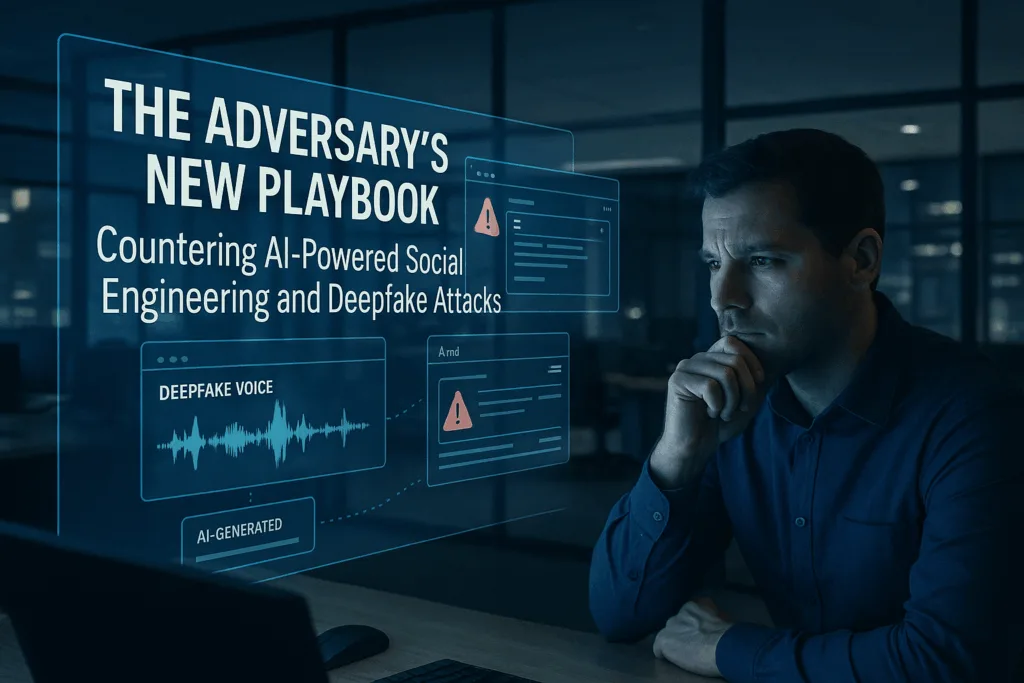
Imagine this: your CEO’s voice, perfectly replicated, calls your CFO with an urgent request—transfer $500k to a new vendor by close of business. It sounds real. The conversation flows naturally. But it’s a deepfake. By the time you realize what happened, the wire transfer is complete and unrecoverable.
This isn’t science fiction. It’s happening now. AI-powered social engineering is redefining what a cyber threat looks like.
The AI Adversary: Reinventing Social Engineering
Traditional phishing relied on broken grammar and generic requests. Now, generative AI models create persuasive, personalized emails, messages, and even deepfake audio and video that are nearly impossible to detect with old methods.
Gartner predicts that by 2026, more than 40% of spear-phishing campaigns will use AI-generated content. And they’re already three times more effective in getting users to click.
For CISOs and security leaders, this evolution changes the game. Here’s what you need to know—and do—to respond.
Identifying Deepfake Threats: Technical and Behavioral Red Flags
Knowing what to look for is the first step. While perfect detection is still a work in progress, emerging tools and awareness strategies provide some traction.
Technical Indicators:
- Inconsistent lighting or shadows in video deepfakes
- Unnatural blinking, facial movements, or lip sync issues
- Audio glitches or peculiar phrasing in synthetic speech
- Metadata anomalies from AI-altered media files
Behavioral Red Flags:
- Unusual tone or urgency from senior executives
- Requests to bypass standard procedures or skip approvals
- Calls or messages that push for secrecy or rush
- Inconsistency between the communication and known schedules or time zones
Train your team to recognize not just suspicious messages, but suspicious context. The attacker may know your org chart—but they won’t know your people like you do.
Updating Your Incident Response Plan for AI Impersonation
Today’s response playbooks rarely account for real-time, AI-driven impersonation. It’s time to adapt:
Embed Out-of-Band Verification
For sensitive transactions or instructions allegedly sent by executives, implement mandatory out-of-band verification. If your CFO receives a voice memo from the CEO asking for a $1M wire, confirm using a secure, unrelated channel—text, company chat, or even an in-person conversation.
Build an Impersonation Response Process
- Establish procedures for suspected deepfake alerts
- Create a protocol for capturing the suspected audio or video
- Notify legal and compliance teams early—deepfakes can have serious implications
- Include public relations if reputation damage is a risk
Educate with Scenarios
Don’t just tell employees that deepfakes exist. Show them. Use simulated voice clones and AI-generated phishing messages in training. Let them experience how good the fakes really are.
Tools for Resilience: Fighting AI with AI
Security vendors are racing to adapt. Here are technologies gaining traction:
Deepfake Detection Engines
Tools like Intel’s FakeCatcher and Microsoft’s Video Authenticator use physiological markers and machine learning to spot manipulated media in real time.
Behavioral Biometrics
Analyzing typing cadence, mouse movements, and usage patterns offers user verification less susceptible to voice/video spoofing.
AI-Aware Email Gateways
Next-gen secure email gateways (SEGs) incorporate contextual AI analysis to identify messages that read like phishing—even if the spelling is perfect.
Verified Communications Platforms
Solutions that embed digital signatures into audio/video communications can validate authenticity when your executives speak.
Every tool has limitations, but layered together, they create friction for the attacker. That’s the point.
Why Zero Trust Helps (Even Here)
Zero Trust isn’t just for network perimeter defense. It offers direct benefit against social engineering threats too:
- Always Verify, Never Assume: Zero Trust requires continuous identity verification, not just at login.
- Least Privilege Access: An impersonator may break in, but limited access hampers their reach.
- Segmentation and Micro-Controls: If fraud occurs, Zero Trust prevents cascading damage by containing the blast radius.
When AI can mimic your executives, Zero Trust can add a skeptical lens to every digital identity and transaction.
The Path Forward
AI-powered social engineering is not just a future concern. It’s active now, targeting the most trusted voices inside your organization. Generic phishing filters and outdated awareness training are no longer enough.
You need a new playbook. One that includes:
- Realistic, AI-informed user education
- Out-of-band verification for high-risk actions
- Deepfake detection capabilities
- Zero Trust implementation across systems
Let’s get proactive.