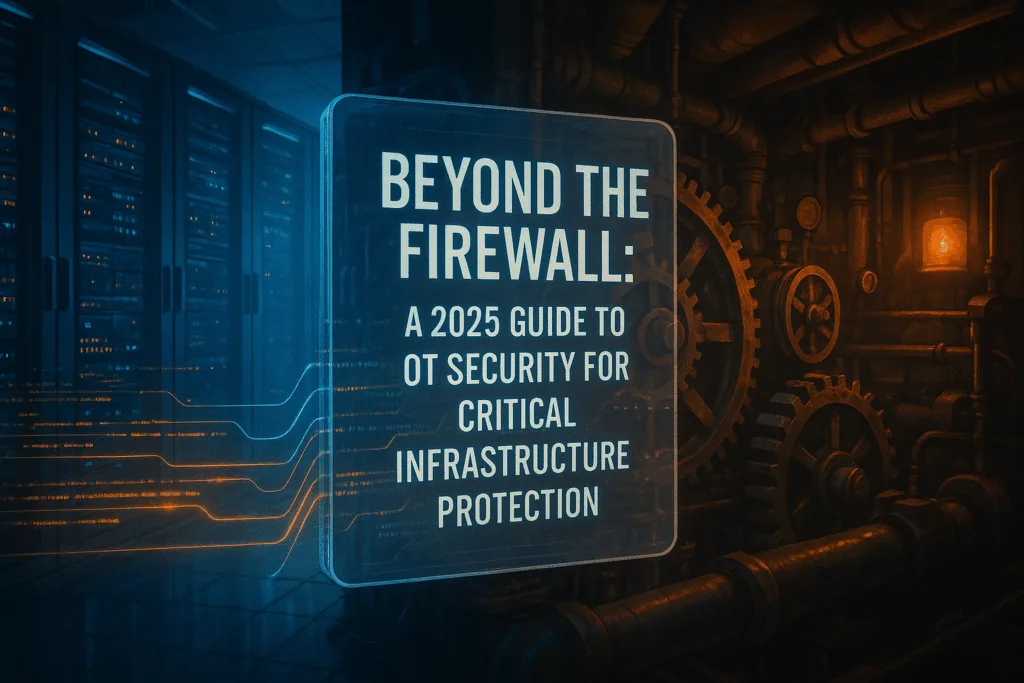
By 2025, it’s projected that over 75% of Operational Technology (OT) organizations will have experienced an intrusion that spills over into operational disruption. That’s a staggering figure, up from just 50% a few years ago. For years, we’ve relied on the concept of the ‘air gap’—the belief that the systems controlling our physical world were safely disconnected from the digital one. That gap is now a myth. Your biggest business risk may not be a data breach, but a compromised valve, a manipulated turbine, or a halted production line.
As a CSO, Plant Manager, or Operations Director, you’re on the front lines of this new reality. The convergence of Information Technology (IT) and OT means your factory floor is now part of your attack surface. Traditional IT security, centered around the firewall, is essential for protecting data. But it’s fundamentally unprepared to protect the machinery that generates your revenue and keeps our critical infrastructure running. It’s time to master OT security, because the stakes are no longer just about data. They’re about physical safety and operational survival.
IT vs. OT: Why Your Firewall Isn’t Enough
The most common mistake we see is leaders trying to apply IT security rules directly to their OT environments. It’s a recipe for failure, because the two domains operate on fundamentally different principles. Think of it this way: IT security is built to protect a bank vault. Its top priority is confidentiality. If the vault is locked down, the mission is a success, even if it causes a temporary inconvenience for customers.
OT security, on the other hand, is built to keep a city’s power grid running. Its top priorities are availability and safety. Any security measure that risks shutting down the power, even for a moment, is a catastrophic failure. Downtime isn’t an inconvenience; it’s a crisis that can cost millions and endanger lives.
This core difference drives everything:
- Priorities: In IT, we prioritize Confidentiality, Integrity, then Availability (CIA). In OT, the priority is flipped to Availability and Safety first, then Integrity and Confidentiality.
- Systems: IT deals with systems that have 3-5 year lifecycles. OT systems, like Industrial Control Systems (ICS) or SCADA, can be in service for 15-25 years. This is why more than 60% of industrial sites still operate legacy systems with unpatched vulnerabilities.
- Protocols: Your IT team speaks TCP/IP. Your OT environment uses a different language with protocols like Modbus, DNP3, or Profinet, which were often designed decades ago without any security in mind.
Simply installing a firewall and an antivirus agent on a 20-year-old Human-Machine Interface (HMI) is not a strategy. It’s a gamble. Effective OT security requires a different mindset and a specialized toolset.
The 2025 Threat Landscape: Common Attack Vectors for OT Security
Threat actors are business-savvy. They know that disrupting your operations is far more profitable than just stealing your data. A successful attack on critical infrastructure’s OT systems can halt production for weeks, with recovery and remediation costs frequently exceeding $5 million per incident. They are actively targeting the unique weaknesses in industrial environments.
Here are the attack vectors you need to be watching in 2025:
- Exploitation of IT/OT Convergence: The most common entry point is no longer a direct assault on the OT network. It’s a phishing attack on an engineer’s laptop that has access to both the corporate and control networks. Once inside the IT network, attackers move laterally to find the bridges into your operational environment.
- Ransomware with an Operational Twist: Modern ransomware doesn’t just encrypt your files. It targets your industrial processes. Attackers are now capable of manipulating HMIs to display false readings or locking down controllers to halt production, holding your physical operations hostage.
- Third-Party and Supply Chain Risk: Your vendors, maintenance contractors, and system integrators all represent potential entry points. A compromised laptop belonging to a third-party technician who connects directly to your control network can bypass all your perimeter defenses.
- Legacy System Vulnerabilities: That massive install base of unpatched, decades-old equipment is a goldmine for attackers. These systems often lack basic security controls like authentication or encryption, making them incredibly easy to compromise once an attacker gains network access.
Practical Defense: Monitoring and Segmentation Without Disruption
So, how do you defend an environment you can’t lock down? The answer lies in visibility and control, not in blocking and tackling like you do in IT. The goal is to build a resilient operation that can withstand an attack, not an impenetrable fortress that’s impossible to run.
Here’s how you can implement effective OT security measures without impacting your sensitive processes:
-
Network Segmentation: This is your most powerful foundational control. In simple terms, you create secure zones within your OT network. You build digital bulkheads to ensure that a fire in one compartment (like a breach in your billing system) doesn’t sink the whole ship (your power generation turbines). This containment strategy severely limits an attacker’s ability to move from less critical systems to your most vital operational assets.
-
Passive Monitoring: You can’t install security agents on most OT devices, but you can listen to the traffic flowing between them. Specialized OT monitoring tools connect to your network and use deep packet inspection to understand the industrial protocols being used. They learn what normal operations look like and can instantly alert you to abnormal behavior, like a command to shut down a pump sent from an unauthorized workstation, without ever touching the endpoint itself.
-
Secure Remote Access: Your operators and third-party vendors need remote access. But a simple VPN connected to the corporate network is a wide-open door. You need granular, role-based access controls that ensure a specific user can only access a specific machine for a specific purpose during a specific time window. Every session should be monitored and recorded.
Building Your OT Security Program: The First Essential Steps
Getting started with OT security can feel overwhelming, but it doesn’t have to be. A journey of a thousand miles begins with a single step. Here are the three essential first steps to build a robust and compliant program from the ground up.
-
Create a Crown Jewel Asset Inventory: You cannot protect what you don’t know you have. The first step is to get a complete, detailed inventory of every device on your OT network. What is it? What does it do? What version of firmware is it running? Who is responsible for it? This isn’t just a spreadsheet. It’s the foundational map for your entire security strategy.
-
Conduct a Specialized OT Vulnerability Assessment: Once you know what you have, you need to understand its weaknesses. This is not a standard IT vulnerability scan, which can crash sensitive OT equipment. You need a process that combines passive network analysis with safe, controlled discovery to identify vulnerabilities, unpatched systems, and misconfigurations without putting operations at risk.
-
Develop a Specific OT Incident Response Plan: Your IT incident response plan is not sufficient. What is your process if a key controller goes offline? Who has the authority to take a production line down to contain a threat? How do you restore operations from a backup that could be decades old? Your OT IR plan must involve operations and engineering teams and address the unique physical consequences of a cyber-physical attack.
Securing your operational technology is no longer an IT project. It’s a core business imperative. The threats are real, and the consequences of inaction are severe. But by understanding the unique challenges of the OT environment and taking deliberate, focused steps, you can build a security program that ensures safety, reliability, and resilience for years to come. The future of your operations will be defined not by the strength of your firewall alone, but by the depth of your visibility and control across your entire converged enterprise.
Protect your critical operations. Schedule a specialized OT Security Assessment with our experts today.