
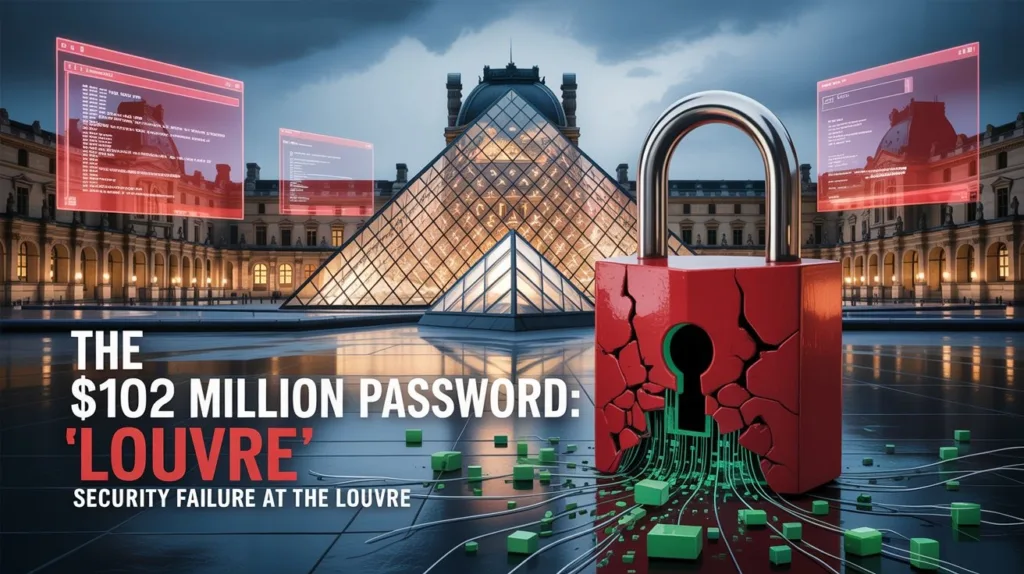
In this detailed case study, we analyze the October 2025 jewel heist at the Louvre. This post-incident analysis explores how the $102 million loss was not a singular event but the inevitable result of a decade-long, systemic failure. The heist, executed by “petty criminals” , exposed a complete breakdown across the museum’s physical, digital, and governance systems.
Background
- Organization: The Louvre Museum
- Industry: Museum & Cultural Heritage
- Event: $102 Million Jewel Heist (October 19, 2025)
The Louvre, a high-security, high-value target, was breached in under seven minutes by a “low-tech” group using a ladder. The attackers stole €88 million ($102 million) in French crown jewels. This analysis deconstructs how the museum was, in fact, a “soft target” protected by a mere facade of security.
Analysis of the Converged Security Failure
Our post-mortem focused on the three interconnected points of collapse that made the heist possible:
- Physical Failure:
- A critical external surveillance camera monitoring the Apollo Gallery was misconfigured and facing the wrong direction.
- This created a perfect blind spot at the window the thieves used for entry, a fact admitted by the Louvre’s Director.
- Digital Failure:
- The password for the museum’s core video surveillance system (VMS) was “Louvre”.
- This, along with other “trivial” passwords like “THALES” and obsolete systems like Windows 2000 , was documented in a 2014 audit.
- This vulnerability allowed attackers to perform remote reconnaissance, study camera feeds, and precisely identify the physical blind spot.
- Governance Failure (The Root Cause):
- Museum leadership had been repeatedly warned of “major weaknesses” in audits from 2014 and 2017.
- A 2025 report from France’s Court of Auditors found that management chose to prioritize “high-profile” projects, like new art acquisitions, over essential security upgrades.
Key Failures & Recommended Solutions
The case study identifies foundational principles that were violated and provides a framework for resilience:
- Failure of “Secure by Default”:
- The system should have been programmatically engineered to reject common and context-specific passwords like “Louvre”.
- Lack of Multi-Factor Authentication (MFA):
- A single password should never protect a critical asset.
- For the Louvre’s legacy OT systems (like the VMS) , compensating controls are the solution. This includes network segmentation and secure “jump servers” that enforce modern MFA before granting access.
- Ignored Audits as Failed Risk Quantification:
- Leadership failed to translate the 2014 technical finding (“weak password”) into its true business impact (“a $100M+ vulnerability”). Audits must be treated as actionable, quantified business risk.
The Outcome: A Systemic Collapse
The implementation of these failures led to a catastrophic and preventable loss:
- The Heist: A “low-tech” group of opportunistic criminals successfully executed one of the largest jewel heists in history.
- The Real Cost: The $102 million loss was not an unforeseen incident ; it was the “foreclosure on a decade of documented, ignored, and accepted risk”.
Conclusion
The Louvre’s $102 million technical debt serves as a “deafening wake-up call” for all security and engineering leaders. True security resilience is not born from high-tech tools but from a culture that acts on audits, empowers engineers to build “Secure by Default,” and understands that security is a foundational enabler of the organization’s mission.
Contact Information: For more information on our security solutions, please contact:
Grab The Axe, LLC Email: info@grabtheaxe.com Phone: (602) 828 0532 Website: grabtheaxe.com