You spend millions on your security stack. You hire the best analysts. You deploy the most advanced AI-driven threat detection tools available. Your perimeter is strong, and your internal controls are rigorous. Yet you remain vulnerable. The danger does not come from a flaw in your firewall or a gap in your encryption. It comes from the accounting firm you use for audits. It comes from the boutique marketing agency that manages your social media. It comes from the specialized logistics provider that handles your shipping.
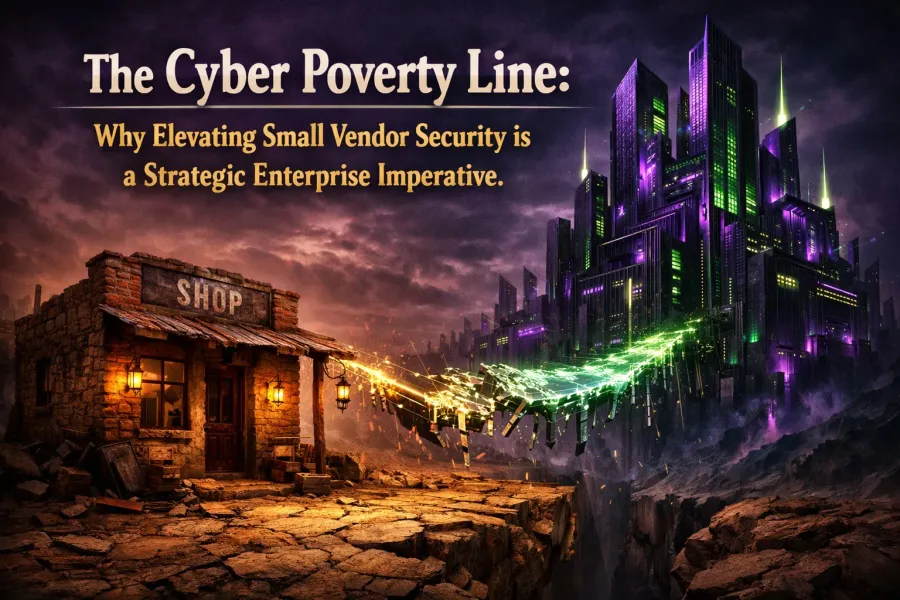
These partners likely live below The Cyber Poverty Line. This economic threshold separates organizations that can afford effective cybersecurity from those that cannot. It creates a stark inequality in our digital ecosystem. This inequality is not just a problem for small businesses. It is a critical strategic failure point for the largest enterprises in the world. We must stop viewing small vendor security as their problem to solve. We must start viewing it as a shared ecosystem risk that requires active intervention.
What is the “Cyber Poverty Line” and how does it threaten the entire digital ecosystem?
The Cyber Poverty Line is the minimum level of investment in talent, technology, and process required to successfully repel commodity cyberattacks. Organizations above this line possess the resources to maintain visibility into their networks. They can patch vulnerabilities quickly. They can recover from incidents with minimal downtime. Organizations below this line operate in the dark.
Most small and medium-sized businesses fall below this threshold. They lack dedicated security staff. Their IT budget is barely enough to cover basic operations. They rely on outdated antivirus software and default configurations. This creates a massive pool of vulnerable targets. The statistics paint a grim picture: 98% of cyber incidents occur at organizations below The Cyber Poverty Line. These are not just random victims. They are the soft underbelly of the global economy.
This threatens the entire digital ecosystem because connectivity is universal. We do not operate in silos. We operate in a dense mesh of digital relationships. When a hacker compromises a small vendor, they do not stop there. They use that foothold to pivot into the networks of larger partners. The small vendor is rarely the final target. They are merely the entry point. The ultimate prize is the data and intellectual property of the enterprise client.
This dynamic creates a paradox: you can have a fortress for a headquarters, but if your supply chain is built on sand, the fortress will fall. The ecosystem is only as resilient as its weakest node. Right now, the majority of those nodes are critically underfunded and undefended.
Why compliance questionnaires fail to solve the problem
Most enterprises attempt to manage this risk through compliance. You send out a 200-question spreadsheet to every new vendor. You ask if they have multi-factor authentication. You ask if they have an incident response plan. You ask if they encrypt data at rest. The vendor checks the boxes. They might even believe they are telling the truth. You file the questionnaire, and you mark the vendor as compliant.
This approach is fundamentally flawed. It confuses compliance with capability. A small business owner might check the box for “incident response plan” because they have a phone number for an IT consultant written on a sticky note. That is not a capability. That is a wish.
Compliance questionnaires effectively transfer liability. They do not reduce risk. They give enterprise leaders a false sense of security. You have a document that says your supply chain is secure. Reality tells a different story: attacks on small vendors are the primary vector for 40% of major enterprise breaches in the last 18 months. The paperwork says one thing, but the attackers prove another.
We cannot questionnaire our way out of poverty. We cannot demand that a company with ten employees and thin margins magically acquire enterprise-grade security capabilities. The math does not work. If we want to solve this problem, we must move beyond demands. We must move toward enablement.
Should large enterprises subsidize the security stack of their smaller vendors to protect themselves?
This question often meets resistance in boardrooms. Why should a large enterprise pay to secure a separate company? It sounds like charity. It is not charity. It is self-preservation. It is a strategic investment in supply chain resilience.
Consider the physical world for a moment: if a contractor comes to work at your headquarters, you do not ask them to bring their own security guard. You do not ask them to install their own locks on your doors. You provide the security environment. You issue them a badge. You monitor their movements with your cameras. You extend your security umbrella to cover them while they are in your ecosystem.
We need to apply this same logic to digital relationships. If a small vendor handles your sensitive data, their security posture is your security posture. It is often cheaper to subsidize a basic security stack for a critical vendor than to pay for the cleanup of a massive breach. This subsidy does not have to mean writing a check. It can take many forms:
- Shared Licenses: Extending your volume pricing for endpoint detection and response tools to your key suppliers.
- Hosted Enclaves: Requiring vendors to work solely within a secure virtual desktop infrastructure that you control.
- Consulting Hours: Allocating a portion of your security team’s time to help vendors configure their systems correctly.
These actions cost money. However, the cost is a fraction of the millions lost in a ransomware attack or data exfiltration event. The goal is to lift your specific supply chain above The Cyber Poverty Line. You cannot fix the whole world, but you can fix the part of the world that connects to your network.
Bridging the Gap: Tailored Security for Every Tier
At Grab The Axe, we understand that security is not one-size-fits-all. A defensive strategy that works for a Fortune 500 company will bankrupt a local supplier. Conversely, a solution designed for a small business will crumble under the complexity of an enterprise network.
This is why we tailor our consulting and physical security services to the specific economic and operational reality of the client. We do not just sell “security.” We sell appropriate resilience.
For our Enterprise Clients, we focus on high-level strategy, complex physical penetration testing, and supply chain risk management. We help you map your ecosystem and identify the weak nodes that threaten your operations.
For Small and Medium Businesses, we strip away the complexity. We focus on the high-impact basics: affordable vulnerability assessments, employee training that actually sticks, and practical physical security controls. We help smaller organizations climb above the Cyber Poverty Line without requiring them to hire a full-time CISO.
This dual approach allows us to serve as the bridge. We help enterprises secure their own perimeter while simultaneously offering their vendors a realistic, affordable path to compliance and capability.
Conclusion: A Shift in Mindset
The current model of vendor risk management is broken. We treat security as a line item that every company must figure out on its own. This ignores the economic reality of The Cyber Poverty Line. It ignores the fact that 80% of the average enterprise supply chain consists of organizations that simply cannot fight off state-sponsored actors or sophisticated criminal gangs.
We must stop blaming small businesses for lacking the resources of large enterprises. We must stop pretending that a questionnaire equals protection. The leaders of the future will be the ones who build resilient ecosystems. They will be the ones who understand that helping a vendor secure their network is the most selfish and smart thing they can do.
Your security is only as strong as your most vulnerable vendor. Learn why closing the Cyber Poverty Gap is a strategic imperative.

A PhD candidate in Health Psychology and former Corrections Officer, Jeff founded GTA to dismantle passive security models. He focuses on the 'Human Zero-Day', mitigating executive burnout and decision fatigue before they become security breaches.