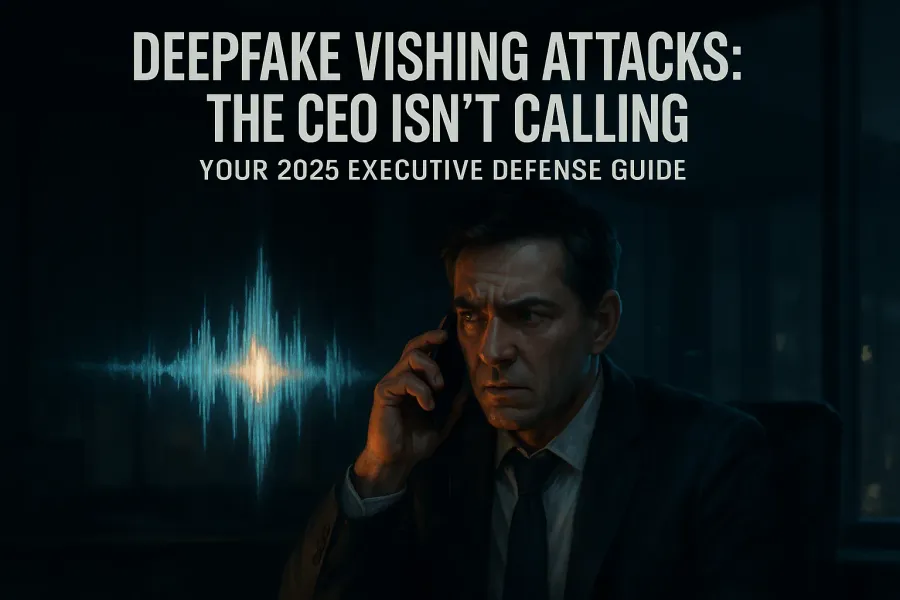
That urgent phone call from your CFO demanding an immediate, high-value wire transfer sounds exactly like them. The tone is right. The sense of urgency is palpable. But it isn’t them. You’re on the receiving end of a sophisticated attack, and your next move could cost the company millions. AI-powered vishing attacks targeting financial transfers increased by over 350% in the last year. The average loss per successful incident is a staggering $1.2 million. This isn’t a theoretical threat for the future. It’s happening right now, and it’s aimed directly at your most trusted people.
The days of misspelled emails being the primary sign of fraud are long gone. Attackers now have access to powerful AI tools that can clone a person’s voice with terrifying accuracy. Your traditional security awareness training is simply not equipped to handle this new reality. It’s time to arm your leadership and finance teams with the knowledge and procedures to defend against the imposter in your phone.
What are Deepfake Vishing Attacks? A New Breed of Imposter
Let’s break this down. Vishing is short for ‘voice phishing’. It’s a social engineering attack where criminals use the phone to trick people into divulging sensitive information or performing an action, like transferring money. The ‘deepfake’ component is the game-changer. It uses artificial intelligence, specifically machine learning models, to create a synthetic, computer-generated voice that mimics a specific person.
How does it work? Security researchers have demonstrated the ability to clone a person’s voice with as little as three seconds of audio. Think about that. Any publicly available recording of an executive, from a conference keynote on YouTube to a podcast interview or even a company-wide video message, can be weaponized. The AI analyzes the unique characteristics of the voice: its pitch, cadence, and accent. It then reconstructs these characteristics to say anything the attacker types into a script. It’s like a digital parrot that can not only mimic words but also the specific vocal identity of your CEO.
The FBI’s Internet Crime Complaint Center (IC3) has already issued specific warnings about this trend, highlighting the use of synthetic media in Business Email Compromise (BEC) and vishing schemes. These deepfake vishing attacks are hyper-targeted. Attackers do their homework. They know your executives’ names, their roles, and often, details about current projects to make the call seem legitimate. Their target is precise: your executive assistants, your finance department heads, and anyone with the authority to move money.
The Tell-Tale Signs: How to Expose an AI-Generated Voice
Distinguishing a high-quality deepfake voice from a real one is difficult, but it’s not impossible. The technology isn’t perfect, and a trained, skeptical ear can often detect the subtle flaws. You need to teach your teams to listen for the machine behind the voice. Here are the red flags to watch for:
- Unnatural Pacing: Listen for odd pauses, speech that is too slow or too fast, or a monotonous, robotic rhythm. A real human conversation has a natural ebb and flow that AI struggles to replicate perfectly.
- Flat Emotional Tone: The fake voice might convey urgency in its words but lack the corresponding emotional stress or color in its tone. It might sound strangely detached from the high-stakes situation it’s describing.
- Weird Audio Artifacts: You might hear subtle digital noise, odd breathing sounds, or a slightly compressed, hollow quality to the audio. While a bad connection can cause this, it’s also a hallmark of current voice synthesis tech.
- Difficulty with Direct Questions: A deepfake is often working from a script. If you ask an unexpected question or interrupt the speaker, the AI may falter, pause for too long while it processes, or give a generic, non-specific answer.
- The Personal Knowledge Test: Ask a simple, personal question that an imposter couldn’t possibly know and wouldn’t find online. For example, ‘What did you think of the lunch we had yesterday?’ or ‘How is your dog doing?’ A refusal to answer or a clumsy attempt to deflect is a major red flag.
Above all, the biggest red flag is the request itself. An unexpected, urgent demand for a large wire transfer, a change in payment details, or the sharing of sensitive credentials over the phone should always trigger suspicion, no matter how authentic the voice sounds.
Your Defense Blueprint: Mandating Multi-Channel Verification
Technology got us into this mess, but process is what will get us out. You cannot rely on your ability to spot a fake. You must rely on a mandatory, non-negotiable verification procedure. This simple, procedural defense is the single most effective way to shut down deepfake vishing attacks.
Implement this three-step protocol for any sensitive request received by voice or email:
- Pause and Acknowledge. Do not act immediately. The attacker’s primary weapon is manufactured urgency. Take that away by pausing. Acknowledge the request politely. For example: ‘I understand this is urgent. I will get on it right away.’
- Hang Up and Terminate. End the call. Do not continue the conversation. Do not use the number from the caller ID to call back.
- Verify Independently. Contact the executive through a completely different and trusted communication channel. Call them back on their known mobile number from your contacts. Send them a message on a secure platform like Signal or Microsoft Teams. A quick video call is even better. State the request clearly and ask for direct confirmation.
For the highest-stakes transactions, consider implementing a pre-agreed-upon challenge phrase or codeword. It’s a low-tech solution to a high-tech problem, and it works. This process must be mandatory for everyone, from the newest hire in accounting to the most senior executive assistant. No exceptions.
From Awareness to Readiness: Training Your Human Firewall
Your people are your last line of defense, but they need the right training and the right corporate culture to succeed. Old-school awareness training that just tells people ‘be careful’ is useless against this threat.
Your training must be active, practical, and continuous. You should run regular, unannounced drills that simulate deepfake vishing attacks. Let your team experience the pressure of a convincing, AI-generated call in a safe environment. This builds muscle memory and prepares them for the real thing. Debrief after each drill to discuss what went right and what could be improved.
Most importantly, you must foster a culture of security where it is not only acceptable but expected to question unusual requests, even from the CEO. An executive assistant must feel 100% empowered to say, ‘I understand, but per our security policy, I must hang up and verify this request through a secondary channel.’ This isn’t insubordination. It’s executing the company’s defense protocol. Leadership must champion this from the top down, rewarding employees who follow procedure and prevent potential fraud.
This isn’t just an IT issue. It’s a core business risk that directly threatens your company’s financial stability and reputation. The threat is sophisticated, and it’s evolving quickly. But it’s also a threat you can neutralize. The defense starts not with a new piece of software, but with a new mindset. It’s built on a foundation of skepticism, fortified by rigid procedures, and activated by a well-trained, empowered team. The CEO isn’t calling with that wire transfer request. It’s time to make sure your team knows how to hang up.
Train your team to detect the imposter. Inquire about our Executive Security Awareness Training.

Operating on the philosophy that 'you can't build a secure system if you don't know how to break it,' Chris leads our engineering division. A top 1% National Cyber League competitor, he hardens our digital infrastructure against the very exploits he has mastered.