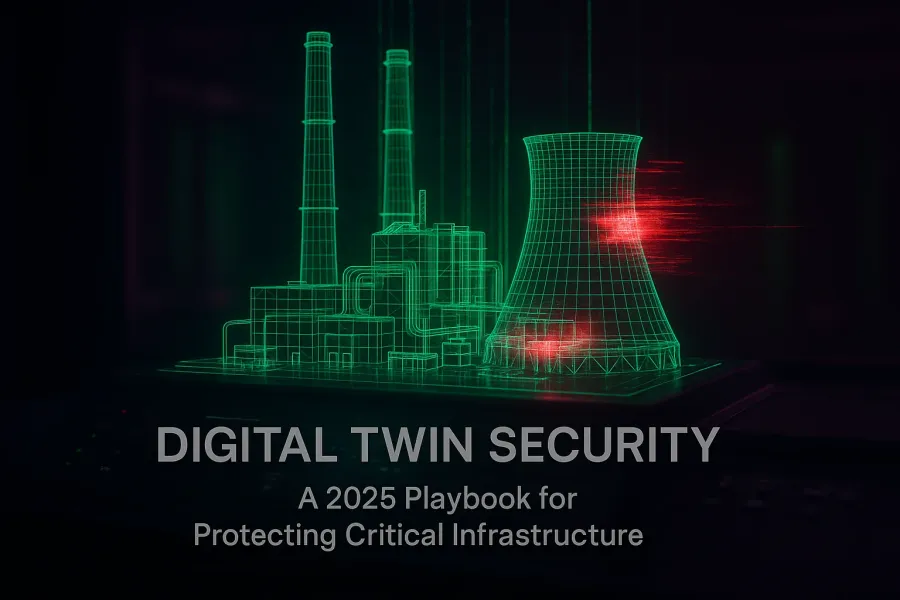
Is your digital twin a strategic asset or your next critical vulnerability? By 2025, Gartner predicts over 75% of large enterprises will use digital twins to model complex assets. This creates a massive new attack surface that most organizations are not prepared to defend. For those in critical infrastructure, the stakes are not just financial. A compromised digital twin doesn’t just crash a server; it can cause real-world physical sabotage. The fear of a manipulated model causing a turbine to overspin, a chemical mixture to become volatile, or a power grid to destabilize is no longer theoretical. It’s the new reality of converged security, and it demands a new playbook.
Traditional IT security controls were not designed for this hyper-connected, cyber-physical landscape. The challenge lies in securing the entire ecosystem, from the physical sensor on a factory floor to the cloud platform running the simulation. This playbook provides a practical, engineering-focused approach to building a resilient and secure digital twin environment.
What are the unique attack vectors targeting digital twins?
The attack vectors for a digital twin are fundamentally different from those targeting a standard IT database or web application. The goal isn’t just to steal data, it’s to manipulate physical processes by proxy. The primary threat is data poisoning. This is where an attacker feeds manipulated sensor data into the twin. The corrupted model then makes what it believes are optimized decisions, but in reality, it recommends dangerous or inefficient actions for the physical asset to execute. Imagine a temperature sensor being spoofed to read cooler than reality, causing the digital twin to disable a critical cooling system and leading to physical equipment failure.
Another major vector is the API. The Industrial Control Systems Cyber Emergency Response Team (ICS-CERT) highlighted a 300% increase in reconnaissance activities targeting digital twin APIs in a 2025 report. These APIs are the connective tissue between the physical world, the digital model, and enterprise systems. If compromised, an attacker can directly inject malicious commands or siphon off sensitive operational data. Unlike a typical IT breach, the feedback loop is immediate and can have kinetic consequences.
Finally, we must consider attacks on the simulation model itself. An adversary could compromise the algorithms or baseline data used by the twin. This could introduce subtle, hard-to-detect flaws that degrade performance over time, causing millions in damages through lost efficiency before anyone notices the system was ever breached.
How can we ensure data integrity from physical to digital?
Trusting the data flowing from your operational technology (OT) environment is non-negotiable. Ensuring integrity and authenticity is the bedrock of digital twin security. The first step is to treat data at its source. Every sensor and IoT device must be a trusted entity. This can be achieved through secure boot processes, where devices cryptographically verify their firmware upon startup, and the use of hardware security modules (HSMs) to protect cryptographic keys.
Next, the data in transit must be protected. Think of it like a tamper-evident package. Every data packet sent from a sensor should be cryptographically signed. This allows the digital twin platform to verify that the data came from the legitimate sensor and has not been altered en route. Using protocols like Transport Layer Security (TLS) for encryption is a baseline, but the added layer of message-level signing provides a much stronger guarantee of authenticity.
Once the data arrives, a validation pipeline is crucial. This pipeline should check data for plausibility against historical norms and physical constraints. For instance, if a sensor suddenly reports a temperature that is physically impossible to reach in a microsecond, the system should flag it as anomalous, regardless of its valid cryptographic signature. This creates a defense-in-depth approach, combining cryptographic trust with physics-based, common-sense validation to catch even sophisticated data poisoning attempts.
What are the practical steps to segment a digital twin ecosystem?
The complexity of digital twin environments, which span OT networks, corporate IT, and cloud platforms, makes them difficult to secure with a traditional perimeter-based model. A flat network is an invitation for disaster. The key is aggressive segmentation based on the principle of least privilege.
Start with micro-segmentation. Your digital twin ecosystem should not be one monolithic network. It should be broken down into smaller, isolated zones. The sensors on the factory floor should be in their own network segment, unable to communicate directly with anything other than their designated data aggregator. This aggregator sits in another segment, and it can only talk to the digital twin platform in the cloud. This architecture drastically reduces the attack surface. If one sensor is compromised, the breach is contained to its small segment, preventing the attacker from moving laterally across your network.
Adopt a Zero Trust architecture. In a Zero Trust model, no user or device is trusted by default, regardless of whether they are inside or outside the network perimeter. Every connection request must be authenticated and authorized. For a digital twin, this means the cloud platform must verify the identity of every single data aggregator trying to connect. The engineers accessing the twin’s interface must authenticate using multi-factor authentication. This approach is critical for securing the APIs that host the digital twin, as it ensures only legitimate, authorized services can interact with the model.
A well-defined Demilitarized Zone (DMZ) is also essential. This is a buffer network that sits between your OT network and the corporate IT network. Data from the OT environment flows into the DMZ, where it is scrubbed and validated before being passed to the digital twin platform. This prevents a direct path for an attacker to move from a compromised IT system, like an email server, directly into your sensitive operational environment.
How do we build a resilient digital twin?
Security is not just about preventing attacks; it’s also about ensuring the system can withstand failures and continue to operate safely. A resilient digital twin is designed to handle both cyber-attacks and mundane issues like sensor failures without causing a catastrophic physical event.
One key aspect of resilience is building models with graceful degradation. The twin should be able to detect when a data feed is unreliable or has been lost and adjust its model accordingly. It might switch to a predictive model based on historical data or alert a human operator that it is running with incomplete information. The system should never be allowed to make a critical decision based on a single, unverified data stream. This concept of N-version programming, where multiple independent models or sensors are used to verify a result, can be life-saving.
Redundancy is also critical. This applies to sensors, network paths, and the cloud infrastructure hosting the twin. If one sensor fails, a backup should take over. If one network path is disrupted, data should be rerouted. The digital twin application itself should be architected for high availability across multiple cloud regions to withstand a datacenter-level outage.
Finally, always ensure there is a human in the loop for critical decisions. The digital twin should be a powerful advisory tool, not an unquestioned autonomous commander. For high-stakes actions, the twin’s recommendation should be presented to a qualified human operator for final approval. This provides a crucial manual override and a last line of defense against a compromised or malfunctioning system.
The journey to secure digital twins is a complex one, blending deep expertise from both OT and IT security disciplines. The core principles of ensuring data integrity, enforcing strict network segmentation, and designing for resilience are not just best practices; they are essential for protecting the physical world from digital threats. As these digital replicas become the nerve centers of our critical infrastructure, securing them becomes one of the most important engineering challenges of our time.
Don’t let your digital replica become your biggest liability. Contact Grab The Axe for a specialized Cyber-Physical Systems Security Assessment.

Operating on the philosophy that 'you can't build a secure system if you don't know how to break it,' Chris leads our engineering division. A top 1% National Cyber League competitor, he hardens our digital infrastructure against the very exploits he has mastered.