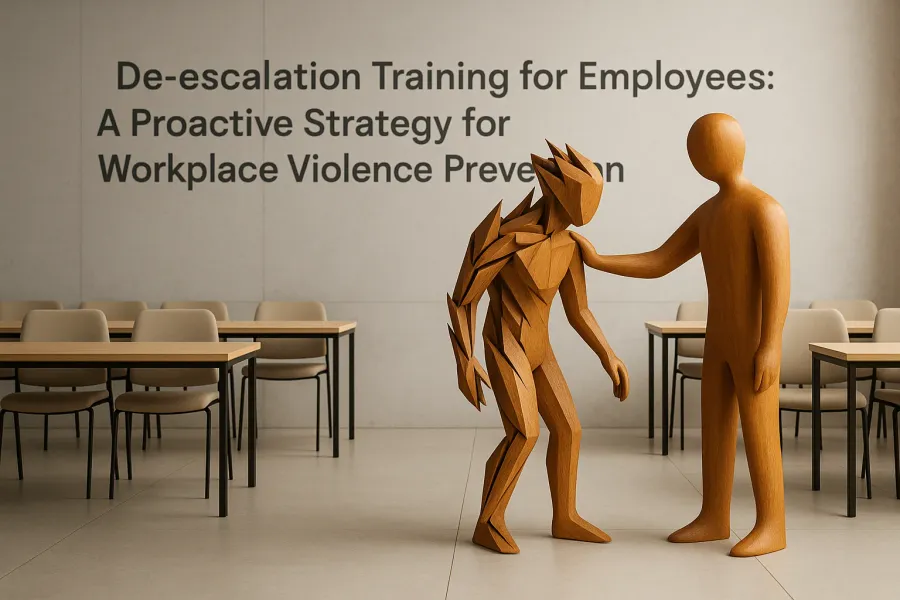
Does this number surprise you? Over two million American workers report being victims of workplace violence each year. As a security leader, you know that number represents more than just a statistic. It’s your team members feeling unsafe, your managers feeling unprepared, and your organization exposed to serious risk. The fear that a tense customer interaction or internal disagreement could spiral into violence or a lawsuit is a heavy weight to carry. The problem isn’t a lack of caring. It’s often a lack of a clear, consistent, and effective methodology for managing conflict before it ignites. It’s time to move from a reactive posture to a proactive strategy. It’s time to talk about de-escalation training for employees.
This isn’t just for your security guards. It’s a critical skill for every single person on your payroll, from the front desk to the C-suite. Providing your people with the tools to calmly and safely manage agitation is one of the most powerful investments you can make in your company’s safety, morale, and overall culture.
The Core Principles: Your Anchor in the Storm
Verbal and non-verbal de-escalation isn’t about winning an argument. It’s about reducing the emotional temperature of a situation. Think of your employee as a calm harbor and the agitated person as a ship in a storm. The goal is to guide that ship safely to shore, not to fight the waves. The core principles are surprisingly simple but require conscious practice.
Verbal De-escalation: This is what you say and how you say it.
- Lower Your Voice: Speak slowly and in a low, calm tone. An agitated person will often unconsciously mirror your vocal pitch. Your calm can become their calm.
- Listen Actively: Don’t just wait for your turn to talk. Hear what the person is truly saying. Acknowledge their feelings with phrases like, “I can see why you’re frustrated,” without necessarily agreeing with their position.
- Keep it Simple: Avoid corporate jargon, complex questions, or condescending language. Use short sentences and simple words.
- Be Respectful: Use polite language even if it’s not being returned. This maintains your professionalism and can disarm the other person’s aggression.
Non-Verbal De-escalation: Your body language often speaks louder than your words.
- Maintain Neutral Body Language: Keep your hands visible and open. Avoid crossing your arms, pointing, or clenching your fists, as these are seen as aggressive postures.
- Respect Personal Space: Stand at a slight angle to the person, not directly face-to-face, which can feel confrontational. Give them at least one-and-a-half to three feet of space. Encroaching on personal space can escalate tension dramatically.
- Control Your Facial Expressions: Maintain a calm, neutral expression. A look of shock, anger, or fear can fuel the other person’s agitation.
Reading the Signs: Early Intervention is Key
The best time to de-escalate a situation is before it truly begins. You can equip your employees to recognize the early warning signs of agitation, allowing them to intervene safely and effectively. It’s about building situational awareness, not paranoia. Teach your teams to look for clusters of behaviors, not just single actions.
Common Warning Signs Include:
- Verbal Cues: A raised voice, rapid speech, swearing, or making direct threats.
- Physical Cues: Clenched fists, a tightened jaw, pacing, a flushed face, or violating personal space.
- Behavioral Cues: Unreasonable demands, challenging authority, or displaying irrational behavior.
When an employee recognizes these signs, their first step isn’t to jump in and solve the problem. It’s to assess the situation. Is the person a threat to themselves or others? Is it safe to engage? This is a critical decision point where proper training makes all the difference. An employee who feels confident in their assessment is less likely to panic or overreact.
Practical Techniques for Defusing Anger
When faced with an angry individual, employees need a simple, memorable framework to guide their response. Complex protocols are forgotten under stress. At Grab The Axe, we teach a simple four-step process that works.
1. Listen: Give the person your undivided attention. Let them vent. Interrupting them will only make them feel unheard and more frustrated. Use minimal encouragers like “I see” or “uh-huh” to show you’re engaged.
2. Empathize & Acknowledge: Find a point of agreement or acknowledge their feeling. This is the most crucial step. Saying, “That sounds incredibly frustrating,” or “I understand why you’re upset about that delay,” validates their emotion without conceding to unreasonable demands. It shifts the dynamic from adversarial to collaborative.
3. Ask Clarifying Questions: Once the initial emotional peak has passed, start asking open-ended questions. “Can you walk me through what happened?” or “What would a solution look like to you?” This transitions the person from an emotional state to a more logical, problem-solving one.
4. Propose a Solution: Offer realistic, actionable choices. Frame it as a partnership. “Here’s what I can do for you right now,” or “Let’s look at two options we can explore to fix this.” Giving them a sense of control helps resolve the underlying feeling of powerlessness that often fuels anger.
This structured approach gives employees a clear path to follow, reducing their own anxiety and increasing their chances of a successful, peaceful outcome. This is the core of effective de-escalation training for employees.
Building a Training Program That Actually Works
How do you ensure this training sticks? A one-off webinar or a dusty manual won’t cut it. To build real confidence and competence, your training program must be engaging, memorable, and rooted in reality. Companies that do this well see incredible results. We’ve seen clients report a 40% reduction in physical incidents after implementing a comprehensive program.
Elements of High-Impact De-escalation Training:
- Interactive Role-Playing: Employees must practice these skills in realistic, simulated scenarios. This builds muscle memory for how to respond under pressure. It’s the difference between reading about swimming and actually getting in the pool.
- Focus on ‘Why’: Explain the psychology behind anger and de-escalation. When employees understand why a technique works, they are more likely to use it correctly.
- Tailored Scenarios: Use examples and situations that are specific to your industry and your employees’ daily roles. A retail employee faces different challenges than an office worker.
- Managerial Coaching: Equip your frontline managers to reinforce these skills. They are your first line of defense and your most important coaches. They need the training just as much as their teams do, so they can lead by example.
- Ongoing Reinforcement: De-escalation is a perishable skill. Use short refresher sessions, team huddles, and ongoing communication to keep the principles top-of-mind.
The goal of de-escalation training for employees isn’t to turn them into amateur psychologists or security experts. It’s to give them the confidence to manage difficult human interactions professionally and safely, knowing they have the full support and backing of their organization.
Investing in these skills is a direct investment in your people. It tells them that their safety and well-being are a priority. It reduces turnover, minimizes liability, and builds a resilient corporate culture where conflict is managed constructively, not ignored until it explodes. The future of workplace safety is proactive, and it starts with empowering your people with the right words and the right techniques.
Empower your employees with the skills to safely defuse conflict. Explore our de-escalation training programs.

With a dual background in I/O Psychology (PhD Candidate) and Business Management (MBA), Marie bridges the gap between clinical rigor and operational strategy. She oversees B2B relations, compliance, and the 'business' of risk management.