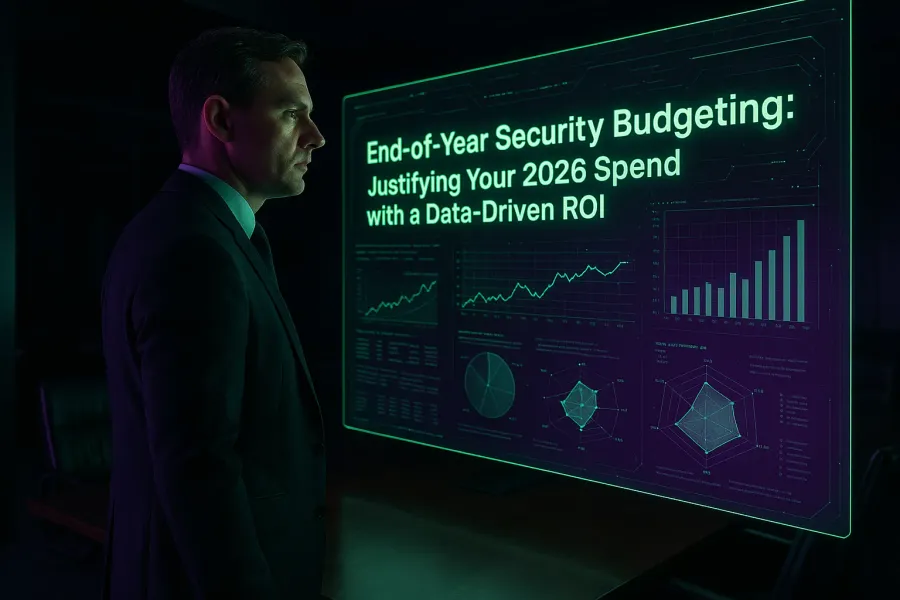
Did you know that by 2025, a CISO’s value will be measured not just by prevented incidents, but by their ability to generate value from security investments? This Gartner prediction marks a fundamental shift in our field. The annual budget conversation can no longer be a reactive plea based on fear, uncertainty, and doubt. For successful end-of-year security budgeting in 2025, you must pivot from a technical cost center narrative to one of strategic business enablement, backed by irrefutable data. The board doesn’t just want to know what you’re protecting against. They want to know how security investments drive growth, resilience, and competitive advantage.
From Cost Center to Strategic Enabler: Framing Your 2026 Security Pitch
The most common mistake security leaders make is presenting their budget as a list of tools and threats. The C-suite, however, thinks in terms of risk, revenue, and resources. To build a compelling business case for your 2026 security budget, you must translate your technical needs into their language. This requires a complete reframing of the conversation.
Instead of leading with the latest attack vectors, start with business objectives. Are you planning a major digital transformation? Expanding into a new market? Launching a new AI-driven product? Each of these initiatives carries inherent risks that your security program can mitigate, thereby enabling and de-risking the company’s strategic goals. Frame your budget request as a direct investment in these goals. For example, a request for an advanced application security platform isn’t just a cost; It’s an investment to ensure the new product launches on time without a critical vulnerability that could cripple its adoption and damage the brand.
Your presentation should focus on three core pillars of business value:
- Risk Reduction: Quantify the financial impact of potential threats. Use industry data to ground your argument. With the average cost of a data breach now at $4.45 million, a program that reduces the likelihood of such an event by even 20% has a clear, calculable value. Present this as ‘Annualized Loss Expectancy’ (ALE) before and after your proposed investments.
- Operational Efficiency: Security isn’t just about prevention. It’s also about efficiency. How do your proposed initiatives save the company time and money? For instance, implementing a security AI and automation platform does more than stop attacks; It reduces manual toil for your team, cuts down on false positives, and shortens incident response times. As data shows, companies with these systems have breach costs $1.76 million lower on average; That’s a powerful efficiency metric that directly impacts the bottom line.
- Business Enablement: This is where you align directly with growth. A robust security posture can become a competitive differentiator. It builds customer trust, which is critical for retention and acquisition. It can also unlock new revenue streams by allowing the company to meet stringent compliance requirements (like GDPR or CCPA) needed to enter new markets or handle sensitive data.
By structuring your argument this way, you shift the perception of your program from a necessary evil to an indispensable partner in achieving corporate objectives. It’s the most critical step in effective end-of-year security budgeting.
The New Lexicon of Security ROI: Metrics That Matter
To support your strategic narrative, you need the right metrics. Traditional metrics like ‘number of attacks blocked’ are operationally useful but fail to resonate in the boardroom. They show activity, not impact. To demonstrate the ROI of your security programs, you must adopt a lexicon of business-centric metrics.
Here are the metrics that will capture the board’s attention:
- Cost of Inaction: This is a powerful framing tool. Instead of just presenting the cost of a new control, also present the potential cost of not implementing it. Use the $4.45 million average breach cost as a starting point and tailor it to your organization’s specific risk profile. What would a day of operational downtime cost? What is the potential brand damage from a public breach? This reframes the spend as an insurance policy with a clear payout.
- Security-Enabled Revenue: Track the revenue from contracts or clients that were won specifically because your company met their high security standards. This directly links security investment to revenue generation.
- Risk Reduction Percentage: Use a risk register to score and quantify organizational risks. Show how your proposed budget will reduce the scores of the top 5-10 business risks. A statement like, ‘This investment will reduce the risk of a catastrophic supply chain compromise by 40%’ is far more impactful than ‘We need to buy a new vendor risk management tool.’
- Time-to-Remediation: Track the average time it takes to detect and remediate a critical vulnerability or incident. A downward trend in this metric demonstrates improved efficiency and resilience, which translates to lower potential damages and operational disruption. It’s a clear indicator of a maturing program.
These metrics provide the quantitative backbone for your qualitative story. They are the ‘data’ in your data-driven budget proposal and are essential for any CISO aiming for strategic influence.
Budgeting for Tomorrow’s Battlefield: PQC and Offensive AI
Effective end-of-year security budgeting isn’t just about the here and now. It’s about building a program that can withstand the threats of tomorrow. Two of the most significant emerging threats that must be on your 2026 radar are Post-Quantum Cryptography (PQC) and the weaponization of AI.
Explaining these concepts to a non-technical board can be challenging. Use simple analogies. For PQC, explain that the cryptographic standards that protect almost all our data today can be broken by a future quantum computer. The threat is not just in the future. Adversaries are likely engaging in ‘harvest now, decrypt later’ attacks, stealing encrypted data today with the expectation of decrypting it once they have a quantum computer. Your 2026 budget must include funds for discovery and planning, not necessarily a full rip-and-replace; You need to start inventorying your cryptographic assets and developing a migration roadmap. This is a matter of future-proofing the entire organization.
For offensive AI, the threat is more immediate. Adversaries are using AI to create more sophisticated phishing lures, develop novel malware that evades detection, and automate attacks at a scale and speed humans cannot match. Your defense must evolve in kind. This means your 2026 budget needs to allocate funds for AI-powered defensive tools. These systems can analyze massive datasets to identify anomalous behavior, predict potential attacks, and automate responses, fighting machine-speed attacks with machine-speed defense. This isn’t a luxury; It’s the new baseline for a credible security program.
Allocating even a small percentage of your budget to research, proof-of-concepts, and strategic planning for these future threats demonstrates foresight. It shows the board you’re not just a manager of the present but a steward of the company’s long-term digital survival.
Ultimately, your success in the 2026 budget cycle will depend on your ability to articulate a clear, compelling vision for security as a driver of business success. By reframing your pitch around value, backing it with business-relevant metrics, and demonstrating strategic foresight, you transform the budgeting process from an annual battle into a collaborative planning session. You prove that a well-funded security program is not a drain on resources but one of the smartest investments an organization can make in its future.
Move your security program from a cost center to a strategic enabler. Download our framework for building a compelling, data-driven security budget for 2026.

A PhD candidate in Health Psychology and former Corrections Officer, Jeff founded GTA to dismantle passive security models. He focuses on the 'Human Zero-Day', mitigating executive burnout and decision fatigue before they become security breaches.