With ransomware attacks on the industrial sector jumping by 87% in the last year, it’s brutally clear that standard IT security playbooks are failing our critical infrastructure. The factory floor is not the corporate office. The systems that control physical processes, our operational technology (OT), have unique requirements for safety and availability that most IT-centric security models simply break. When you try to protect a programmable logic controller (PLC) like it’s a sales database, you don’t just risk a data breach. You risk a physical catastrophe.
This is the core challenge of IT/OT convergence. How do you build a bridge between these two worlds without creating a superhighway for attackers? For decades, the most resilient answer has been a framework born from industrial engineering itself: the Purdue Model for Industrial Control Systems (ICS).
The Purdue Model: A Practical Blueprint for OT Defense
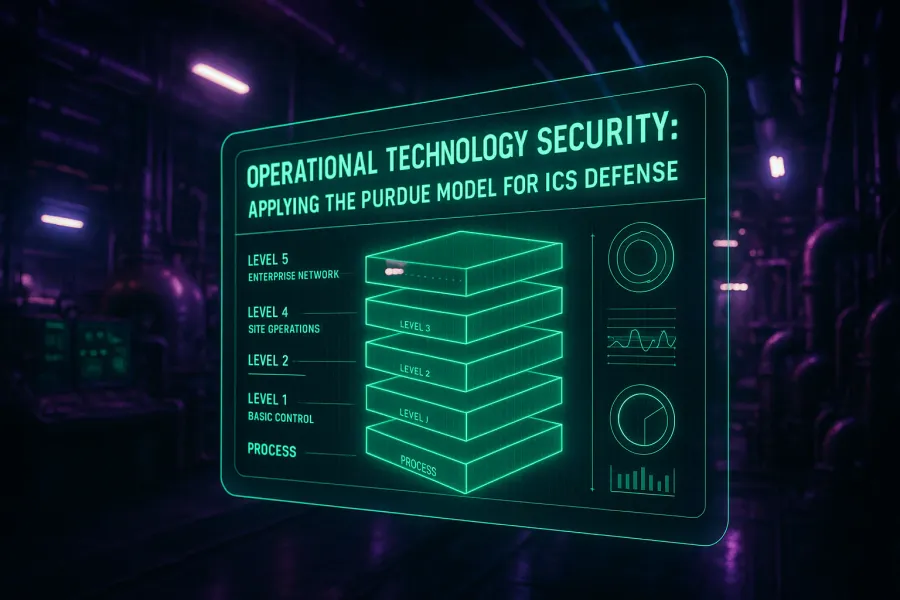
The Purdue Model isn’t a product or a complex algorithm. It’s a logical architecture, a blueprint that organizes industrial networks into hierarchical levels based on function and criticality. Think of it like designing a secure facility. You don’t just have one big wall around the outside. You have a perimeter fence, locked building doors, secure server rooms, and safes for the most critical assets. The Purdue Model applies this concept of defense-in-depth to your OT environment, creating zones that limit the scope and impact of any potential breach.
Proper network segmentation, a core tenet of the model, can mitigate or prevent over 90% of common OT attack vectors. Let’s break down the levels:
- Level 0: The Process Level. This is the physical world. It includes the sensors, actuators, valves, and motors that perform the actual industrial work. Security here is primarily physical.
- Level 1: Basic Control. This level includes the PLCs and Remote Terminal Units (RTUs) that read data from Level 0 sensors and execute commands. A 2024 Dragos report found that 70% of OT security vulnerabilities were discovered in Level 1 and Level 2, making this a critical area to protect.
- Level 2: Area Supervisory Control. Here you’ll find the Human-Machine Interfaces (HMIs) and SCADA software that operators use to monitor and control the processes within a specific area of the plant.
- Level 3: Site Operations. This level manages site-wide functions. It includes systems like historians for data logging, engineering workstations, and asset management servers. This is the highest level considered part of the core OT environment.
- Level 3.5: The Industrial Demilitarized Zone (IDMZ). This is not an original part of the model but is a modern essential. The IDMZ is a buffer zone that separates the OT network from the IT network. All traffic passing between them must be strictly controlled and inspected here. It’s the guarded checkpoint between two different countries.
- Level 4: Business Logistics. This is the traditional IT network. It houses systems like Enterprise Resource Planning (ERP), email servers, and corporate applications.
- Level 5: The Enterprise Network. This includes the wider corporate network and connections to the internet.
By segmenting systems this way, an attacker who compromises an email server in Level 5 can’t simply pivot to a PLC in Level 1. Each level crossing is a security checkpoint.
Key Security Controls for Each Level of Your OT Network
Implementing the Purdue Model requires more than just configuring some firewall rules. It demands a deliberate strategy for applying specific controls at each level to build a truly defensible architecture for your operational technology security.
Levels 0, 1, and 2: The Core of Industrial Control
This is where operations live or die. The primary goal is preventing unauthorized access and changes that could impact safety and availability.
- Network Segmentation: Use internal firewalls or data diodes to create micro-segments between control cells. Isolate Level 2 from Level 1, ensuring an HMI compromise doesn’t give an attacker direct access to every PLC it manages.
- Hardening and Access Control: Change default passwords on all devices. Implement role-based access control for HMIs and engineering workstations. If a device supports it, disable unused ports and services.
- Vulnerability Management: This is tricky. You can’t run an active vulnerability scanner against a live PLC without risking an outage. Use passive network monitoring to identify vulnerable assets and prioritize patching during scheduled maintenance windows.
Level 3: Managing Site-Wide Operations
This level aggregates data and manages the lower levels. It’s a prime target for attackers looking to cause widespread disruption.
- Dedicated Systems: Don’t use the same server for your historian and as a file share for the department. Systems at this level should be single-purpose and hardened.
- Strict Access Policies: Only authorized engineering and operations personnel should have access. All remote access should be terminated at the IDMZ, never directly into the Level 3 network.
- Network Monitoring: Deploy an OT-specific intrusion detection system (IDS) here to monitor for anomalous traffic patterns, unexpected protocol usage, or connections from unauthorized devices.
Securely Managing IT/OT Data Flow
One of the biggest pain points for any industrial organization is sharing data between the plant floor and the business network. The business needs production data for planning, but every connection is a potential attack path. This is where the IDMZ becomes the most important part of your operational technology security strategy.
Your IDMZ shouldn’t be a simple firewall. It should be a dedicated network segment with multiple layers of security. All communication should be structured around a conduit model. Instead of allowing the ERP system in Level 4 to directly query the historian in Level 3, the historian should securely push its data to a replication server in the IDMZ. The ERP system then queries that replica. This ensures that no traffic originating from the IT network is ever allowed to directly access the OT network.
Key technologies for a robust IDMZ include:
- Next-Generation Firewalls (NGFWs): With deep packet inspection capabilities that understand industrial protocols like Modbus or DNP3.
- Proxy Servers: To terminate sessions and broker communications, preventing direct connections.
- Data Diodes: For situations where data must only flow one way, from OT to IT, with a hardware guarantee that no traffic can flow back.
The goal isn’t to stop data flow. It’s to ensure that every byte of data that crosses the IT/OT boundary is intentional, inspected, and secure. You’re not building a wall; you’re building a secure, and heavily monitored, gateway.
It’s time to stop treating operational technology security as an extension of IT. The risks are different, the priorities are different, and the solutions must be different. The Purdue Model provides a logical, time-tested framework for building a segmented and defensible ICS environment. While new technologies like IIoT and cloud connectivity are introducing new challenges, the core principles of the model: segmentation, zoned access, and controlled conduits, remain the most effective foundation for protecting the systems that run our world. The future will involve adapting these principles, not abandoning them.
Secure your critical infrastructure. Download our technical whitepaper on implementing the Purdue Model.

Operating on the philosophy that 'you can't build a secure system if you don't know how to break it,' Chris leads our engineering division. A top 1% National Cyber League competitor, he hardens our digital infrastructure against the very exploits he has mastered.