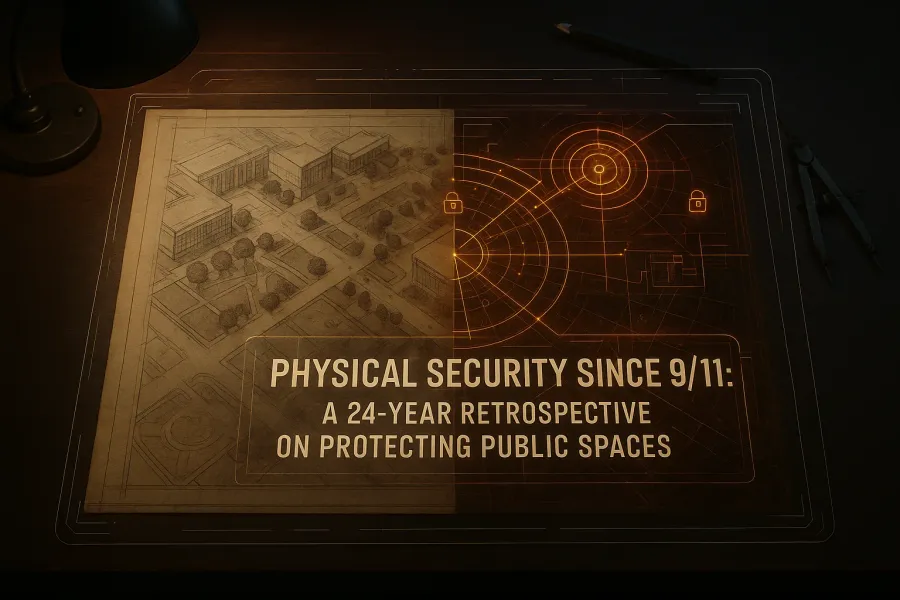
Twenty-four years ago, the world learned a brutal lesson about the failure of imagination. The 9/11 Commission Report didn’t just document a tragedy. It gave us a blueprint for security reform by identifying critical failures in policy, capabilities, and management. For those of us in the field, it was a mandate. The era of reactive, perimeter-focused security was over. The evolution of physical security since 9/11 has been a long, expensive, and necessary journey from ‘guards, gates, and guns’ to an integrated, intelligence-led discipline. But are the measures we put in place still relevant? For any security director, facility manager, or public official, that’s not a rhetorical question. It’s a question of budget, public trust, and human lives.
The Permanent Shift: Lasting Changes in Public Space Security
The single most significant change in physical security since 9/11 was the shift in mindset. Before the attacks, corporate and public security often focused on crime prevention and loss mitigation. Afterward, the focus expanded dramatically to include counter-terrorism and the protection of critical infrastructure. This wasn’t just a policy change. It was a fundamental rewiring of how we perceive and manage risk in public spaces.
The most visible result was the Homeland Security Act of 2002, which created the Department of Homeland Security (DHS) by consolidating 22 different federal agencies. This massive government reorganization was designed to break down the information silos that prevented agencies from connecting the dots before the attacks. It signaled a new era of centralized command and information sharing, setting a template that public and private sectors would follow.
Simultaneously, the U.S. private security industry exploded. It grew into a multi-hundred billion dollar market as corporations, venue operators, and property managers were forced to harden their facilities. Suddenly, every high-rise office building, stadium, and shopping mall had to re-evaluate its posture. Access control became more stringent, CCTV systems became ubiquitous, and the demand for trained security personnel skyrocketed. This wasn’t about creating fortresses. It was about creating layers of defense designed to deter, detect, and delay a potential threat long before it could reach its target.
Pushing the Perimeter: The Evolution of Standoff Distance and Hostile Vehicle Mitigation
Before 9/11, ‘standoff distance’ was a concept largely confined to military or high-security government installations. It’s the simple idea of creating physical space between a potential threat, like a car bomb, and your asset. The attacks brought this concept to the forefront of urban design and public security. We learned the hard way that a property line is not a security perimeter.
The evolution of physical security since 9/11 saw standoff distance become a core principle. You see its application everywhere, though you may not notice it. The strategic placement of heavy concrete planters, bollards, and reinforced street furniture around federal buildings, stadiums, and pedestrian plazas isn’t just for aesthetics. These are hostile vehicle mitigation (HVM) measures designed to stop a speeding truck in its tracks. They push the security perimeter outward, protecting the soft targets within.
This thinking dovetailed with the widespread adoption of Crime Prevention Through Environmental Design, or CPTED. CPTED is a practical approach to security that uses architectural design and the management of physical environments to influence human behavior. It’s about making a space feel controlled and watched, which discourages criminal activity. Good lighting, clear lines of sight, well-placed landscaping that eliminates hiding spots, and defined entryways are all CPTED principles. Post-9/11, these concepts became a priority in new construction and urban renewal, integrating security into the very fabric of our public spaces rather than just bolting it on as an afterthought.
Breaking Down Silos: Forging Public-Private Intelligence Partnerships
One of the most damning findings of the 9/11 Commission Report was the failure of intelligence agencies to share critical information with each other, let alone with state and local law enforcement. The hijackers operated in plain sight because no single agency had the complete picture. This led to a revolution in public-private security partnerships.
The old model, where federal agencies held intelligence close and law enforcement handled street-level crime, was obsolete. The creation of fusion centers across the country was a direct response. These centers bring together personnel from federal agencies like the FBI and DHS, state and local police, and often representatives from the private sector. Their job is to analyze threat information from multiple sources and disseminate actionable intelligence to the people on the ground who need it, from a patrol officer to a corporate security director.
For the private sector, this was a game-changer. Security leaders at major corporations and public venues were no longer just consumers of vague public warnings. They became active partners in the security ecosystem. This two-way street of information is now critical. A private security guard at a port might spot suspicious activity that is part of a larger, national threat pattern. By reporting it through the proper channels, that ground-level observation becomes a vital piece of the intelligence puzzle. This collaboration is one of the most powerful and least visible legacies of the post-9/11 security realignment.
Beyond Security Theater: Are Post-9/11 Measures Still Effective?
This is the tough question every security leader has to answer, especially when justifying multi-million dollar budgets to a board of directors. Are the security measures born in the immediate aftermath of the attacks still relevant, or has the threat evolved past them? The answer is both.
Some measures have been rightly criticized as ‘security theater’: actions that create the feeling of security without providing any real benefit. They are often reactive, inconvenient, and easily circumvented by a determined adversary. The key is to distinguish between theater and effective, risk-based security. Pouring concrete and installing cameras is easy. Understanding the specific threats to your facility and implementing measures that directly mitigate those risks is hard.
The principles we adopted after 9/11 are more relevant than ever. Layered security, standoff distance, intelligence sharing, and access control are timeless concepts. What must evolve is their application. The threat is no longer just a large-scale, coordinated attack. It’s the lone actor, the insider threat, the cyber-physical attack that uses a network breach to disable physical security systems, or the use of commercial drones for hostile surveillance or attack. Our security posture must be just as dynamic and adaptable as the threats we face. We can’t rely on a 20-year-old playbook. Constant risk assessment, red teaming, and investment in modern technology are not luxuries. They are necessities.
Looking back over the last 24 years, the evolution of physical security since 9/11 is undeniable. We’ve moved from a reactive, siloed approach to a proactive, integrated, and intelligence-driven one. We’ve redesigned our public spaces and forged new partnerships between government and the private sector. The lessons were learned at an unbearable cost, and the threats will continue to evolve. The future will demand an even deeper integration of physical and cybersecurity, the smart use of AI and data analytics to predict threats, and a continued commitment to vigilance. Our work is to honor the past by securing the future.
On this day of remembrance, take a hard look at your own security posture. Contact Grab The Axe for a modern physical security assessment grounded in the lessons of the last two decades.

A leader defined by a 'bias for action,' Dusten specializes in physical security assessments that impact profitability. He leverages high-logic strategies to pinpoint high-ROI vulnerabilities, ensuring defense measures actually scale with the business.