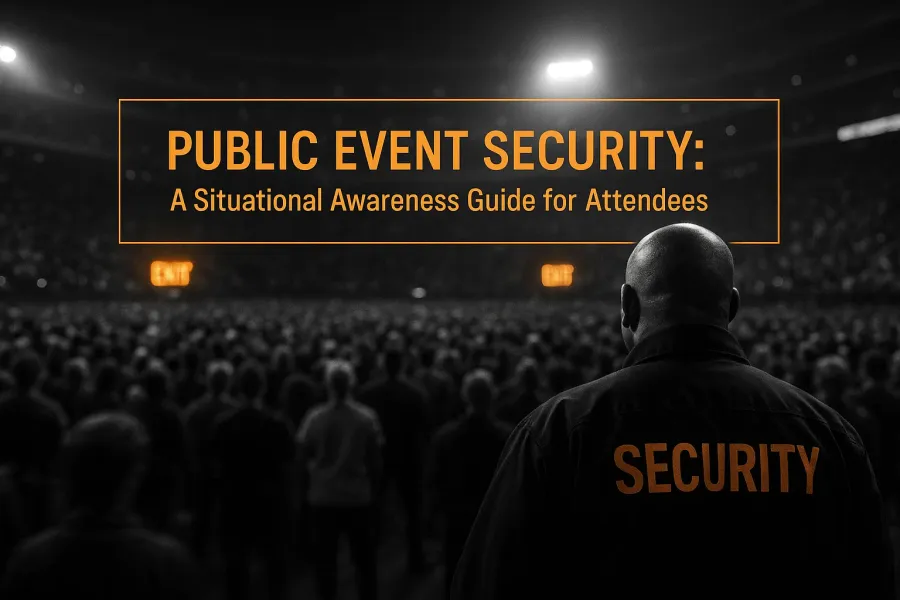
Did you know that over 80% of people at large events don’t mentally note the location of more than one emergency exit? That’s a staggering number. And it points to a dangerous gap in how we approach our personal safety in public spaces. We buy the ticket, show up for the show, and assume the hired security has it all covered. That assumption is a critical mistake. While event staff and security are a vital layer of protection, the most important security asset you have is your own awareness. True public event security isn’t just about guards and gates: It’s about your ability to see, think, and act decisively to protect yourself and the people you’re with.
This guide isn’t about making you paranoid. It’s about making you prepared. It’s a practical, no-nonsense look at how to build a habit of situational awareness so you can enjoy your event with confidence, knowing you have a plan.
Your Safety Plan Starts Before You Leave Home
Your approach to public event security should begin long before you hear the first chord of a song or the opening whistle. Simple planning can dramatically increase your personal safety by giving you options when you might need them most. Don’t leave your security to chance.
First, know the venue. Look at a map of the stadium or festival grounds online. Where are the exits? Not just the one you plan to enter through, but all of them. Are there alternate routes out of the main performance area? Understanding the layout gives you a mental blueprint to work from if you need to move quickly. Identify landmarks near these exits, like a specific food vendor or merchandise tent, so you can find them more easily in a chaotic environment.
Second, establish a clear communication and rendezvous plan with your group. Cell service at large events is notoriously unreliable. Pick a specific, easy-to-find meeting spot outside the venue in case you get separated: A spot a block or two away is better than right at the main gate, which will likely be congested. Make sure everyone in your group knows the plan. For kids, write your phone number on their arm with a marker. It’s a low-tech solution that works.
Third, think about what you carry. Travel light. A bulky bag is a liability in a dense crowd, making you a target for theft and slowing you down if you need to move. Carry essentials like your phone, ID, and a credit card in a front pocket or a secure, small bag: A fully charged phone is your lifeline, but also consider a portable power bank. Your goal is to be mobile and unencumbered.
Situational Awareness: Your Best Defense in a Crowd
Once you’re at the event, it’s time to put your planning into practice. Situational awareness is simply paying attention to your surroundings and understanding how they might affect your safety. It’s not about anxiously scanning for threats: It’s about calmly observing and processing information so you can make better decisions.
When you arrive, take a moment to orient yourself. This is where your pre-event planning pays off. Physically locate the two or three nearest exits to your seat or spot in the crowd. Point them out to your friends or family. This simple act of verbalizing and pointing locks the locations in your memory. Note the location of security personnel, first aid stations, and police officers. These are your resources in an emergency.
Next, establish a baseline. A baseline is the normal state of the environment. How is the crowd generally behaving? What’s the mood? Once you know what’s normal, you can more easily spot anomalies: things that don’t fit. This could be an unattended bag, a person wearing a heavy coat on a hot day, or an individual moving against the flow of the crowd with unusual intensity. The U.S. Department of Homeland Security’s ‘If You See Something, Say Something™’ campaign is a cornerstone of public event security for a reason. Don’t let the ‘bystander effect’ convince you someone else will report it. If something feels wrong, trust your gut. Discreetly inform a security guard or event staffer. You’re not being a nuisance; You’re being a responsible part of the event’s security ecosystem.
Finally, manage your position in the crowd. Avoid getting pinned against a barrier or wall. Stay on the edges of the densest crowds where you have more room to maneuver. If you feel the crowd surging or becoming dangerously compressed, move out of that area immediately. Your safety is more important than your view of the stage.
When Seconds Count: Understanding ‘Run, Hide, Fight’
In a worst-case scenario, having a clear, simple action plan is critical. Crowd dynamics studies show that the first 60-90 seconds of an emergency are the most important for making a decision that ensures your safety. The ‘Run, Hide, Fight’ protocol, endorsed by federal agencies, is the standard for active threat situations: It’s a straightforward framework that applies directly to a large venue.
Run: This is always your first priority. If there is a safe escape path, use it immediately. Leave your belongings behind. The goal is to get as far away from the threat as possible. Help others escape if you can, but don’t let their hesitation slow you down. Your primary duty is to save yourself first so you can help others later: Having already identified your exits is what makes this step possible.
Hide: If you can’t get out safely, find a place to hide. Your goal is to get out of the attacker’s view and find a location that provides protection. In a large venue, this could be inside a concession stand, a restroom, or a storage closet. Lock or barricade the door if possible. Silence your phone completely, don’t just put it on vibrate. Stay quiet and calm.
Fight: This is an absolute last resort, to be used only when your life is in imminent danger. Act with physical aggression and commit to your actions. Improvise weapons from whatever is available: a chair, a fire extinguisher, a belt. Work with others to disrupt or incapacitate the threat. This is a brutal calculus, but it’s about survival.
Understanding this protocol removes the paralysis of indecision. It gives you a clear set of priorities: get away, hide, or, if you have no other choice, fight for your life.
The landscape of public event security is constantly evolving, but personal responsibility remains the constant. Technology will bring new tools for venue operators, but no tool is a substitute for an alert and prepared attendee. The principles of planning, awareness, and decisive action will always be the foundation of your safety.
Your safety is your responsibility. Share these life-saving tips with your friends and family before your next big event.

A leader defined by a 'bias for action,' Dusten specializes in physical security assessments that impact profitability. He leverages high-logic strategies to pinpoint high-ROI vulnerabilities, ensuring defense measures actually scale with the business.