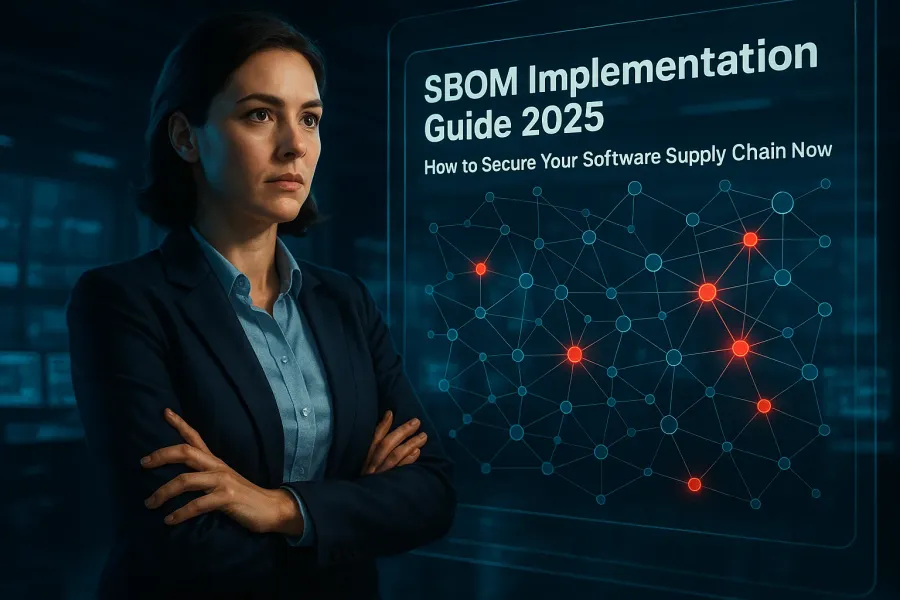
Software supply chain attacks have surged over 740% since 2019. It’s a staggering number, and it points to a threat that keeps CISOs, CTOs, and development leads up at night. The applications you build and deploy are not monolithic creations. They’re assembled from countless third-party and open-source components, each one a potential trojan horse. You can’t secure what you can’t see. This is where a Software Bill of Materials, or SBOM, moves from a ‘nice-to-have’ to a non-negotiable security tool for 2025. An SBOM is your inventory list, your blueprint, and your first line of defense against inherited risk. This guide will show you exactly how to put it into practice.
What is an SBOM and Why is it Essential in 2025?
Think of an SBOM like a list of ingredients on a food package. It’s a formal, machine-readable inventory of all the software components, libraries, and modules that are included in a piece of software. It details the component names, suppliers, versions, and dependencies. It gives you a complete picture of your application’s DNA.
For years, we operated on a model of ‘trust but verify’. That era is over. Now, the baseline is ‘never trust, always verify’. Why the shift? Three major factors are at play:
- The Rise of Open Source: The modern development landscape is built on open-source software (OSS). By 2025, it’s estimated that over 90% of custom applications will contain OSS components. While this accelerates innovation, it also means you’re constantly inheriting the security posture, or lack thereof, of countless external projects.
- Sophisticated Attackers: Threat actors are no longer just targeting your perimeter. They’re infiltrating the supply chain itself by injecting malicious code into popular open-source libraries, knowing it will be distributed downstream to thousands of unsuspecting organizations. A single compromised component can lead to a widespread breach.
- Regulatory Mandates: The risk is no longer theoretical. It’s a matter of national security and business continuity. The U.S. White House Executive Order 14028 now mandates SBOMs for any software sold to the federal government. This has created a ripple effect, with bodies like CISA promoting SBOMs as a best practice for everyone. What was once a government requirement is now the industry standard for due diligence.
Without an SBOM, you’re flying blind. When a new vulnerability like Log4Shell is discovered, the first question is always: “Are we affected?” Without an SBOM, that question can take weeks to answer as teams scramble to manually inspect codebases. With an SBOM, you can answer it in minutes.
A Step-by-Step SBOM Implementation Guide
Creating and managing SBOMs is a systematic process. It’s not a one-time task but a continuous cycle that integrates directly into how you build software. Here’s a practical, step-by-step approach to get you started.
Step 1: Discovery and Tool Selection
Your first step is to understand your current environment. What programming languages do you use? What package managers? What CI/CD tools are in place? This context will help you choose the right SBOM generation tools. These tools typically fall into the category of Software Composition Analysis (SCA). They scan your source code, binaries, and package manager files to automatically identify all components and their dependencies.
Step 2: Generate Your First SBOMs
Start by generating SBOMs for your most critical applications. Integrate your chosen SCA tool into your build process. This ensures that every time you build your software, an up-to-date SBOM is created alongside the final artifact. The goal is automation. The SBOM should be a natural output of development, not a manual chore.
Standard formats are key for interoperability. The two most common are SPDX (Software Package Data Exchange) and CycloneDX. Your tools should be able to export in one or both of these formats.
Step 3: Centralize and Analyze
Generating SBOMs is only half the battle. You need a centralized platform to store, manage, and analyze them. This allows you to query your entire software portfolio instantly. When a new vulnerability is announced, your analysis platform should be able to cross-reference the vulnerable component version against every SBOM you have. This turns a frantic fire drill into a precise, targeted response.
Step 4: Enrich with Vulnerability Data
Your SBOM platform should integrate with public and private vulnerability databases (like the NVD and others). It automatically enriches your component list with known vulnerability information (CVEs). This provides immediate visibility into the specific risks present in your applications.
Step 5: Remediate and Monitor
With a clear view of your vulnerabilities, you can create a prioritized remediation plan. Focus on the most critical vulnerabilities in your most sensitive applications first. Your SBOM provides the data needed to track remediation progress. The process doesn’t end there. You must continuously monitor your applications for newly disclosed vulnerabilities, as the threat landscape changes daily.
Integrating SBOMs into Your DevSecOps Pipeline
A common fear is that new security requirements will slow down development. When done right, SBOMs do the opposite. They accelerate secure development by providing fast, automated feedback.
Integrating an SBOM process into your DevSecOps pipeline is about shifting security left. Here’s how it works:
- At the IDE: Developers can use plugins to get early warnings about vulnerable components as they write code.
- At the Pull Request: Automated checks can prevent new code from being merged if it introduces components with critical vulnerabilities or unlicensed software.
- At the Build Stage: This is where the SBOM is officially generated and stored. The build can be configured to fail if the generated SBOM contains components that violate your security policies (e.g., a component with a known critical vulnerability).
- At the Deployment Stage: Before deploying, a final check ensures the application’s SBOM is compliant. Post-deployment, the SBOM is used for continuous monitoring in production.
This automated approach provides developers with the immediate feedback they need to fix issues early in the lifecycle when it’s cheapest and easiest to do so. It transforms security from a roadblock into a guardrail that keeps development moving quickly and safely.
Leading Tools and Platforms for SBOM Management
The market for SBOM tools is mature and offers a range of options for different needs and budgets. They generally fall into three categories:
- Open-Source Tools: Projects like the OWASP CycloneDX toolset and OWASP Dependency-Track provide powerful, free-to-use capabilities for SBOM generation and analysis. They are excellent for teams that have the technical expertise to deploy and manage them.
- Commercial SCA Platforms: These are polished, all-in-one solutions that offer SBOM generation, vulnerability scanning, license compliance, and policy enforcement with enterprise-level support. They are designed for easy integration and comprehensive reporting.
- Cloud-Native Tools: Major cloud providers and repository platforms (like GitHub Advanced Security) are increasingly building SBOM generation and analysis directly into their services. If you’re already invested in one of these ecosystems, this can be a very low-friction way to get started.
The right choice depends on your organization’s scale, budget, and existing technology stack. The key is to select a tool that can produce a standard format and integrate cleanly into your development workflow.
An SBOM is more than a compliance document. It’s a foundational element of modern software security and risk management. Implementing a robust SBOM program gives you the visibility to defend against supply chain attacks, the speed to respond to new threats, and the confidence to innovate securely. As software continues to be assembled, not just written, knowing what’s inside isn’t just a best practice. It’s a condition for survival.
Don’t wait for a breach. Contact us for a Software Supply Chain Security Assessment today!

Operating on the philosophy that 'you can't build a secure system if you don't know how to break it,' Chris leads our engineering division. A top 1% National Cyber League competitor, he hardens our digital infrastructure against the very exploits he has mastered.