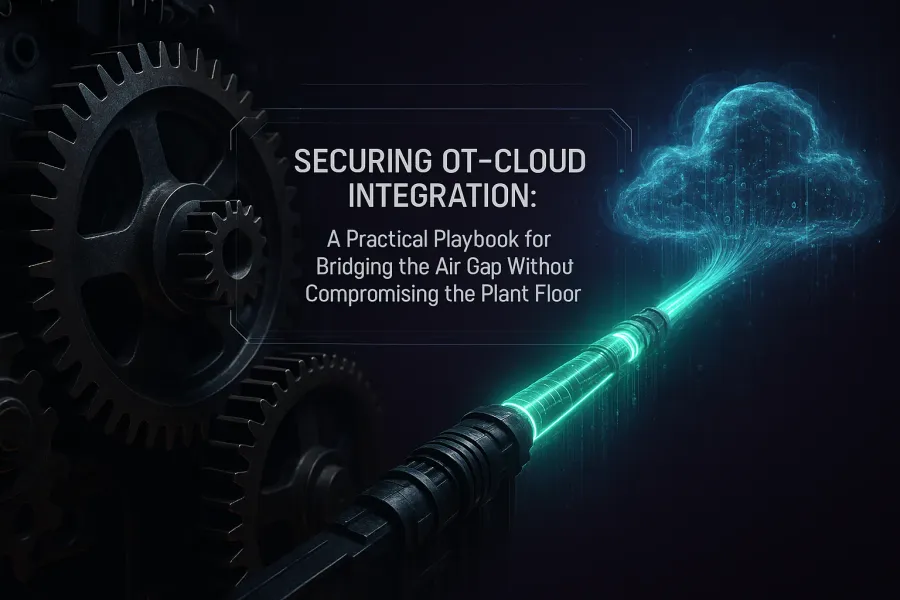
Did you know that attacks targeting operational technology (OT) systems have skyrocketed by over 2000% since 2018? This isn’t just a number on a security report. It’s a direct threat to the physical machinery that runs our manufacturing plants, power grids, and water treatment facilities. The business demands data for IIoT analytics and predictive maintenance, pushing you to connect these legacy systems to the cloud. But the plant manager knows that a single wrong move, a single compromised connection, could lead to a plant shutdown, equipment damage, or even a safety incident. This is the core challenge of securing OT-cloud integration. You’re asked to bridge a decades-old air gap, connecting inherently insecure systems to the most hyper-connected environment on earth. It’s not impossible, but it demands a completely different playbook than standard IT security.
Most of your OT assets were never designed to be connected to the internet. With operational lifespans of 20-30 years, many run on unpatchable operating systems and use protocols like Modbus that have no built-in security. Connecting them directly is like leaving the front door of your factory wide open. The key is to build a purposeful, highly controlled bridge that allows valuable data to flow out without creating a pathway for threats to flow in. This requires a deep understanding of both OT constraints and cloud capabilities.
What is the right architecture for securely connecting OT networks to the cloud?
For years, the Purdue Model has been the go-to framework for segmenting industrial control system (ICS) networks. It’s a great conceptual model, but its rigid, hierarchical structure struggles to accommodate the fluid, data-centric nature of the cloud. A modern approach to securing OT-cloud integration adapts the principles of the Purdue Model for a connected world. The goal is no longer a complete air gap, but a controlled, monitored, and defensible connection.
The most effective architecture centers around an Industrial Demilitarized Zone (IDMZ). Think of the IDMZ as a secure, neutral territory between your trusted OT network (the plant floor) and the untrusted IT and cloud networks. No direct traffic ever passes between OT and the cloud. Instead, data from the plant floor is collected by servers in a secure OT zone. This data is then published to servers within the IDMZ. Cloud services can then access this data from the IDMZ, but they can never reach back into the OT network. This creates a critical buffer. A compromise of a cloud-connected server in the IDMZ doesn’t automatically grant an attacker access to your PLCs or SCADA systems.
How do you implement network segmentation and unidirectional data flow?
Architecture is the blueprint, but segmentation and data flow control are the walls and security doors. Within your OT network, you must implement micro-segmentation. This means creating small, isolated network zones around critical assets. For example, the control systems for one production line should not be able to communicate directly with another unless absolutely necessary. This contains the blast radius of an incident. If one segment is compromised, the infection can’t easily spread across the entire plant floor.
The gold standard for enforcing one-way data flow from the OT network to the IDMZ is a data diode. A data diode is a hardware-based security device that is physically incapable of transmitting data in more than one direction. It uses fiber optic technology where the transmitter on one side is physically disconnected from the receiver on the other. It’s the ultimate guarantee that no malicious commands or malware can travel from the IT/cloud side back into your sensitive control systems. While software-based firewalls are essential, a data diode provides a level of deterministic, physics-based security that software alone cannot match for securing OT-cloud integration.
What specific tools and techniques can monitor OT traffic for anomalies?
Once data leaves the plant floor and enters the IDMZ, you need visibility. Standard IT monitoring tools are often blind to the specialized protocols used in OT environments. You need OT-native monitoring solutions that understand protocols like Modbus, DNP3, and Profinet. These tools use deep packet inspection (DPI) to not just see traffic, but to understand the commands being sent. For example, is a command to a PLC within its normal operating parameters, or is it trying to do something dangerous?
Beyond protocol analysis, behavioral anomaly detection is critical. These systems baseline the normal communication patterns in your OT environment. They learn what devices talk to each other, when they talk, and what they typically say. When a new, unexpected communication path appears or a device starts behaving erratically, the system flags it as a potential threat. This is crucial for catching zero-day attacks or insider threats that traditional signature-based tools would miss. This continuous monitoring is a non-negotiable part of securing OT-cloud integration effectively.
How can you leverage cloud-native security services to protect OT data?
Ironically, the cloud itself offers powerful tools to help secure OT data, as long as the architecture is right. You should never connect your OT assets directly to the cloud. Instead, use edge computing platforms like AWS IoT Greengrass or Azure IoT Edge, which run within your IDMZ. These edge devices can receive data from the OT network, then filter, process, and encrypt it before sending it to the cloud. This has two major benefits.
First, it minimizes the attack surface. Only a single, hardened edge device communicates with the cloud, not dozens or hundreds of vulnerable OT endpoints. Second, it ensures only clean, necessary data is transmitted. You can strip out sensitive network information and validate data formats at the edge, preventing malformed data from ever reaching your cloud analytics platforms. Once the data is in the cloud, you can apply robust cloud-native security services for identity and access management, encryption, and logging, all without ever exposing your plant floor to direct internet risk.
The push for digital transformation isn’t slowing down. Integrating OT and cloud is no longer a question of ‘if’ but ‘how’. By designing a resilient architecture with an IDMZ, enforcing unidirectional data flow with technologies like data diodes, and implementing specialized OT monitoring, you can deliver the data the business needs without betting the factory to do it. The future of industrial operations will rely on this secure, intelligent convergence, turning plant floor data into a strategic asset instead of a critical liability.
Get our step-by-step guide on designing a secure and resilient architecture for your OT-to-cloud data integration projects.

Operating on the philosophy that 'you can't build a secure system if you don't know how to break it,' Chris leads our engineering division. A top 1% National Cyber League competitor, he hardens our digital infrastructure against the very exploits he has mastered.