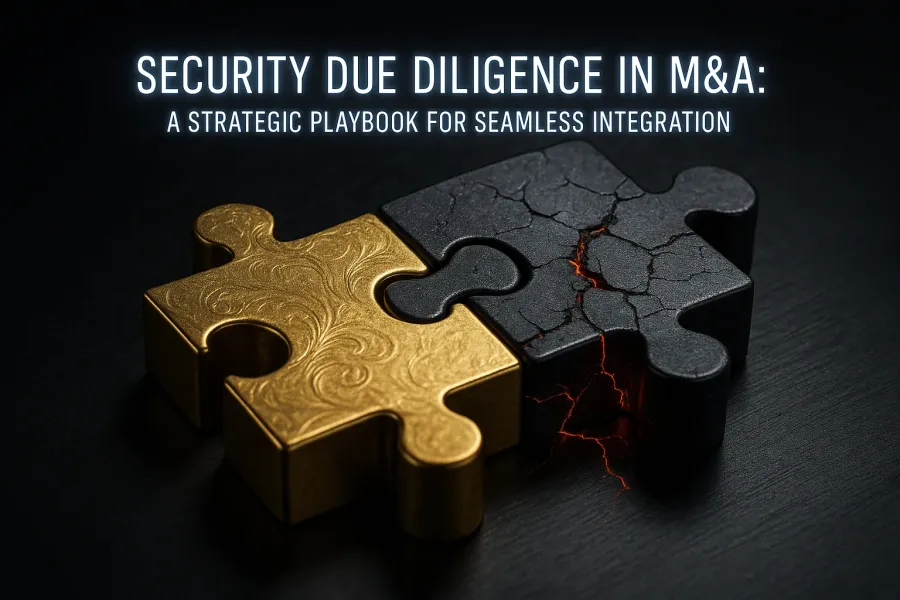
What if your next strategic acquisition, the one poised to redefine your market position, is secretly a Trojan horse? It’s a disconcerting thought, yet a stark reality for many. A recent survey found that an alarming 53% of acquiring companies uncovered significant cybersecurity issues in their target company only after the deal was signed. This isn’t just an IT problem. It’s a fundamental failure in valuation that can introduce millions in remediation costs, cripple operations, and erode shareholder value. In today’s hyper-connected landscape, a robust process for Security Due Diligence in M&A is not merely a defensive measure. It is a critical component of strategic value creation, transforming a potential liability into a fortified asset.
Too often, security diligence is relegated to a superficial vulnerability scan, a shallow check-box exercise that fails to probe the true nature of a target’s risk posture. This approach misses the complex interplay between technology, policy, and people that defines an organization’s actual resilience. A truly effective due diligence process must be converged, meticulously examining both the digital and physical security domains to build a holistic, actionable intelligence picture before you sign on the dotted line.
Beyond the Scan: A Framework for Comprehensive Security Due Diligence
To move beyond the basic scan is to treat security diligence as a strategic intelligence-gathering operation. It requires a multi-faceted framework that evaluates not just the technology in place, but the culture and processes that govern it. A comprehensive assessment must dissect the target’s security ecosystem across four critical pillars.
First is the Technical and Architectural Review. This goes far deeper than automated scans. It involves manual source code analysis for proprietary applications, a thorough review of network architecture for segmentation weaknesses, and a deep dive into cloud security configurations and identity and access management (IAM) protocols. Think of it like a structural survey of a building. A surface inspection might look fine, but a structural engineer checks the foundation, the load-bearing walls, and the integrity of the core materials. This is what we must do for a target’s technology stack.
Second is the Governance, Risk, and Compliance (GRC) Audit. Technology is only as effective as the policies that direct its use. This phase scrutinizes the target’s security policies, incident response plans, and data governance frameworks. Are their policies merely documents, or are they living procedures that are tested, enforced, and understood by the team? We examine their compliance records for regulations like GDPR, CCPA, or HIPAA. A history of non-compliance is not just a record of past mistakes. It’s a leading indicator of a dysfunctional security culture and a predictor of future incidents.
Third, we must analyze the Human Element. People are consistently the most targeted and often the most vulnerable layer of any security program. This involves assessing the target’s security awareness training programs, understanding the security expertise of their key personnel, and evaluating the overall security culture. Does the leadership team champion security, or do they view it as a cost center? The answer to that question reveals more than any penetration test ever could. Clashing security cultures are a primary driver of friction and failure during post-merger integration.
Finally, and most frequently overlooked, is the Physical Security Assessment. The convergence of physical and cyber threats is no longer a theoretical concept. Integrating physical security systems, like access control and surveillance, is a critical and often neglected part of due diligence. We must ask: Who has physical access to critical data centers? Are their visitor management protocols robust? Are their surveillance systems integrated with their network monitoring tools? An unsecured server room can render a billion-dollar cybersecurity investment worthless. These domains are not separate. They are two sides of the same coin.
The First 100 Days: Architecting a Unified Security Post-Merger
Successful Security Due Diligence in M&A doesn’t end when the deal closes. It provides the blueprint for the crucial first 100 days of integration. This period is not about frantic, reactive fixes. It is about the deliberate and strategic harmonization of two distinct security ecosystems. A well-structured 100-day plan turns the chaos of integration into a controlled, value-driven process.
Days 1-30: Discovery, Triage, and Control. The initial month is focused on establishing control and gaining deep visibility. This involves deploying monitoring tools across the new environment, consolidating incident response contacts into a unified command structure, and conducting a rapid risk assessment to prioritize the most critical vulnerabilities discovered during diligence. This is the triage phase. You must quickly identify the metaphorical bleeding wounds and stabilize the patient before attempting more complex surgery.
Days 31-60: Policy Harmonization and Quick Wins. With immediate threats contained, the focus shifts to creating a single, coherent security governance framework. This means reconciling disparate policies on everything from data handling to remote access and acceptable use. This is also the time for strategic “quick wins” to build momentum and demonstrate value. This could involve rolling out a unified endpoint detection and response (EDR) solution or standardizing on a single multi-factor authentication (MFA) platform. These actions reduce the attack surface and begin the process of building a unified security culture.
Days 61-100: Technology Integration and Cultural Alignment. The final phase of the initial sprint involves the heavy lifting of technology stack integration and fostering a single, shared security culture. This includes developing a roadmap for consolidating redundant security tools, integrating security operations centers (SOCs), and aligning physical access control systems. Simultaneously, it is crucial to launch joint training initiatives and communication campaigns. These efforts ensure that all employees, from both legacy organizations, understand and operate under the new, unified security mission. This is where you truly forge a new, stronger entity from two separate parts.
Deal-Breakers: Identifying Red Flags That Demand a Full Stop
While the goal of due diligence is often to find a path to a secure integration, it must also serve as a critical go/no-go checkpoint. Some issues are so fundamental that they should, at a minimum, trigger a major renegotiation of the deal’s value, or halt it altogether. The average cost to remediate security issues discovered after a deal closes is in the millions, a cost that should be priced into the acquisition from the start.
One of the most significant red flags is evidence of an active, uncontained, or undisclosed breach. Acquiring a company with a persistent adversary already inside its network is inheriting an existential threat. Another is systemic non-compliance with major, industry-specific regulations. This indicates a deep-rooted disregard for security and privacy that can be impossible to fix and may come with massive, unavoidable fines.
Look for a complete lack of security leadership or documentation. If there is no CISO or equivalent, no documented incident response plan, and no clear security policies, you are not just acquiring technical debt. You are acquiring a cultural void that will require an immense investment of time, capital, and leadership to correct.
Finally, on the physical side, fundamental incompatibilities in critical infrastructure can be a deal-breaker. If a target’s primary data center is in a location with inadequate physical security, or if their access control systems are archaic and cannot be integrated with your own, the cost and risk of remediation may outweigh the strategic value of the acquisition itself. Recognizing these red flags requires expertise and the courage to advise leadership to walk away from a seemingly attractive deal.
In essence, the M&A process is a high-stakes bet on future value. Comprehensive security due diligence is not about hedging that bet. It’s about ensuring you’re playing with a full deck of cards, with complete knowledge of the risks and opportunities on the table. The future of M&A strategy will see an even greater emphasis on this discipline, with AI-driven threat modeling and predictive risk analysis becoming standard components of the diligence process. By treating security as a core pillar of M&A strategy, organizations can protect their investment, accelerate integration, and unlock the full, uncompromised value of their next acquisition.
Don’t let your next acquisition be a Trojan horse. Engage Grab The Axe’s M&A security due diligence team to get a true picture of the risks and opportunities.

A PhD candidate in Health Psychology and former Corrections Officer, Jeff founded GTA to dismantle passive security models. He focuses on the 'Human Zero-Day', mitigating executive burnout and decision fatigue before they become security breaches.