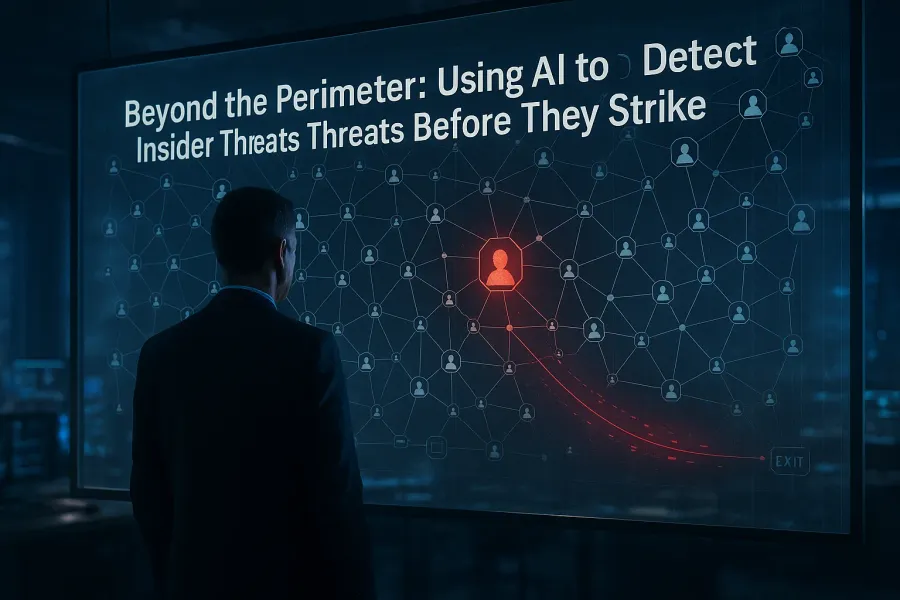
With the average cost of a single insider threat incident climbing to $15.4 million, it’s clear that your greatest security risk might not be a faceless hacker thousands of miles away. It could be a trusted employee with legitimate access to your network. For decades, we’ve invested heavily in building taller walls and stronger gates. We’ve fortified the perimeter. But what happens when the threat is already inside? Traditional tools, built to catch external attackers, are often blind to the subtle, dangerous actions of an insider. They generate a storm of false positives, burying your security teams in noise while the real threat quietly walks out the door with your crown jewels. The solution isn’t more rules or bigger walls. It’s smarter security. It’s time to use AI to detect insider threats by focusing on the one thing that always leaves a trail: human behavior.
The Illusion of the Secure Perimeter
Your security stack is likely impressive. You have firewalls, intrusion prevention systems, and advanced endpoint protection. These are essential, but they share a fundamental flaw. They are designed to spot threats trying to break in. An insider, by definition, is already in. They have keys, a badge, and the trust of your organization. Their actions, even malicious ones, often look like normal work to a traditional, rule-based security system.
This is why nearly 60% of organizations report that detecting insider attacks is significantly harder than spotting external threats. A rule might flag a large data download, but what if that employee is a data scientist who regularly works with large datasets? The alert is triggered, your SOC team investigates, and they find nothing. It’s a false positive. After a few hundred of these, your team experiences alert fatigue, and their attention dulls. This is the noise that attackers hide in. Malicious insiders and even well-meaning but negligent employees don’t trip the same alarms as malware. They don’t use known exploits. They use their legitimate credentials to do illegitimate things. To catch them, you need to stop looking for signatures and start understanding context.
How AI Builds a Blueprint of Normal
This is where AI-powered User and Entity Behavior Analytics (UEBA) changes the game. Think of a great security guard in a small office building. They don’t just check IDs. They know who comes in early, who stays late, which departments collaborate, and who always gets coffee at 2 PM. They have a mental baseline of what’s normal. When someone from accounting suddenly starts trying to access engineering servers at 3 AM, the guard knows something is wrong. It’s a deviation from the baseline.
An AI-driven UEBA platform does this at a massive scale for your entire digital environment. It ingests data from dozens of sources. Think logs from your servers, endpoints, cloud applications, and physical access systems. For every user and every device (entities), the AI builds a unique, dynamic baseline of normal activity. It learns:
- What time does this user typically log in and out?
- What servers and files do they normally access?
- How much data do they usually upload or download?
- From what geographic locations do they work?
- Which applications are part of their daily workflow?
This baseline isn’t static. It continuously learns and adapts as roles and responsibilities change. It’s this high-fidelity understanding of ‘normal’ that makes using AI to detect insider threats so powerful. It moves security from a reactive, signature-based model to a proactive, context-aware one.
Spotting the Ghost in the Machine: Key Behavioral Indicators
Once a baseline is established, the AI’s job is to spot meaningful deviations. It’s not just looking for one suspicious action but a sequence of them that, when combined, tell a story of increasing risk. These are the behavioral indicators that legacy systems miss:
- Unusual Access Patterns: An HR manager who never touches financial databases suddenly starts running queries on payroll files. A developer in the U.S. logs in from an Eastern European IP address at 2 AM.
- Data Hoarding or Exfiltration: An employee who normally downloads a few megabytes of data per day suddenly downloads gigabytes of customer data or proprietary code. This might be followed by unusual activity on cloud storage sites or USB drive usage.
- Privilege Escalation: A user attempts to gain administrative rights or access systems and folders far outside their job description. This is a classic indicator of both insider and compromised account threats.
- Abnormal Work Hours: A salesperson who works a standard 9-to-5 schedule begins logging in every night between midnight and 4 AM. While it could be a project deadline, it’s a deviation worth noting, especially when combined with other indicators.
The power of AI is its ability to correlate these low-fidelity signals into a high-fidelity alert. One of these events alone might be a false positive. But when a user logs in at a strange time, accesses unusual files, and then tries to move large amounts of data to a personal cloud drive, the AI model flags it as a high-risk event. This is why AI-powered UEBA platforms can reduce false positive alerts by up to 90%. They let your security teams stop chasing ghosts and focus on credible, contextualized threats.
Building an Effective and Ethical Insider Threat Program
Implementing this technology requires more than just a technical rollout. It requires a cultural one. The biggest fear leaders have is creating a ‘Big Brother’ environment that destroys morale and trust. An effective insider threat program is built on transparency, not surveillance.
Here’s how you deploy an AI-driven program that is both effective and respectful of your employees:
- Communicate Clearly and Often: Be upfront with your team. Explain that the program’s goal is to protect the company’s data and, by extension, their jobs. Frame it as a tool to detect anomalous behavior, not to spy on individual people. The focus is on protecting sensitive assets from risky actions, regardless of who is performing them.
- Involve HR and Legal from Day One: This is non-negotiable. Your monitoring policies must be legally sound and clearly documented. HR can help shape the messaging to ensure it aligns with your company culture. Legal counsel will ensure you comply with all relevant privacy regulations.
- Define a Formal Incident Response Plan: What happens when the AI generates a high-risk alert? Who investigates it? How is it escalated? A clear, documented process ensures that investigations are fair, consistent, and discreet. This protects both the company and the employee from false accusations.
When done right, an insider threat program doesn’t create a toxic culture. It reinforces the idea that security is a shared responsibility and that the organization is taking intelligent, modern steps to protect everyone.
Your most valuable assets are not just the data on your servers, but the people you’ve entrusted with it. While you can’t eliminate human risk entirely, you can get much smarter about how you manage it. The old model of waiting for an alarm to sound is no longer enough. The cost, in both dollars and time, is simply too high. By using AI to understand behavior, you can move from a reactive posture to a proactive one, spotting the signs of a threat long before it strikes.
Secure your organization from the inside out. Schedule a consultation on our Insider Threat Program Development.

Operating on the philosophy that 'you can't build a secure system if you don't know how to break it,' Chris leads our engineering division. A top 1% National Cyber League competitor, he hardens our digital infrastructure against the very exploits he has mastered.