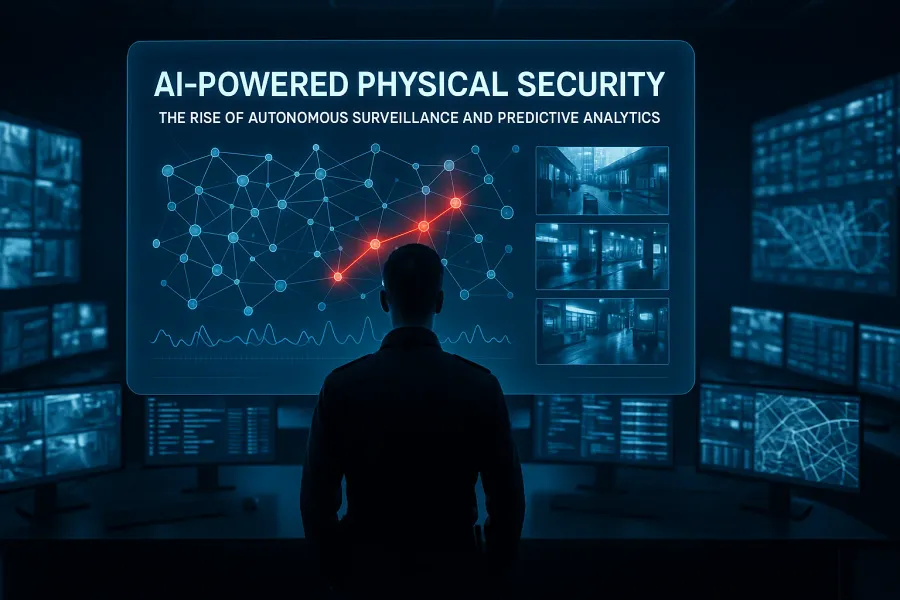
Your security team is watching hundreds of video feeds. They’re looking for the one sign of trouble in a sea of normalcy. But by the time they spot it, the incident has already happened. You’re left reacting, managing the aftermath instead of preventing the threat. What if you could change that? What if you could cut the noise of false alarms by up to 90% and give your team the power to act before a situation escalates? That’s not a future promise. That’s the reality of AI-powered physical security.
For too long, we’ve accepted a reactive model for physical security. We’ve invested in more cameras, more guards, and more monitors, yet the core problem remains. The sheer volume of data is overwhelming for any human team. It’s a system that’s expensive, prone to error, and always a step behind. It’s time for a fundamental shift in strategy from watching to seeing, from reacting to predicting.
From Passive Monitoring to Proactive Intelligence
How exactly does AI transform a standard camera into a proactive security asset? It’s about teaching the system to understand what it’s seeing. Traditional systems trigger alerts based on simple motion. A tree branch swaying in the wind, a plastic bag blowing across a parking lot, or a stray animal can all trigger a false alarm, burying your team in useless notifications.
AI-powered physical security operates on a different level. Using machine learning and computer vision, these systems can:
- Identify and Classify Objects: The system knows the difference between a person, a vehicle, and an animal. It can be trained to recognize specific objects, like a backpack left unattended or a car loitering near a secure entrance.
- Recognize Anomalies: The AI establishes a baseline of normal activity for any given area. It learns the typical flow of people and vehicles. When it detects a deviation, like a person trying to access a restricted area after hours or a vehicle driving the wrong way down a one-way lane, it flags it as a potential threat.
- Analyze Behavior: Advanced systems can even analyze human behavior to identify threatening actions. This can include detecting aggressive movements, falls (slip-and-fall incidents), or individuals attempting to scale a fence. The system isn’t just a pair of eyes. It’s a brain that analyzes and interprets events in real-time.
Think of it this way. A traditional CCTV system is like a security guard staring at a wall of screens, trying not to fall asleep. An AI-powered system is like having a team of highly-trained, superhuman analysts watching every camera feed simultaneously, each one knowing exactly what to look for and never getting tired or distracted.
Key Features of a Truly Integrated AI Security Solution
When you start evaluating AI-powered systems, the market can seem noisy. Many vendors claim to use AI, but the capabilities can vary wildly. To build a truly effective defense, you need to look for a solution that’s both intelligent and integrated. Your goal is to break down the silos between your security systems, not create new ones.
Here are the key features to demand:
- Intelligent Video Analytics (IVA): This is the core of the system. Ensure it goes beyond basic motion detection to offer robust object classification, behavioral analysis, and real-time alerts with low false alarm rates.
- Predictive Threat Modeling: The most advanced systems use predictive analytics. By analyzing historical incident data, traffic patterns, and other variables, the AI can identify vulnerable spots and predict where the next threat is most likely to emerge. This allows you to allocate resources more effectively and harden targets before an incident occurs.
- A Unified Platform: Your AI video surveillance should not be a standalone gadget. It must integrate seamlessly with your other security systems, like access control, alarm systems, and incident reporting software. An unlocked door combined with an unauthorized person detected on camera should trigger a single, unified alert and response protocol.
- Automated Response Workflows: When a credible threat is detected, the system shouldn’t just send an alert. It should initiate an automated response. This could mean locking specific doors, activating lighting in the area, and providing real-time video and location data directly to security personnel’s mobile devices. This automation is what helps reduce incident response times by 30% to 50%.
Using Predictive Analytics to Stay Ahead of Threats
Predictive analytics is where AI-powered physical security truly shines. It’s the difference between catching a thief and preventing the break-in altogether. How does it work? The AI platform acts as a central nervous system, constantly absorbing data from multiple sources.
It analyzes past security incidents at your facility and similar ones. It correlates this with time of day, day of the week, and even public events happening nearby. This data-driven approach allows the system to calculate probabilities and forecast potential risks. For example, it might identify that a specific service entrance is a high-risk area for unauthorized access on weekend evenings. With that insight, you can proactively adjust guard patrols, enhance lighting, or add an extra layer of access control verification during those times.
This isn’t about predicting the future with a crystal ball. It’s about using data to make intelligent, informed decisions that shift your security posture from reactive defense to proactive control. Companies that successfully adopt this kind of integrated, intelligent approach don’t just see better security. They see a 20% reduction in overall security costs over five years because they’re operating more efficiently and preventing costly incidents.
The Ethical Line: Deploying AI Responsibly
With great power comes great responsibility. The use of AI in surveillance raises valid questions about privacy and potential bias. As a leader, it’s your job to navigate these challenges transparently and ethically. You’re not just protecting your assets. You’re protecting your people and your organization’s reputation.
To deploy AI responsibly, you must:
- Prioritize Transparency: Be clear with your employees and visitors about how and where AI surveillance is used. A clear policy builds trust and demystifies the technology.
- Address Algorithmic Bias: AI models are trained on data, and if that data is biased, the AI’s decisions can be too. Work with vendors who are transparent about how they train their models and what steps they take to mitigate bias.
- Focus on Data Security: The vast amount of data collected by these systems is sensitive. Ensure robust cybersecurity measures are in place to protect it, including encryption and strict access controls.
- Define the Mission: The goal of AI-powered physical security should be to detect specific, defined security threats, not to monitor general employee behavior. A clear and limited mission prevents surveillance overreach and keeps the focus on safety.
The future of physical security is already here, and it’s growing at an incredible pace, with the market projected to expand at a CAGR of 25.4% through 2030. Leaders who embrace this shift aren’t just buying new technology. They’re investing in a smarter, more efficient, and fundamentally more effective way to protect their people and property. By moving beyond passive monitoring and leveraging the predictive power of AI, you can finally get ahead of the threats and build a security posture that is as intelligent as it is strong.
Elevate your physical security with AI. Contact us to learn how to build a smarter, more proactive defense.

A leader defined by a 'bias for action,' Dusten specializes in physical security assessments that impact profitability. He leverages high-logic strategies to pinpoint high-ROI vulnerabilities, ensuring defense measures actually scale with the business.