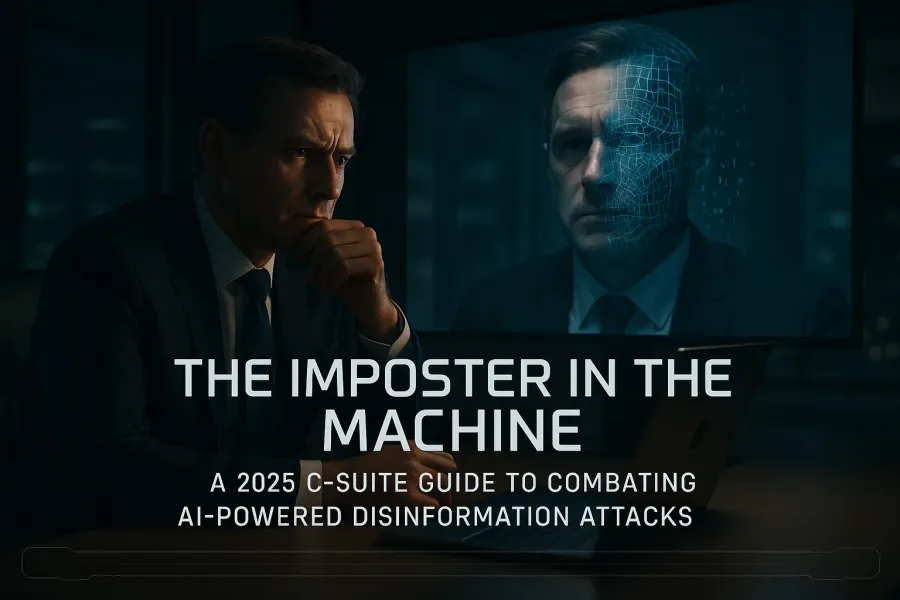
It’s a call you’ve been expecting. The CFO needs an urgent, confidential wire transfer to close a time-sensitive acquisition. Her voice sounds stressed, the details are specific, and the pressure is on. You make the transfer. Only later do you discover you weren’t speaking to your CFO. You were speaking to a machine. An AI-generated voice clone. This isn’t science fiction. Forrester research suggests that over 60% of organizations feel unprepared to detect or respond to a targeted deepfake attack on their leadership. The era of poorly spelled phishing emails is over. We’ve entered the age of the digital imposter, where AI-Powered Disinformation is the sharpest weapon in an attacker’s arsenal.
For leaders, this presents a paralyzing challenge. How can you trust what you see and hear? When the very concept of authenticity is under attack, traditional security models begin to crack. The threat isn’t just about losing money. It’s about stock price manipulation, reputational ruin, and the erosion of trust at every level of your organization. It’s time to build a new defense for this new reality.
The New Playbook: How Attackers Weaponize AI
Threat actors are no longer just crafting clever emails. They are now directors of hyper-realistic digital performances, and your employees are the unsuspecting audience. The primary tool they use is Generative AI, which allows them to create new content—voice, video, text, and images—that is nearly indistinguishable from the real thing.
Here’s what you’re up against:
- Deepfake Vishing (Voice Phishing): With just a few seconds of audio from a public interview or an earnings call, attackers can clone an executive’s voice. They use this to call finance departments, new employees, or executive assistants to authorize fraudulent payments or request sensitive data. The emotional manipulation of a familiar, trusted voice bypasses logical scrutiny.
- Hyper-Realistic Video Attacks: Imagine a video call from your CEO instructing a team to initiate a new project or change a critical password. The video looks perfect. The audio sounds perfect. But it’s a deepfake, synthesized to trick your team. These attacks can be used to sow chaos, steal credentials, or trigger damaging business actions.
- AI-Supercharged Phishing and BEC: Generative AI can now write flawless, context-aware emails that mimic a person’s unique writing style. This elevates Business Email Compromise (BEC) from a nuisance to a critical threat. It’s no surprise that financial losses from BEC attacks, now supercharged by Generative AI, are projected to exceed $15 billion annually. These aren’t just generic requests. They are targeted, personal, and incredibly convincing.
Understanding these techniques is the first step. The second is realizing that your existing defenses, which focus on spotting technical anomalies, are not enough to stop an attack that’s designed to fool a human, not a spam filter.
Beyond the Phishing Quiz: Fortifying Your Human Firewall
Your employees are your first and last line of defense against AI-Powered Disinformation, but their training needs a radical update. Annual click-through training on spotting bad grammar is obsolete. You must inoculate them against manipulation itself.
Here’s how to evolve your security awareness program:
- Run Realistic Drills: Don’t just tell employees about deepfakes. Show them. Work with a security partner like Grab The Axe to create safe, controlled simulations using benign voice clones or video snippets. Let your team experience how convincing this technology is in a training environment. The goal isn’t to trick them. It’s to teach them a healthy skepticism.
- Focus on Verification, Not Detection: Train your employees that it’s no longer their job to be a deepfake detection expert. It’s their job to verify any unusual or high-stakes request through a separate, pre-established channel. This shifts the burden from spotting a perfect fake to following a simple, robust process.
- Establish a Culture of the ‘Safe Challenge’: Employees must feel psychologically safe to question a request, even if it appears to come from the CEO. This means creating a culture where pausing to verify is praised as good judgment, not punished as insubordination. Publicly recognize employees who correctly identify and report simulation attempts.
Security training is no longer a compliance checkbox. It’s an active, continuous-learning process that builds a resilient and vigilant workforce. Analysts predict a 70% increase in sophisticated social engineering attacks using AI by 2025. Your people need the right skills to face that reality.
Building a Digital Fortress: Technical Defenses and Processes
While the human element is critical, you must also harden your technical and procedural defenses. You need to create friction for attackers and safety nets for your employees. The goal is to make it much harder to successfully execute an attack based on AI-Powered Disinformation.
Implement these controls now:
- Multi-Channel Verification: For any sensitive action like a wire transfer, data access request, or system change, require verification through at least two different channels. If the request comes via email, verification must happen via a phone call to a known number or a message on a trusted platform like Teams or Slack. If it comes via a phone call, it needs an email confirmation.
- Verbal Passcodes or ‘Duress Words’: For high-risk teams like finance and HR, establish simple, non-public verbal passcodes. If an executive calls with an urgent financial request, the employee’s first step is to ask for the passcode. If the caller can’t provide it, the conversation ends and is immediately reported.
- Limit Public Data Exposure: Audit the amount of audio and video content featuring your key executives that is publicly available. While you can’t eliminate it, you can be more strategic. Consider what’s necessary for marketing and what creates unnecessary risk. The less raw material you provide attackers, the harder it is for them to build a convincing fake.
- Invest in AI-Powered Detection: New security tools are emerging that use AI to fight AI. These platforms can analyze video for subtle artifacts common in deepfakes or detect anomalies in network traffic associated with these attacks. While not a silver bullet, they add a valuable layer to your technical defenses.
When the Imposter Strikes: Your Disinformation Incident Response Plan
No defense is perfect. You must be prepared to act decisively when a disinformation attack is identified. A slow or chaotic response can be more damaging than the initial attack itself. Your incident response plan needs a dedicated chapter for this specific threat.
Your plan must answer these questions:
- Who is in charge? Designate a core response team including your CISO, CIO, Head of Communications, General Counsel, and Head of HR. Roles and responsibilities must be crystal clear before an incident occurs.
- How do you contain it? The first step is to stop the bleeding. This could mean freezing financial transactions, locking down compromised accounts, or issuing an immediate, all-hands communication to ‘stand down’ on any requests from a specific executive until further notice.
- How do you investigate? You need to quickly determine the scope of the attack. What was the goal? Was it successful? What systems or data were involved? This requires a rapid forensic investigation.
- How do you communicate? Develop a communications strategy for internal and external stakeholders. You need to be transparent to maintain trust, but careful not to release information that could compromise the investigation. Your legal and comms teams are critical here.
- How do you recover and learn? After the immediate threat is neutralized, conduct a thorough post-mortem. What worked? What failed? Use the painful lessons from a real attack to strengthen your defenses for the future.
We are at a technological crossroads. The same AI that promises to drive incredible innovation is also being forged into a powerful weapon. The threat of AI-Powered Disinformation is not a future problem. It’s here now, targeting the trust that holds your business together. But by understanding the attacker’s playbook, fortifying your human firewall, building robust technical and procedural controls, and preparing a clear response plan, you can turn fear into readiness. You can prepare your organization to spot the imposter in the machine.
Don’t let your organization be fooled by a machine. Contact Grab The Axe today for a comprehensive threat assessment and build your defense against AI-driven attacks.

Operating on the philosophy that 'you can't build a secure system if you don't know how to break it,' Chris leads our engineering division. A top 1% National Cyber League competitor, he hardens our digital infrastructure against the very exploits he has mastered.