- › ClickFix shows a fake error or verification prompt that tells the user to open a Run box or terminal, paste a command, and press Enter, which quietly installs malware.
- › The people who fall for it are usually the competent ones. Pasting a command to fix a computer problem is the exact motion IT has taught them their whole careers.
- › Calling that person careless misreads what happened. They followed instructions that looked like every legitimate fix they have ever done, while rushed and trying to get back to work.
- › The technique is spreading because it is cheap, rentable, and slips past antivirus and endpoint detection, since the human runs the command, not the malware.
- › The fix is upstream of the person: remove the ability to paste and run for most users, make verifying before running the normal thing, and stop designing workdays that reward the shortcut.
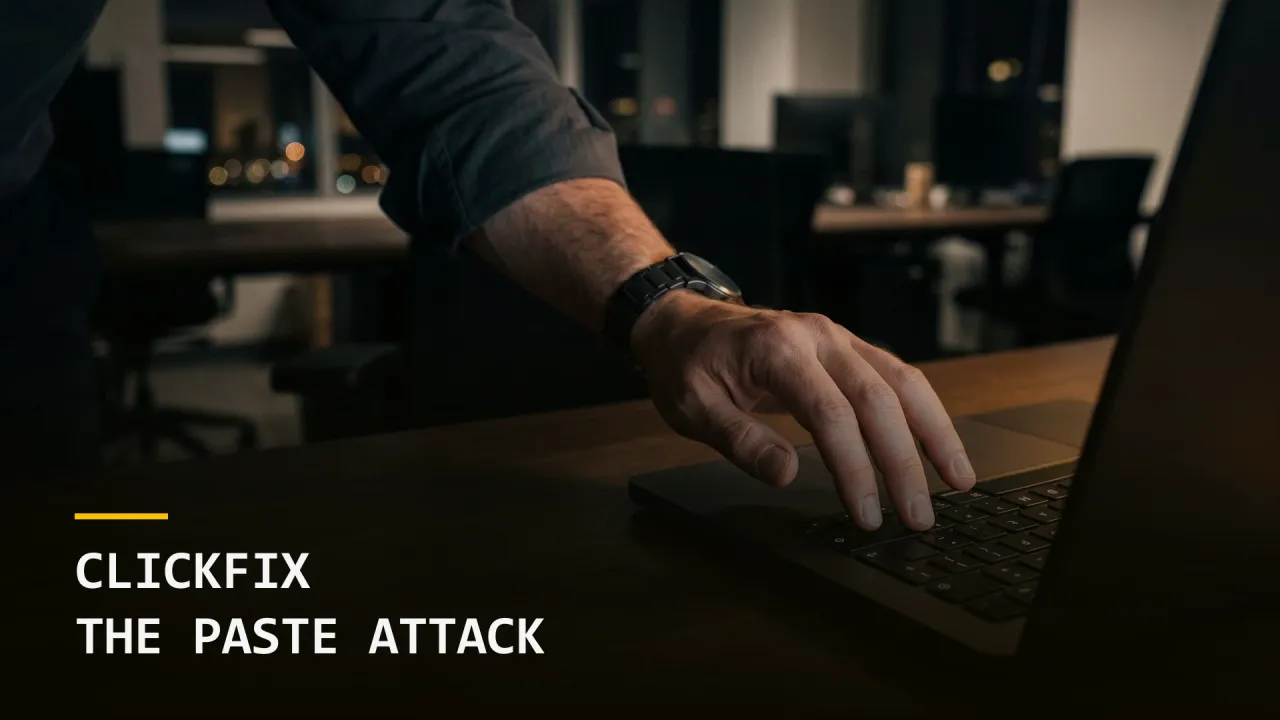
Picture the last hour of someone’s Tuesday. A document will not open, or a site throws up a box that says “Verification failed, complete this step to continue.” The box is calm and official-looking. It says to press the Windows key and R, paste the text it helpfully copied to your clipboard, and hit Enter. So she does. The window flickers, the page loads, and she goes back to work never knowing she just installed the thing the whole security program was built to keep out.
That is ClickFix, and by the time the alert fires, the incident report will already have a name for her. The careless one. The weakest link. The user who should have known better. I want to sit with that person for a minute, because the story security tells about her is wrong, and the wrong story is why this keeps working.
What ClickFix Actually Does
The mechanics are almost insultingly simple. The attacker puts up a fake error, a fake CAPTCHA, a fake “your browser needs to update” prompt, and instead of a malicious download, it gives the user instructions. Open the Run box or the terminal. Paste this. Press Enter. The command it tells you to paste pulls down and runs the real payload. The person does the dangerous part with their own hands.
That last detail is why it is spreading. When the human types the command, there is no suspicious attachment for the mail filter to catch and often nothing for antivirus or endpoint detection to flag until the payload is already running. The technique is cheap, it is now rented out at scale as a service, and it slips past the tools most organizations spent their budget on. Security teams are being told they need new detection tactics, and they do. They also need to look at the part everyone keeps skipping, which is the person, and why a capable one goes along with it.
The People Who Fall for It Are the Competent Ones
Here is the part that surprises people who have not watched this up close. ClickFix does not primarily catch the oblivious. It catches the people who are good at their jobs.
Think about what it actually asks. It asks someone to fix a technical problem by opening a system tool and running a command. Now think about where that person learned that motion. They learned it from IT. Every remote support session where a technician said “press Windows R and type this,” every internal wiki with a copy-this-command fix, every time the help desk pasted a one-liner into chat and said “run this, it’ll sort it out.” We spent years teaching people that pasting a command to fix a computer is normal, competent, get-back-to-work behavior. Then an attacker borrowed the exact script, and we act shocked that it worked.
The employee who pasted the command was being resourceful. She hit a wall, an official-looking box offered the same kind of fix she had done a dozen times before, and she took it so she could get back to the actual work she was behind on. She did the competent thing in a situation engineered to make the competent thing dangerous. Calling her the weakest link tells you nothing true about her, and it tells you a lot about how comfortable the organization is blaming a person instead of looking at what set her up.
Blaming the User Is Misdiagnosing the System
This is the pattern I keep running into, in security and everywhere else people study why humans do what they do at work. An organization looks at a behavior it does not like, decides the problem is the character of the person who did it, and closes the case. The problem was a person. The solution is more training, a sterner email, a note in the file. Nothing upstream changes, and six weeks later someone else pastes the command.
What that org just did is take a systems problem and put it in a people costume. The behavior was produced by the environment. The user was rushed because the workload made rushing the only way to keep up. She trusted the prompt because nothing in her day had ever taught her to distrust a fix that looked routine. She had no fast, obvious way to check whether the box was real, so she made the call people always make under time pressure, which is to keep moving. Every one of those is a condition the organization created or tolerated, and none of them is a flaw in her.
When you watch what actually drives behavior on the ground, the gap between the policy on paper and the reality of the day is almost always where the risk lives. The policy said “never run commands from untrusted sources.” The reality said “run commands to fix things, quickly, because you are behind and that is what fixing looks like.” People follow the reality, every time, because the reality is what they are standing in.
Behavior Is Designed, So Design It
The good news in a systems diagnosis is that a system is something you can change, and you do not have to change a single human being’s character to do it. You just have to stop leaving the behavior to chance.
Take the dangerous capability away from the people who never need it. Most employees have no business running arbitrary commands in a Run box or a terminal, and the ones who do are a small, known group. Restrict the ability to paste and execute for standard users. If someone cannot run the command the fake prompt is begging for, the entire attack collapses at the step it depends on. This is the single highest-return move, and it is a configuration change, not a behavior-change campaign.
Make “verify before you run” the normal, expected thing. The reason ClickFix works is that following a fix-it instruction feels routine and questioning it feels like being difficult. Flip which one is normal. When IT itself models slowing down, when the help desk says “here is how you know this request really came from us,” when checking is framed as competent rather than paranoid, you change the default the person reaches for under pressure. Culture is just the behavior an organization has quietly made normal, and you can make a different one normal on purpose.
Give people a real and fast way to check. A person will not stop to verify if verifying is slow, humiliating, or unclear. Most will not open a ticket and wait twenty minutes to ask whether a prompt is legitimate while a deadline burns. Build a check that takes ten seconds and does not make anyone feel stupid for using it, a channel, a known-good internal page, a person who is genuinely glad to be asked. If checking is harder than complying, people will comply, and that is a design decision you made, not a moral failing they have.
Look hard at the rush. Nearly every one of these stories has a tired, behind, over-loaded person at the center of it, taking the shortcut because the shortcut was the only way through the day. You will not train your way out of that. When people are chronically stretched, they invent shortcuts, and the shortcuts route straight around your controls. If your environment runs everyone at the edge, you have built a place where ClickFix works, and no amount of awareness posters will fix a workload problem.
Retire the theater. The annual click-through module and the canned phishing test that exists to generate a scary number do not change what someone does at 4:45 on a Tuesday. They generate a screenshot for the auditor. If you want different behavior, invest in the small share of training that actually changes it, the kind built by someone who was paying attention to how people really work, and stop pretending the checkbox was the point.
The Person Was the Most Predictable Part
I keep coming back to her, the employee at the end of her Tuesday, because everything about what she did was predictable. Rushed person, official-looking fix, familiar motion, no easy way to check, a culture that rewarded speed and had never once rewarded suspicion. Run that setup a thousand times and a meaningful number of capable people paste the command. That is not a mystery about human weakness. It is a system behaving exactly as it was built to behave.
ClickFix is going to keep spreading because it is cheap and it works, and it works because it targets the most human thing in the building, the impulse to fix the problem and get back to the job. You can meet that with contempt for your own people, or you can meet it by designing an environment where the competent instinct is also the safe one. One of those actually lowers your risk. The other just gives you someone to blame after.
Curious how much of your risk is riding on the shortcuts your own workflows reward? Start with our free Human Attack Surface Score, or read our companion piece on blameless reporting and how punishment quietly teaches people to hide the very things you need to see. When you are ready to build the culture instead of blaming the people in it, contact Grab The Axe.

With a dual background in I/O Psychology (PhD Candidate) and Business Management (MBA), Marie bridges the gap between clinical rigor and operational strategy. She oversees B2B relations, compliance, and the 'business' of risk management.
View Author Page →