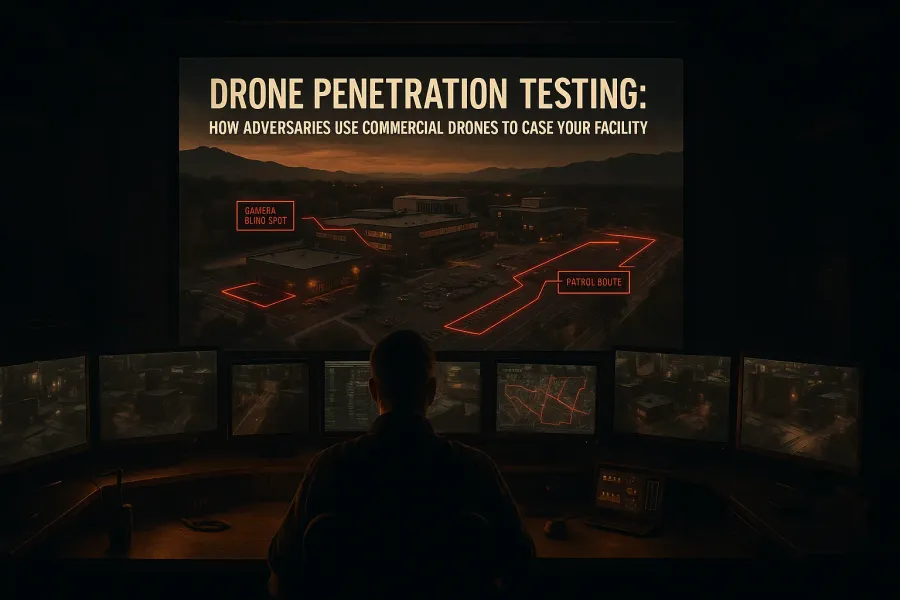
Your ten-foot fence and state-of-the-art cameras are designed to stop threats on the ground. That makes sense. For decades, that’s where the threats came from. But what about the threat that’s 200 feet up, costs less than a thousand dollars, and can see every inch of your property with perfect clarity? An attacker with a commercial drone doesn’t care about your perimeter. They fly over it.
Most physical security managers I talk to are still thinking in two dimensions. They focus on doors, gates, and guards. That’s a dangerous blind spot. Inexpensive, commercially available drones have completely changed the game for physical reconnaissance and even network intrusion. We’re not talking about military-grade hardware. We’re talking about devices you can buy online today that give an adversary an unprecedented advantage. It’s time to start thinking in three dimensions, because the people trying to get into your facility already are.
What a Sub-$1000 Drone Sees That You Don’t
The first mistake is underestimating the capability packed into a small, consumer-grade drone. These aren’t just toys. High-resolution 4K cameras and thermal imaging sensors are now standard on many models. This gives an attacker a powerful surveillance platform they can deploy from a half-mile away, completely out of sight.
Think about what that means for your facility. An adversary can use a drone to conduct a complete survey of a 50-acre facility in under 30 minutes. In that short flight, they can map every camera location and, more importantly, every camera’s blind spot. They can track your security patrol patterns and schedules, identifying the exact window of opportunity to make a move. They can inspect rooftops for unsecured access points like skylights or maintenance hatches that you assume are safe because they are out of reach from the ground.
Thermal cameras add another layer. An attacker can use them to see heat signatures through walls to locate server rooms, identify occupancy in different parts of a building, or even spot weaknesses in your HVAC system that could be used for access. Your fence is irrelevant. Your motion sensors are useless. From the air, your carefully planned ground-level defenses become a predictable map for an adversary to navigate.
More Than Just a Flying Camera: Drones as a Network Attack Platform
If you think the threat is limited to surveillance, you’re missing the second, more critical half of the problem. Drones are not just for looking. They are for getting close. An attacker can use a drone as a delivery vehicle for a variety of digital attacks, bypassing your network firewall by simply flying over it.
How does this work in the real world? An attacker can attach a small, powerful device like a Flipper Zero or a Wi-Fi Pineapple to a drone. They can then fly that drone right up to a third-story window and park it there. From this vantage point, they are now within range of your corporate Wi-Fi network. They can conduct a whole range of attacks: Wi-Fi sniffing to capture unencrypted data, running de-authentication attacks to force employees to connect to a rogue access point, and harvesting credentials.
They can even use a drone to physically drop a rogue device onto a flat roof near an office. This device, powered by a small battery, can then provide the attacker with persistent remote access to your network. The attacker never has to set foot on your property. They execute the entire operation from a car parked down the street, retrieve their drone, and are gone before your SOC even registers an anomaly. This is the definition of converged security. It’s a physical intrusion that enables a digital attack, and it’s a tactic that traditional security plans are completely unprepared for.
The Anatomy of a Drone Penetration Test
So how do you defend against a threat you can’t see coming? You have to see it first. A drone penetration test is a controlled, ethical simulation of the exact tactics an adversary would use. It’s not about just flying a drone around. It’s a structured assessment designed to identify and remediate these specific aerial vulnerabilities.
A proper drone penetration test has three clear phases.
First is passive reconnaissance. Our team acts just like an attacker. We identify potential launch points off-property and conduct initial flights to map your facility’s layout from the air. We document camera placements, fence lines, and patrol routes, building the same intelligence picture an adversary would.
Second is active testing. This is where we probe for weaknesses. We’ll fly specific patterns to test the blind spots of your existing camera coverage. We’ll simulate network attacks by flying a payload near your building to determine how close we can get and what networks are visible. We’ll also test your human response. Does anyone see the drone? If they do, what’s the procedure? Who do they call? How long does it take for a response to be initiated? Most organizations find their response plan for an unidentified aerial vehicle is non-existent.
Third is remediation and reporting. The goal isn’t just to show you the gaps. It’s to give you a practical, no-nonsense plan to fix them. The findings from a drone penetration test lead to tangible countermeasures. This might include repositioning cameras to cover aerial approaches, implementing a drone detection system that uses radio frequency analysis, or simply updating your standard operating procedures so your guard force knows exactly what to do when a drone is spotted. Sometimes the fix is as simple as adding new blinds to executive-level windows: The key is you won’t know what to fix until you’ve looked at your facility from an attacker’s point of view.
The threat from drones isn’t science fiction. It’s happening now, and the technology is only getting cheaper and more powerful. Waiting until a drone-assisted breach occurs is a critical mistake. You need to understand how your organization looks from the air and what an attacker can accomplish with a few hundred dollars and a clear line of sight. It’s a new dimension of security, and it requires a new dimension of thinking.
You can’t defend against a threat you don’t understand. Discover your aerial vulnerabilities before an attacker does. Let’s talk about a drone penetration test.

A leader defined by a 'bias for action,' Dusten specializes in physical security assessments that impact profitability. He leverages high-logic strategies to pinpoint high-ROI vulnerabilities, ensuring defense measures actually scale with the business.