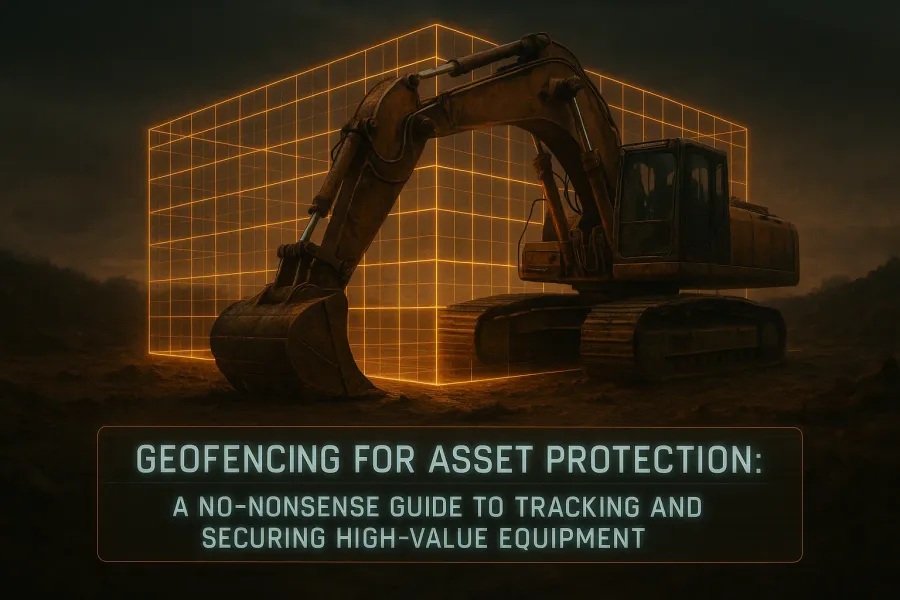
Your excavator is worth a quarter-million dollars. Do you know exactly where it is right now? Or is it just ‘somewhere on the 50-acre job site’? For any business managing high-value mobile equipment, from construction machinery to delivery fleets, that uncertainty is a serious liability. The days of relying on sign-out sheets and visual checks are over. In today’s fast-paced environment, losing track of expensive assets isn’t just an inconvenience; it’s a direct hit to your bottom line, leading to project delays, replacement costs, and inflated insurance premiums. This is where geofencing for asset protection moves from a ‘nice-to-have’ technology to an operational necessity.
It’s about taking control. It’s about drawing a line in the sand, digitally, and getting an immediate alert the second a critical piece of equipment crosses it without approval. This isn’t science fiction. It’s a practical, accessible tool that can drastically cut your losses and streamline your operations.
How Geofencing Actually Works for Asset Tracking
Let’s cut through the jargon. At its core, geofencing uses GPS technology to create a virtual perimeter around a real-world geographical area. Think of it as an invisible fence for your most important assets. The system is made of three simple parts: the asset, the boundary, and the alert.
First, a small, durable GPS tracking device is attached to your equipment, whether it’s a bulldozer, a generator, or a delivery truck. This device constantly communicates its location. Second, you use a software platform, accessible from a computer or smartphone, to draw a virtual boundary, the geofence, on a map. This could be the perimeter of a construction site, a specific delivery route, or the boundary of your storage yard. Third, you set the rules. If the asset enters or, more importantly, leaves that defined area, the system automatically triggers an action. This action is usually an instant alert sent via text message, email, or a push notification to you or your security team.
It’s that straightforward. An asset crosses a line you drew on a map, and you know about it immediately. This isn’t just about theft prevention. You can set time-based rules, too. For example, you can create a geofence around a job site and receive an alert if a vehicle is started or moved after 6:00 PM or on a weekend. This is how you stop unauthorized use, which reduces wear-and-tear and fuel consumption. In fact, companies that implement this technology often report up to a 30% reduction in fuel costs simply by eliminating unapproved trips and optimizing routes.
Choosing and Implementing Your Geofencing Solution
Getting started with geofencing for asset protection requires a clear plan. Not all solutions are created equal, and the right choice depends entirely on your specific needs. Here are the key things to consider before you invest.
First, look at the hardware. For assets on a rugged construction site, you need trackers that are waterproof, dustproof, and can withstand heavy vibrations and extreme temperatures. A tracker designed for a package in a warehouse won’t last long on the arm of an excavator. Battery life is another critical factor. Some devices can be hardwired into a vehicle’s power source, while others rely on long-life batteries that may need to be replaced or recharged periodically.
Next is the software. Is the platform intuitive and easy to use? The best system in the world is useless if your team finds it too complex to manage. Look for a clean interface that allows you to easily draw and adjust geofences, set up custom alerts, and run reports. You should be able to see the status of all your assets at a glance, on one screen. The global market for GPS tracking is exploding, projected to hit over $4.9 billion by 2026, so you have plenty of options. Choose a provider with a proven track record.
Finally, think about integration and scalability. Your business is going to grow, and your security solution should grow with it. Can the geofencing system you choose handle an expanding fleet of assets? More importantly, can it integrate with other security and management systems you already use? This is where the real power of the technology is unlocked.
Beyond Location: Integrating Geofencing for Automated Security
Simple location tracking is useful, but true geofencing for asset protection is about automated response. When your geofencing system is integrated with other technologies, it becomes a proactive security measure, not just a reactive one. This is how you move from merely knowing an asset was stolen to actively preventing the theft or recovering it in record time.
Imagine an excavator is moved outside its designated geofence at 2:00 AM. The system doesn’t just send you a text. It can be configured to automatically trigger a sequence of events. The system could instantly activate a loud, on-site siren and flashing lights. It could send a signal to a video surveillance system to immediately turn the nearest camera to the asset and begin recording. For vehicles, an integrated system can even send a command to an engine immobilizer, safely disabling the engine once the vehicle comes to a stop and preventing a restart.
This level of automation is a game-changer for asset recovery. Instead of finding out about a theft hours later, you are alerted in seconds. This speed is critical. Data shows that automated geofence alerts can slash asset recovery time by over 50%. You’re giving law enforcement a real-time location and a head start, dramatically increasing the chances of getting your property back before it’s gone for good. This integration transforms geofencing from a passive monitoring tool into an active, automated guard for your most valuable equipment.
Geofencing is more than just dots on a map; it’s a powerful command and control system for your physical assets. By creating smart boundaries, you not only protect against theft but also gain invaluable oversight into how your equipment is being used, improving both security and operational efficiency. The technology is here, it’s accessible, and it’s effective. As asset tracking technology evolves, we’ll likely see more predictive capabilities, using AI to flag anomalous movement patterns before a geofence is even breached. But for now, the direct, rules-based control it offers is one of the most practical and impactful security investments a business can make.
Stop guessing where your assets are. Read our guide to implementing a geofencing strategy that protects your bottom line.

A leader defined by a 'bias for action,' Dusten specializes in physical security assessments that impact profitability. He leverages high-logic strategies to pinpoint high-ROI vulnerabilities, ensuring defense measures actually scale with the business.