Police Drone Programs Spread Nationwide & the EU AI Act Slips to 2027 (07/24/2026)
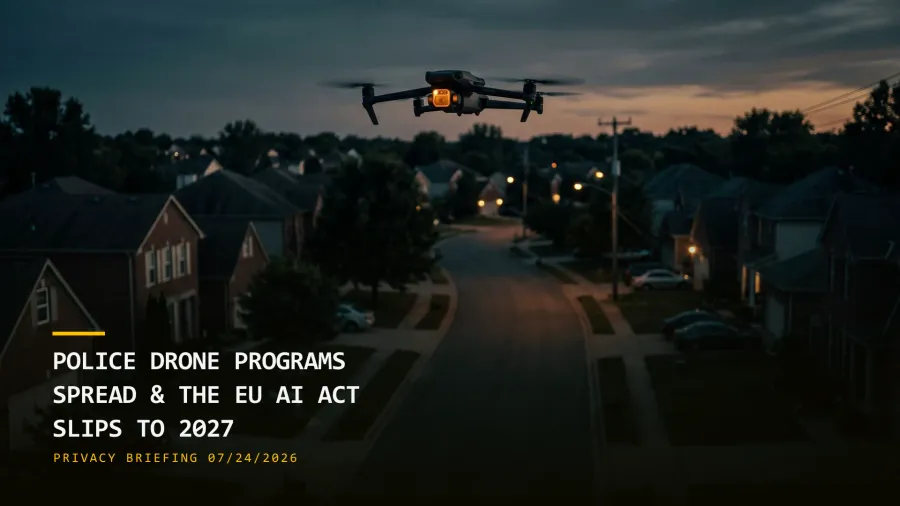
- › Hundreds of police departments have cleared a key hurdle toward launching drone-as-first-responder programs, expanding routine aerial surveillance into areas patrol officers rarely reach.
- › The EU's Digital Omnibus pushed back the AI Act's high-risk workplace rules from August 2026 to December 2, 2027.
- › The European Commission published new guidelines and a code of practice on transparency for AI-generated content ahead of the AI Act's transparency obligations.
- › Madison Square Garden's face-recognition cameras were briefly switched off for Taylor Swift, highlighting who controls a system marketed as security.
- › A US immigration final rule replacing duration-of-status with fixed admission periods adds tracking obligations that ripple into employer compliance.
Surveillance keeps expanding into places it could not reach before, and the rules meant to govern it keep moving. Police drones are lining up to become a routine presence overhead. Europe pushed its workplace AI rules two years down the road. And a face-recognition system sold as public safety went dark for one famous guest, which tells you who the switch really answers to.
Top 5 Critical Privacy Alerts
1. Drone-as-First-Responder Programs Spread Across the Country
Police departments nationwide are lining up to launch drone-as-first-responder (DFR) programs, and hundreds have cleared a key regulatory hurdle toward deployment, expanding aerial surveillance and data collection into areas patrol officers typically cannot reach (EFF). A drone dispatched to every call becomes a camera over neighborhoods that were never previously under routine watch, and the footage it collects is a new pool of data that has to be retained, governed, and protected somewhere.
Operator Note: If your facility sits under a jurisdiction rolling out DFR, assume the airspace over your property is now recorded during any nearby incident. Add overhead surveillance to your physical security and privacy assessments, and know your local retention and access rules for that footage.
2. The EU AI Act’s Workplace Rules Slip to December 2027
The EU’s Digital Omnibus pushed back key AI Act provisions, moving the high-risk workplace rules from August 2, 2026, to December 2, 2027 (Global Privacy Watch, Data Protection Report). A delay reads like relief, and the smarter reading is runway, because the obligations for AI in hiring and monitoring are still coming and the organizations that use the extra time to build governance will not be scrambling in 2027.
3. The EC Publishes GenAI Transparency Guidance
The European Commission published new guidelines on the transparency of AI-generated content, complementing the code of practice it released in June, weeks before the AI Act’s transparency obligations take effect (Alston & Bird). Labeling AI-generated content is becoming a legal expectation with a deadline attached, and any organization producing synthetic media at scale should read where the lines are being drawn now.
4. MSG’s Face-Recognition Cameras Went Dark for One Guest
Madison Square Garden’s face-recognition and surveillance system, which its owner has called central to making the venue secure, was briefly switched off on the night of July 2 for Taylor Swift (PogoWasRight). A system marketed as neutral public safety that can be turned off for a favored guest is a system whose real purpose is whatever its operator decides on a given night, and that discretion is the part the public never gets to audit.
5. A US Visa Rule Adds Fixed Admission Periods
US immigration authorities finalized a rule, effective September 15, 2026, replacing the longstanding duration-of-status framework for F-1 students, J-1 exchange visitors, and I media representatives with fixed admission periods and new extension requirements (JD Supra). Tracking obligations like these turn into data-handling obligations for the universities and employers that host these individuals, because someone has to hold and act on the new status records.
Additional Privacy Alerts
Surveillance & Oversight
- Be Skeptical of the Rogue-Agent Narrative: A Guardian commentary argues that the story of OpenAI’s models autonomously hacking a third party deserves a harder look before it becomes the accepted account. The Guardian
The Axe Report is a daily briefing from Grab The Axe. Need help assessing your organization’s security posture? Take our free Human Attack Surface Score assessment.

A PhD candidate in Health Psychology and former Corrections Officer, Jeff founded GTA to dismantle passive security models. He focuses on the 'Human Zero-Day', mitigating executive burnout and decision fatigue before they become security breaches.
View Profile →Media Inquiries
For expert commentary, interview requests, or high-res assets regarding this announcement, initialize the terminal.


)