Facial Recognition Reaches the Underground, California Fines a Broker (08/11/2026)
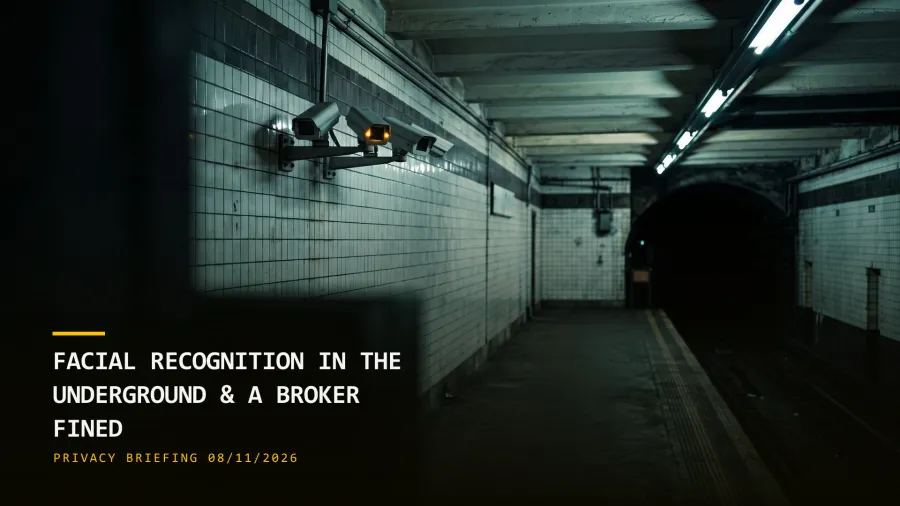
- › British Transport Police began live facial recognition deployments in London Underground stations, starting at Victoria and rotating between locations.
- › California's privacy agency fined data broker LocateSmarter LLC $116,490 for making opt-out difficult, its first penalty of a broker under the state law.
- › Illinois expanded its Genetic Information Privacy Act to cover biomarker testing, widening what counts as protected genetic data.
- › Texas is testing enforcement of its age assurance law against internet infrastructure rather than against the sites themselves.
- › New roadside technology fingerprints the Bluetooth and Wi-Fi signals of passing devices and ties them to the vehicle's plate.
Live facial recognition arrived in the London Underground today, starting at Victoria and rotating between stations. Everyone who walks through gets their face measured against a list. Nobody consented, and nobody can decline and still get to work. Meanwhile California issued the first fine of a data broker under its privacy law, and the amount is worth reading carefully.
Top 5 Critical Privacy Alerts
1. Live Facial Recognition Comes to the Underground
British Transport Police extended their live facial recognition trial into London Underground stations, with the first deployment beginning at Victoria and further deployments rotating between Underground and rail sites. Biometric Update
Operator Note: A transit system is the one place a person genuinely cannot route around. You can decline a shop that scans faces. You cannot decline the commute that pays your rent. Deploying this where refusal costs someone their job removes consent from the equation and calls the result acceptance.
2. California Fines a Data Broker $116,490
California’s privacy agency penalized LocateSmarter LLC for making it difficult for people to opt out of the sale of their personal information, the agency’s first fine of a data broker under the state privacy law. PogoWasRight
Operator Note: Read the number rather than the milestone. $116,490 against a business whose entire product is the friction they just got fined for. If the penalty is smaller than the revenue the behavior generates, it is a cost of doing business, and the brokers will price it that way until it isn’t.
3. Illinois Extends Genetic Privacy to Biomarkers
The Illinois governor signed SB 2886, expanding the state’s Genetic Information Privacy Act to cover biomarker testing and biomarkers. The Act already regulates the collection, use, and disclosure of genetic information. Inside Privacy
Operator Note: Illinois is the state where a private right of action turned biometric law into real liability. Any expansion of what counts as protected there is worth reading closely, because the enforcement pattern follows the definition.
4. Texas Goes After the Infrastructure Instead of the Sites
The Texas attorney general is testing enforcement of the state’s age assurance law against internet infrastructure providers rather than against noncompliant sites directly. Biometric Update
Operator Note: Pushing enforcement down to infrastructure means the party making the blocking decision has no relationship with the user and no stake in getting it right. That is how over-blocking becomes the safe default.
5. Roadside Cameras Start Reading the Devices in the Car
New technology attaches to automated license plate readers and captures the Bluetooth, Wi-Fi, and radio signals broadcast by devices in passing vehicles, converting them into identifiers tied to the plate. Ars Technica
Operator Note: This is today’s article. Leaving the phone at home was the last piece of practical advice that still worked, and it stops working when your watch, your earbuds, and the car itself are all broadcasting. We take it apart in your license plate is now a key to every device you carry.
The Axe Report is a daily briefing from Grab The Axe. Need help assessing your organization’s security posture? Take our free Human Attack Surface Score assessment.

A PhD candidate in Health Psychology and former Corrections Officer, Jeff founded GTA to dismantle passive security models. He focuses on the 'Human Zero-Day', mitigating executive burnout and decision fatigue before they become security breaches.
View Profile →Media Inquiries
For expert commentary, interview requests, or high-res assets regarding this announcement, initialize the terminal.



)