Flock Kills Audio Surveillance, Adversarial Clothing & the Delete Act (07/17/2026)
- › Flock ended its pilot to detect signs of human distress through its acoustic sensors, after pressure over listening for voices, not just gunshots.
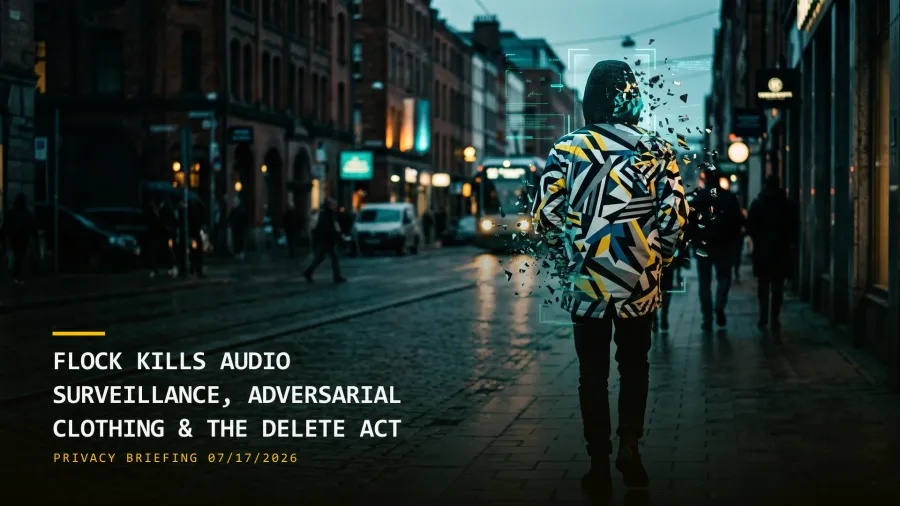
- › Designers are selling adversarial clothing built to confuse facial recognition, turning privacy into a fashion statement as the tech spreads across Britain.
- › California's Delete Act platform goes live August 1, requiring data brokers to check for and honor consumer deletion requests every 45 days.
- › New Jersey enacted a data broker law that is effective immediately, making it the seventh state to regulate the industry.
- › The EU ordered Google to give rival AI assistants the same access to an Android phone's camera, microphone, and screen that Gemini already has.
Flock built a microphone network to hear gunshots, then quietly started teaching it to listen for human distress, which is the moment a safety tool becomes a surveillance one. Public pressure stopped it this week, and that is the good news. The rest of today’s stories are about the same tension: people sewing garments to blind facial recognition, California forcing data brokers to actually delete you, and the EU deciding who gets to reach through your phone’s camera. The through-line is consent, and who is asked for it.
Top 5 Critical Privacy Alerts
1. Flock Ends Its Human-Voice Distress Detection Pilot
Flock Safety, the vendor best known for its license plate reader network, ended a pilot that would have used its acoustic gunshot sensors to detect signs of human distress (EFF). A device sold to hear gunfire was being retuned to interpret human voices, and that is the whole pattern of surveillance creep in one product: the hardware gets installed for the narrow reason nobody argues with, then the software quietly widens what it listens for.
Operator Note: Watch the sensor’s software, not its brochure. The camera or microphone you approved for one purpose is one update away from a broader one, and the update rarely comes with a new consent conversation.
2. Adversarial Clothing Goes After Facial Recognition
Designers are bringing adversarial clothing to market, garments patterned to confuse facial recognition systems, as the technology rolls out across Britain (The Guardian). When people start wearing camouflage against cameras in daily life, that is a signal worth reading. It says the public has noticed the watching and decided the burden of opting out now falls on them, stitched into what they wear.
3. California’s Data Broker Deletion Platform Goes Live August 1
Beginning August 1, California’s Delete Request and Opt-Out Platform requires data brokers to check the system at least every 45 days and process the consumer deletion requests they find (Alston & Bird). For years, deleting yourself from the data broker economy meant filing the same request hundreds of times, one broker at a time. One request that reaches all of them is the first version of this that respects the person’s time instead of the industry’s.
4. New Jersey Enacts a Data Broker Law, Effective Immediately
On June 30, Governor Sherrill signed New Jersey’s data broker law, making the state the seventh to regulate the industry, and it took effect on signing (JD Supra). Seven states now means a broker cannot pretend the person on the other end of the file has no rights, and the immediate effective date removes the usual grace period the industry uses to keep selling while it prepares.
5. EU Orders Google to Open Android Sensors to Rival AI
The European Commission ordered Google to give rival AI assistants the same reach into Android that Gemini has: the camera, the microphone, whatever is on screen, a wake word that fires with the display off, and the ability to drive other apps by imitating taps (The Hacker News). This is aimed at competition, and it is worth sitting with what it grants. The remedy for one company’s deep access to your phone is to hand that same depth of access to several more.
Operator Note: More competition among AI assistants is not the same as more privacy. Every assistant you let reach the camera, microphone, and screen is another party watching from inside the device, and the count going up is not automatically good for the person holding the phone.
Additional Privacy Alerts
Data Minimization & User Consent
- Thousands of Google Workers Petition Over AI Layoffs: More than 4,500 Google employees signed a petition to CEO Sundar Pichai demanding layoff protections and buyout options as the company reshapes around AI. The Guardian
Privacy-Enhancing Technologies
- New York Bans AI Glasses in State Courthouses: New York became the first state to prohibit AI-enabled smart glasses and other recording-capable eyewear in all state courthouses, citing how discreetly the devices capture audio, video, and images. JD Supra
The Axe Report is a daily briefing from Grab The Axe. Need help assessing your organization’s security posture? Take our free Human Attack Surface Score assessment.

A PhD candidate in Health Psychology and former Corrections Officer, Jeff founded GTA to dismantle passive security models. He focuses on the 'Human Zero-Day', mitigating executive burnout and decision fatigue before they become security breaches.
View Profile →Media Inquiries
For expert commentary, interview requests, or high-res assets regarding this announcement, initialize the terminal.



)