ICE Took a Million DNA Samples, 20 States Sue Over Benefits Data (08/06/2026)
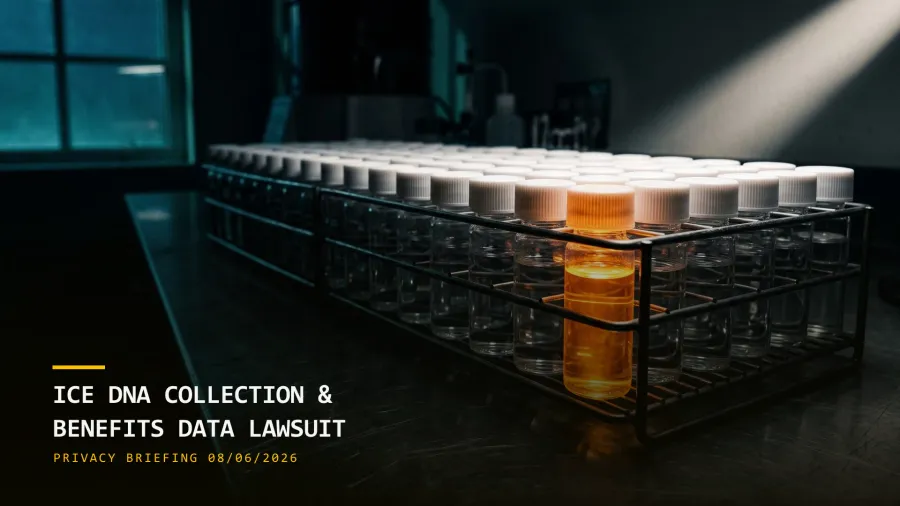
- › Immigration and Customs Enforcement collected close to a million DNA profiles in a single year, including samples from young children.
- › The Legal Defense Fund filed an amicus brief challenging the NYPD's practice of covertly taking DNA, in a case involving a woman's discarded water cup.
- › More than 20 states and the District of Columbia sued to block wide federal access to the personal records of low-income benefits recipients.
- › A federal court in the Eastern District of New York signaled that warrant applications filed long after a phone was seized will be denied.
- › Adversarial clothing marketed to defeat facial recognition is mostly theater, and buying it can substitute for the protections that actually work.
A DNA sample is the one identifier a person cannot rotate, reissue, or revoke. It also identifies their relatives, who never encountered the system at all. Today’s stories are about how much of it is being collected, how quietly, and from whom. The pattern underneath them is that the collection decision and the consequence land on different people.
Top 5 Critical Privacy Alerts
1. ICE Collected Close to a Million DNA Profiles in a Year
Reporting by Dhruv Mehrotra details Immigration and Customs Enforcement collecting nearly a million people’s DNA over the past year, including samples taken from young children. The account opens with a man arriving for a routine probation check-in in Waco, Texas, and finding ICE officers waiting. PogoWasRight
Operator Note: Genetic data does not expire and it implicates people who were never present. A database built this year describes the siblings and children of everyone in it for the rest of their lives, which is a scale of consequence no consent form in this process ever described.
2. The NYPD Took a Woman’s DNA From a Water Cup
The Legal Defense Fund filed an amicus brief on July 31 in Leslie v. City of New York, challenging the NYPD’s practice of covertly collecting DNA. Shakira Leslie, a Black woman, had her DNA taken from a water cup she used while handcuffed. PogoWasRight
Operator Note: Handing someone water while they are restrained is an act of basic decency, and it was also the collection method. When a routine kindness doubles as evidence gathering, the next person in that chair declines the cup, and every officer after this one works with a little less cooperation.
3. Twenty States Sue Over Access to Benefits Recipients’ Records
More than 20 states and the District of Columbia sued the federal administration to block wide access to the personal information of millions of recipients of a benefits program for low-income families, with the data going to immigration authorities. PogoWasRight
Operator Note: This is the purpose limitation question with the argument stripped out. People handed over records to receive food assistance. If that data can move to enforcement, the honest thing to tell the next applicant is that applying is a disclosure decision, and nobody is telling them that.
4. A Court Says a Two-Month-Old Phone Warrant Comes Too Late
A decision from the Eastern District of New York denied a warrant to search two cell phones the government had held for more than two months after the window on a prior warrant lapsed. Courts are signaling that indefinite retention of a seized device pending a fresh application will not be approved. PogoWasRight
5. Adversarial Clothing Is Mostly Theater
Several companies now sell clothing patterned to confuse facial recognition. Bruce Schneier’s read is that most of it is security theater, and the concern worth taking seriously is what it displaces. Schneier on Security
Operator Note: A person who buys the jacket believes they have solved the problem and stops asking for the policy change that would actually solve it. Selling comfort as protection is its own harm, and the same logic applies to any control in your program that exists mainly to make somebody feel handled.
The Axe Report is a daily briefing from Grab The Axe. Need help assessing your organization’s security posture? Take our free Human Attack Surface Score assessment.

A PhD candidate in Health Psychology and former Corrections Officer, Jeff founded GTA to dismantle passive security models. He focuses on the 'Human Zero-Day', mitigating executive burnout and decision fatigue before they become security breaches.
View Profile →Media Inquiries
For expert commentary, interview requests, or high-res assets regarding this announcement, initialize the terminal.



)