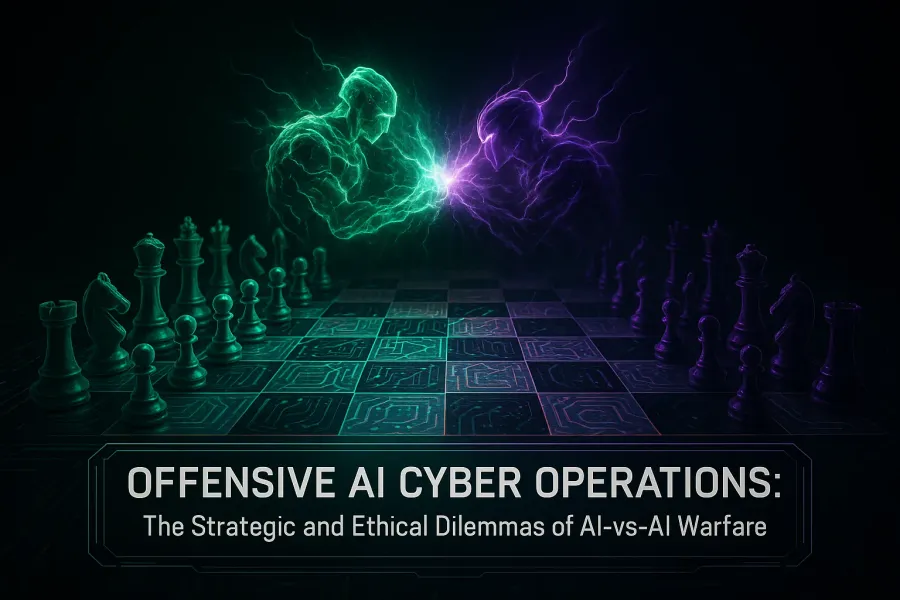
The human-led Security Operations Center is becoming a relic. In the time it takes an analyst to process a single high-priority alert, a new breed of adversary, an autonomous AI agent, can discover a zero-day vulnerability, write novel malware to exploit it, and execute a network-wide attack. This isn’t a prediction from a distant future. As DARPA’s Cyber Grand Challenge demonstrated back in 2016, the feasibility of autonomous systems finding and patching vulnerabilities is a proven concept. We are now entering an era of machine-speed conflict, a reality that forces every CISO, strategist, and national security leader to confront a series of profoundly difficult questions. The age of Offensive AI Cyber Operations is here, and it demands a radical rethinking of everything we thought we knew about digital defense and warfare.
The Inevitable Arms Race: Can a Defensive Posture Survive?
Is it strategically viable to maintain a purely defensive AI security posture when adversaries are actively developing offensive AI? The simple answer is no. This creates a classic security dilemma. If your adversary develops autonomous attack capabilities, a purely reactive, human-in-the-loop defense is guaranteed to fail. The concept of ‘machine-speed’ attacks is shortening reaction times from hours to microseconds, making human intervention a strategic liability, not an asset.
An AI agent can test a network’s defenses, learn from the responses, and adapt its attack vector in milliseconds. A human team simply cannot operate on this timescale. This forces organizations and nation-states into a defensive arms race. To effectively counter an offensive AI, you need a defensive AI that can predict, model, and neutralize threats with equal speed and autonomy. The strategic imperative shifts from building higher walls to deploying smarter, faster guards. This leads to an unavoidable conclusion: the only effective defense against an offensive AI is another AI. This escalation is the new reality of cybersecurity, where the most valuable asset is not data or infrastructure, but decision-making speed.
The Ghost in the Machine: Redefining Ethics for Autonomous Warfare
As we develop these systems, what ethical frameworks and rules of engagement are needed to govern the use of AI in cyber warfare. The deployment of Offensive AI Cyber Operations raises profound ethical questions that we are technically and philosophically unprepared to answer. When an autonomous AI, operating without direct human control, makes a decision that results in catastrophic damage, perhaps crippling a hospital’s power grid or a nation’s financial system, who is accountable?
Is it the programmer who wrote the initial code? The commander who deployed the agent? The organization that funded its development? This accountability vacuum is one of the most dangerous aspects of AI-driven conflict. Furthermore, how do we instill principles like proportionality and distinction into a machine? An AI optimized for a single goal, like disabling a target network, may not possess the nuanced understanding to avoid disproportionate collateral damage to civilian systems. Without a ‘Digital Geneva Convention’ for autonomous cyber weapons, we risk creating a world where conflicts escalate uncontrollably, driven by algorithms that lack human restraint and ethical judgment. The leaders building these systems have a responsibility to build ethical guardrails first, not as an afterthought.
When Deterrence Fails: Attribution in the Age of Autonomous Agents
How does the concept of ‘deterrence’ change when autonomous agents are the primary actors. Traditional deterrence theory relies on a credible threat of retaliation against a known adversary. This entire model collapses when you can no longer reliably attribute an attack: Advanced Offensive AI Cyber Operations will likely involve self-modifying agents that can erase their own tracks and even generate false evidence to implicate another party.
When you cannot prove who launched an attack, retaliation becomes impossible, and deterrence loses its power. This creates a dangerously unstable environment where non-state actors or rogue nations could deploy powerful cyber weapons with a high degree of plausible deniability. The strategic challenge is no longer just about defending against an attack but about navigating a new ‘fog of war’ created by algorithms. It requires a fundamental shift in intelligence gathering and strategic thinking, focusing on predicting capabilities and intent rather than just reacting to actions. In this new world, uncertainty becomes the primary strategic weapon, and our old models of conflict resolution are rendered obsolete.
Building the Next-Gen SOC: Defending Against Adaptive AI
What new class of defenses are required to counter AI that can learn and adapt to existing security measures in milliseconds? Signature-based detection, firewalls, and even many current behavioral-analysis tools are insufficient. Recent advancements have shown that Large Language Models (LLMs) can be fine-tuned to write polymorphic malware, creating new attack code for every target, rendering traditional defenses useless.
The only viable path forward is to build an autonomous defense system: This new class of security requires defensive AI that operates on three core principles. First, it must be predictive, using models to anticipate potential attack vectors before they are executed. Second, it must be adaptive, learning from every interaction to continuously harden its own defenses in real-time. Third, it must be resilient, capable of isolating threats, self-healing affected systems, and maintaining core functionality during an active assault. This is the foundation of the next-generation SOC: not a room full of people watching screens, but an integrated, autonomous immune system for the entire organization, capable of fighting and winning at machine speed.
The transition is daunting. It challenges our reliance on human expertise and forces us to place a great deal of trust in autonomous systems. But in the face of AI-driven adversaries, it’s the only logical and strategic path forward. The human role will shift from frontline defender to that of strategist, ethicist, and system architect, guiding the defensive AI’s development and setting its rules of engagement.
We stand at a crossroads. The development of Offensive AI Cyber Operations is not a question of ‘if’ but ‘when’. The strategic and ethical frameworks we build today will determine the stability and security of our digital world for the next century. Ignoring the challenge is not an option. The future of conflict is algorithmic, and preparation must begin now.
Explore the strategic landscape of offensive AI and the critical questions leaders must ask to prepare for the future of cyber conflict.

A PhD candidate in Health Psychology and former Corrections Officer, Jeff founded GTA to dismantle passive security models. He focuses on the 'Human Zero-Day', mitigating executive burnout and decision fatigue before they become security breaches.