Most people think violence happens without warning. It almost never does. By the time a stranger is shouting in your face or a coworker is balling up their fists, the human body has already been broadcasting warning signs for minutes, sometimes for half an hour. The problem is that almost no one knows how to read them.
Irritation is not the same as aggression. Irritation is the pre-aggression state. It is the window where the body is quietly preparing for confrontation but has not yet committed to it. Reading the signs of irritation in body language is the single most important skill in personal safety, because irritation is the last moment where de-escalation still works. Once a person crosses into full aggressive body language, you are reacting to an attack. While they are still irritated, you are preventing one.
This guide breaks down exactly what to look for: the subtle physical, facial, and behavioral cues that precede visible aggression, and what to do with that information when you see it in a stranger, a customer, a colleague, or someone you live with.
Why Irritation Is the Most Important Window
The escalation from calm to physical violence follows a predictable biological sequence. Stress hormones flood the body in stages. The first stage is irritation: cortisol and adrenaline start rising, muscles begin to tighten, breathing shifts, and the mind narrows its focus. Nothing visible is happening yet from across a room, but the body is already preparing for a fight.
The second stage is agitation. Movement becomes sharper, facial muscles tense, and the voice changes pitch. The person is now aware they are angry and is actively managing it, or failing to.
The third stage is aggression. This is when you see the pre-attack indicators protective agents watch for: target glancing, personal space violations, clenched fists, rapid pacing. At this point, you have seconds, not minutes.
The goal of situational awareness is to identify stage one while the person is still in it. That is where irritation body language matters. Every cue below is a stage-one signal. If you catch it there, you can change the outcome. If you miss it until stage three, you are no longer in control.
The 10 Signs of Irritation in Body Language
These are the cues I train clients to look for in public environments, in workplaces, and in their own homes. None of them alone is a guarantee of impending violence. But when you see three or more stacking in the same person in a short window, you are watching someone escalate in real time.
1. The Jaw Clench
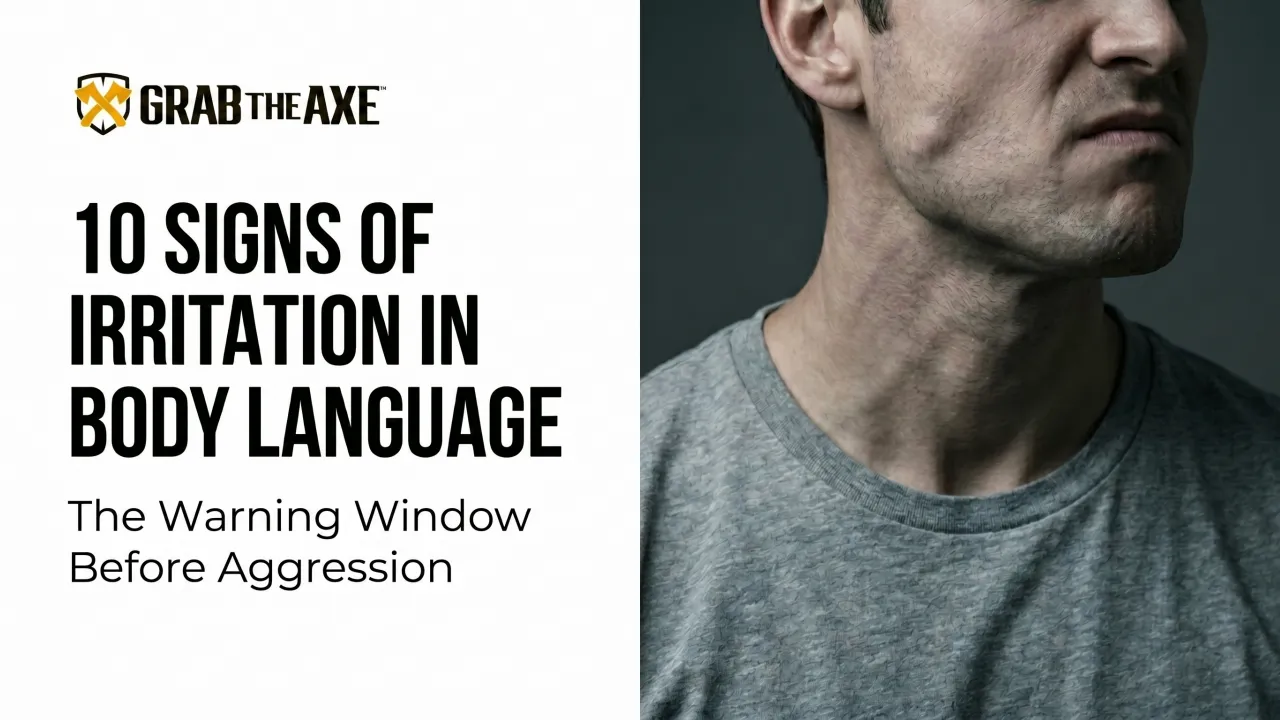
The masseter muscles running along the side of the jaw are one of the most reliable early warning indicators in the human body. When a person is suppressing anger or frustration, they clench their teeth without realizing it. You will see a small, repetitive bulging just in front of the earlobes. Their lips may appear unusually tight. This is the body preparing to bite down on words, literally preparing the jaw for impact. A clenched jaw is often the very first visible sign of irritation, and it appears long before the voice changes.
2. Forceful Exhales Through the Nose
Irritation changes how people breathe before it changes how they speak. Watch for sharp, forceful exhales through the nose, the kind most people describe as “huffing.” The nostrils may flare briefly on each exhale. This happens because the sympathetic nervous system is dumping CO₂ faster than normal as it prepares the body for exertion. A huff, a sigh, or a forceful nasal exhale is the body venting pressure. When you hear it twice in thirty seconds, the person is actively trying not to lose their composure.
3. Lip Compression and Micro-Grimaces
Emotion shows on the face in fractions of a second before the person can control it. When someone is irritated, the corners of their mouth will pull down briefly, or the lips will press flat together in a hard line. Micro-grimaces (tiny, involuntary flashes of anger that last less than a second) often appear when they hear something they strongly disagree with but cannot immediately respond to. These micro-expressions are one of the most underrated early indicators in situational awareness.
4. Skin Color Changes
Irritation causes visible vasoconstriction and then vasodilation. In lighter-skinned individuals, you will see flushing at the neck, the ears, and the upper chest before it appears on the face. In darker-skinned individuals, look for a slight darkening at the tips of the ears and sometimes a sheen of sweat along the hairline. Skin flush is completely involuntary. It is one of the cues a person cannot fake or hide. If you notice redness creeping up from the collar while someone is insisting they’re “fine,” trust the skin, not the words.
5. Rigid Shoulders and Stacked Tension
Watch the shoulders. A calm, relaxed person has shoulders that sit low and move naturally when they breathe. An irritated person’s shoulders creep upward toward the ears and stop moving. The trapezius muscles are loading up for action. You may also see one shoulder sit slightly higher than the other. This is called shoulder stacking, and it means the body is preparing to rotate into a strike. At this stage the person has not decided to fight yet. But the body is quietly getting ready in case they do.
6. Foot Repositioning
Feet tell the truth even when faces lie. A calm, disengaged person keeps their feet loose and pointed in whatever direction feels comfortable. An irritated person begins to square their feet toward the source of their frustration. One foot may shift back into what martial artists call a bladed stance. The knees soften slightly. The weight shifts from the heels to the balls of the feet. None of this is conscious. The body is silently taking a fighting stance long before the mind has made that decision.
7. Fingers Flexing or Tapping
Hands cannot stay still when adrenaline starts flowing. Look for fingers that flex and unflex slowly, or tap insistently on a table, a leg, or the side of a phone. Some people rub their thumb across their fingertips repeatedly, a self-soothing motion that signals the person is trying to contain agitation. Pay particular attention to the dominant hand. It will move first and it will move most.
8. Verbal Compression
Frustration shortens sentences. A calm person speaks in flowing, complete thoughts. An irritated person starts dropping conjunctions and adjectives. “I’m going to need you to stop doing that” becomes “stop.” Questions turn into statements. The tone flattens. The volume does not necessarily rise yet (that is a stage-two cue), but the words get sharper and fewer. If you are managing a conversation and notice someone’s sentences shrinking, you are watching irritation in real time.
9. Extended Silence After a Trigger
Counterintuitively, the most dangerous person in a room is often the quietest one. When a person reaches a level of irritation they can no longer process verbally, they may go silent for an unusual length of time. They are not calming down. They are running through scenarios. Sudden silence after a confrontational remark, especially when accompanied by any of the cues above, is a high-priority warning. The person is loading, not letting go.
10. Breaking and Re-Engaging Eye Contact
In an irritated state, eye contact becomes erratic. The person will look away briefly, almost as if checking something, then snap their gaze back to you harder than before. This is not shyness or avoidance. It is the brain cycling between self-regulation and targeting. Each time their eyes come back, there is slightly more intensity in them. When you notice this pattern, the escalation clock has already started.
Irritation vs. Frustration vs. Anger: Why the Distinction Matters
People use these words interchangeably, but in behavioral terms they describe three different physiological states with three different warning windows.
Frustration is irritation without a clear target. Someone stuck in traffic, fighting with a printer, or waiting too long in line is frustrated. Their body will show cues 1 through 5 (jaw clenching, huffing, micro-grimaces, skin flush, rigid shoulders) but not the directional cues (cue 6, foot repositioning) or the focused cues (cue 10, targeted eye contact). Frustration is not dangerous to you unless you become the target.
Irritation is frustration with a target. The person has decided, consciously or not, that something or someone specific is the cause of their distress. At this point cues 6, 7, and 10 start appearing. The foot squares toward the target. The eyes lock in. This is the stage where you can still de-escalate, but you are now the relevant subject of their rising stress response.
Anger is irritation that has broken through the person’s ability to manage it. The body abandons control. Voice rises. Movements become sharper. This is when the cues of aggressive body language start showing up: expansive posture, invaded space, pointing, shouting. Anger is stage two. You still have time. But your window is closing.
Understanding the difference is critical because the intervention changes at each stage. You de-escalate frustration with patience and distance. You de-escalate irritation with calm acknowledgment and reduced stimulation. You de-escalate anger with space, soft voice, and clear exits. You do not de-escalate aggression. You manage it or you leave.
What to Do When You See the Signs
Reading irritation body language is only useful if you act on it. The core response protocol we teach is built around three moves.
Create distance without signaling retreat. Step back half a pace, turn your hips slightly off-line from theirs, and put an obstacle (a chair, a counter, or a table) between you if one is available. Do this as if you are simply adjusting your position. Abrupt retreat is read as fear and can accelerate a predator’s timeline.
Lower your energy, not your attention. Soften your voice. Slow your words. Drop your tone by half a step. But keep your gaze on them, not locked in a stare, but steady and aware. The goal is to communicate that you are not a threat without communicating that you are prey.
Give them a face-saving exit. Most irritated people do not actually want to fight. They want their frustration to be acknowledged. A simple “you’re right, this is frustrating, let me see what I can do” can collapse an escalation in seconds. If the person is a stranger in public, “my mistake, I’ll get out of your way” accomplishes the same thing. Let them win the small social transaction so they don’t need to win the big physical one.
If the cues continue stacking despite your de-escalation, if you see cues 6, 9, or 10 after you’ve already tried to soften the situation, stop trying to manage the person and start managing your exit. At that point you are no longer in an interaction. You are in a survival problem.
Why This Matters for Organizations
For businesses, the cost of not recognizing irritation is measured in incidents that could have been prevented. Workplace violence, customer-service blowups, and the majority of confrontations with agitated visitors all follow the same escalation curve. Every one of them passes through irritation first. Yet most employee training jumps straight from “be friendly” to “call security” with nothing in between: no framework for reading the warning signs, no protocol for intervening at stage one.
At Grab The Axe, we treat irritation recognition as a core competency of any organization that deals with the public, handles disputes, or has leadership roles where interpersonal friction is common. It is not a soft skill. It is threat assessment applied in real time, and it is trainable. The people who are best at it are not necessarily the biggest or the most experienced. They are the ones who have learned to look at the body, not the face, and to trust what they see before they trust what they hear.
Take Action for Your Safety
Most violent incidents are preceded by a window where someone could have acted differently, said a different word, or simply walked away. That window is what irritation body language shows you. The skill of reading it is not paranoia. It is the opposite of paranoia. It replaces the vague sense that “something feels off” with specific, observable cues you can name, track, and act on.
Want to know how exposed your organization is to escalation events? Take our free Human Attack Surface Score assessment, a ten-question diagnostic that quantifies how prepared your team is to spot threats before they become incidents. Or if you’re ready to build irritation recognition into your security protocol, schedule a conversation with Grab The Axe and we’ll walk you through what it looks like in your environment.
The warning window is always there. The only question is whether anyone in the room is trained to see it.

A PhD candidate in Health Psychology and former Corrections Officer, Jeff founded GTA to dismantle passive security models. He focuses on the 'Human Zero-Day', mitigating executive burnout and decision fatigue before they become security breaches.
View Author Page →