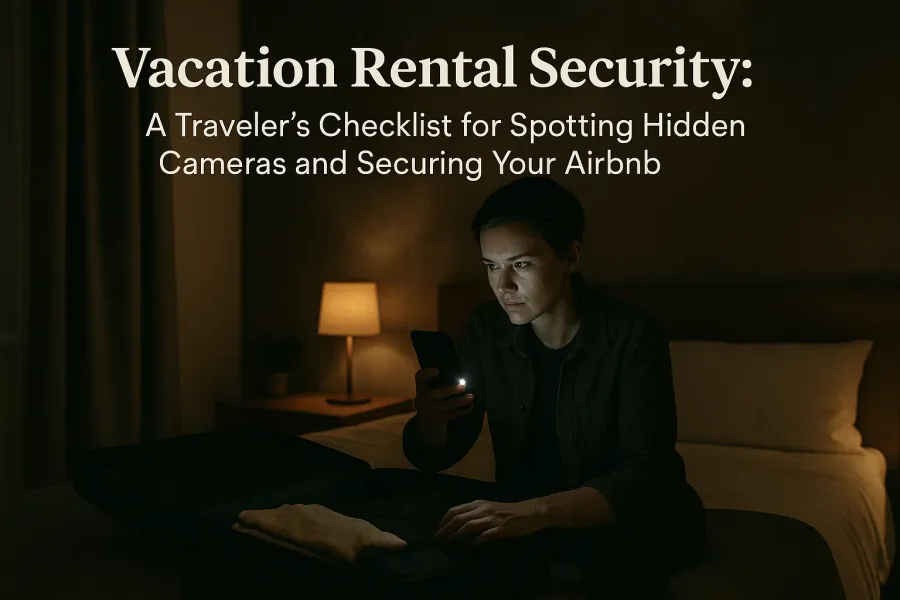
You’ve just walked into your vacation rental. Before you drop your bags and relax, pause for a moment. Does everything feel right? In an age where miniaturized cameras are cheap and easy to buy, that feeling of being watched is a valid concern. The convenience of the sharing economy has introduced new risks, and when it comes to your personal space, you are the first and last line of defense. True vacation rental security isn’t about paranoia: it’s about a systematic, professional approach to confirming your environment is safe. It’s about taking control.
This isn’t theory. This is a practical, field-tested checklist. I’ll walk you through the exact steps to perform a security sweep of any rental property, covering everything from finding hidden cameras to checking the physical weak points that criminals look for. These are simple actions you can take in the first ten minutes that will secure your space for your entire stay.
Common Hiding Spots for Covert Cameras
Criminals and voyeurs rely on complacency. They place cameras where people least expect them or in objects that are easily overlooked. When you conduct your initial sweep, think like an adversary. Where would you place a device to get an unobstructed view of private areas like bedrooms, bathrooms, and living rooms? Start with these common locations.
- Smoke Detectors and Carbon Monoxide Alarms: These are ideal hiding spots. They are centrally located on the ceiling, have a power source, and are rarely inspected by guests. Look for any unusual pinholes, tiny lenses, or signs that the casing has been tampered with.
- Everyday Electronics: Digital alarm clocks, phone chargers, TV boxes, and speakers are prime targets. They blend into the environment and have a built-in power supply. Scrutinize them for any pinhole lenses. A camera lens has to see out, and it will often reflect light differently than the plastic around it.
- Power Outlets and Light Switches: Specialized covert cameras are designed to look exactly like standard outlets or light fixtures. Look for anything that seems out of place or doesn’t match the other fixtures in the room.
- Household Objects: Picture frames, stuffed animals, books, and even fake plants can conceal small cameras. If an object seems strangely positioned—like a teddy bear pointed directly at the bed—it deserves a closer look.
- Small Gaps and Holes: Check for any unusual holes in walls or furniture, especially in areas like the shower or changing areas. A pinhole is all that’s needed for a lens.
Low-Tech and High-Tech Methods for a Room Scan
You don’t need a truck full of expensive gear to perform an effective scan: a combination of simple observation and basic technology is often enough to uncover a hidden device. Run through these two methods systematically.
The Low-Tech Physical Sweep
This is your foundational step: it costs nothing but requires your full attention.
- Turn Off The Lights: The first thing you should do is turn off all the lights in the room. Many covert cameras use infrared (IR) LEDs to see in the dark: while the IR light itself is invisible to the human eye, your smartphone’s front-facing camera can often see it. Open your camera app, switch to the front-facing camera (which typically has a weaker IR filter), and scan the room. Look for any small, pulsing purple or white lights. Pay special attention to the common hiding spots listed above.
- Use a Flashlight: With the lights still off, use a bright flashlight (your phone’s will work) and hold it at eye level. Slowly scan the room, shining the light on every object and surface. You are looking for a glint or reflection. A camera lens, no matter how small, is made of glass and will reflect light back at you from a specific angle: this is one of the most reliable ways to spot a lens hidden in a dark object or behind a screen.
- Physically Inspect: Turn the lights back on and physically inspect anything that looks suspicious. Check for unusual wires, devices that seem out of place, or objects that feel warm to the touch when they shouldn’t be. Trust your instincts. If a smoke detector has a strange wire coming out of it: there’s a problem.
The High-Tech Wi-Fi Scan
Most hidden cameras today are Wi-Fi enabled so the owner can stream footage remotely. This creates a digital footprint you can find. An unsecured Wi-Fi network is a major security flaw in many rentals, not just for cameras but for your personal data: man-in-the-middle attacks, where an attacker intercepts your data, are common on poorly configured networks.
Connect your phone or laptop to the rental’s Wi-Fi network. Then, use a free network scanning app (like Fing for mobile or Nmap for laptops) to see a list of every device connected to that network. You’ll see your own phone, the router, and maybe a smart TV. Look for anything that seems unusual. A device listed as “IP Camera” is an obvious red flag. Even if it’s not clearly labeled, a strange device from an unknown manufacturer deserves investigation. If you find a device you can’t identify, you can try to access its IP address in a web browser. Often, this will bring up a login page for the device, confirming what it is.
Essential Physical Security Checks
Beyond hidden cameras, your vacation rental security depends on strong physical barriers. Most rental properties use basic, easily bypassed locks: criminals know this and target these locations. When you arrive, perform these checks immediately.
- Doors and Locks: Check the main door. Does it have a deadbolt? Is the door frame solid? Give the door a firm push to see if it rattles. Many criminals can bypass a simple doorknob lock in seconds. If possible, use a portable door lock, jammer, or a simple door wedge for extra security, especially while you are sleeping.
- Windows and Sliding Doors: Are all windows and sliding glass doors locked? Do the locks work properly? For ground-floor rentals, this is critical. A simple wooden dowel or security bar placed in the track of a sliding door can prevent it from being forced open.
- Check the Spare Key: Look under the doormat, in the fake rock, or in the lockbox. Is the spare key still there? If so, the code you were given might be the same one given to every previous guest. If you can, remove the spare key and keep it with you until you check out.
- Be Aware of Your Surroundings: Pay attention to the neighborhood. Are the common areas well-lit? Does the property have any blind spots? Situational awareness is a key component of personal security.
Your safety is your responsibility. The rise of affordable surveillance technology means we must be more vigilant, not more fearful. By performing these simple, repeatable checks, you can take direct control of your environment: you can confirm that your private space is truly private. This isn’t about ruining your vacation with worry: it’s about performing a professional assessment so you can set those worries aside and enjoy your trip with confidence.
Don’t let your vacation turn into a security nightmare. Use our step-by-step checklist to secure your next rental property.

A leader defined by a 'bias for action,' Dusten specializes in physical security assessments that impact profitability. He leverages high-logic strategies to pinpoint high-ROI vulnerabilities, ensuring defense measures actually scale with the business.