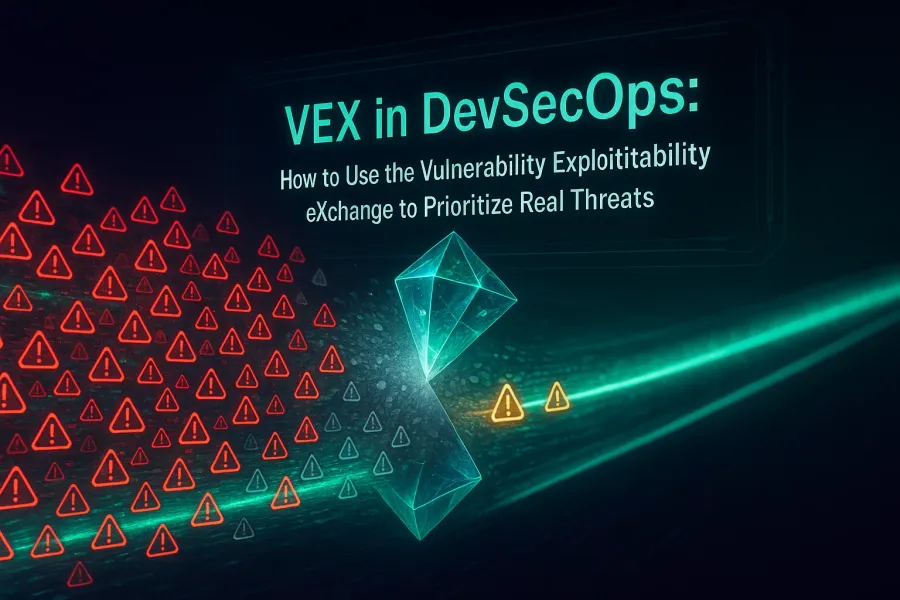
Are you staring at a security report with thousands of vulnerabilities from your latest SBOM scan? If so, you already know the problem. Industry data shows that up to 85% of vulnerabilities flagged in open-source libraries aren’t even reachable in your production environment. Your team is burning out, patching issues that pose no real threat, while your release cycles slow to a crawl. This isn’t just inefficient; it’s a critical security flaw. When everything is a priority, nothing is. It’s time to stop treating all vulnerabilities as equal. It’s time to bring context and intelligence into your workflow with VEX in DevSecOps.
What is VEX and Why Does it Supercharge Your SBOM?
Think of your Software Bill of Materials (SBOM) as a detailed ingredient list for your application. It’s essential. It tells you every component you’ve used, which is the first step in understanding your exposure. But an ingredient list doesn’t tell you if an allergy-causing ingredient was actually baked into the final cake or just sat on the same shelf: That’s where the Vulnerability Exploitability eXchange (VEX) comes in.
VEX is a companion document to your SBOM. It’s a security advisory that provides context. It explicitly states whether a specific vulnerability in a component actually affects your product and, if not, why: It’s the difference between knowing a component has a vulnerability and knowing that vulnerability matters to you.
An SBOM answers, “What is in my software?” A VEX document answers, “Am I actually affected by the vulnerabilities in my software?”
By combining these two, you shift from a noisy, volume-based approach to a precise, risk-based one. This isn’t just a theoretical improvement. CISA has strongly endorsed VEX as a critical tool for cutting through patch fatigue and strengthening the software supply chain. It allows teams to confidently defer or ignore patches for non-exploitable vulnerabilities and focus their full attention on the ones that represent a clear and present danger.
Automating VEX in Your CI/CD Pipeline
The real power of VEX is unlocked when you move it from a manual process to an automated part of your CI/CD pipeline. The goal is to make exploitability analysis a core gate in your development lifecycle, not an afterthought. Integrating VEX in DevSecOps means your pipeline can make smarter build/fail decisions automatically.
Here’s a practical model for how this works:
-
Component & Vulnerability Scanning: Your pipeline already does this. It starts with a tool like Trivy, Grype, or Snyk scanning your codebase and its dependencies, generating an SBOM and a corresponding list of CVEs (Common Vulnerabilities and Exposures).
-
Automated Exploitability Analysis: This is the new, critical step: You integrate a tool that can perform reachability analysis. This type of tool analyzes how your first-party code actually calls upon the functions within a third-party library. If the vulnerable function in a library is never called by your code, it’s not reachable; Therefore, it’s not exploitable in your specific context.
-
VEX Document Generation: Based on the analysis, the tool automatically generates a VEX document in a machine-readable format like CycloneDX. For each vulnerability, it assigns a status:
- not_affected: The vulnerability is present, but not exploitable. The justification could be code_not_reachable or inline_mitigations_exist.
- affected: The vulnerability is present and exploitable. This triggers an immediate alert.
- fixed: The vulnerability has been patched in the version you’re using.
- under_investigation: The status is currently being determined.
-
Informed Policy Decisions: Your CI/CD orchestrator (like Jenkins, GitLab CI, or GitHub Actions) now has the data it needs. Instead of failing a build for every single ‘High’ or ‘Critical’ CVE, it parses the VEX document. The new rule becomes: fail the build only if a vulnerability is affected. All not_affected vulnerabilities are logged but don’t stop the release. This simple logic change eliminates the vast majority of false alarms.
By automating this flow, you embed security intelligence directly into the development process. Developers get immediate, actionable feedback. They’re no longer wasting cycles on theoretical risks. Security teams can trust that the alerts they receive are for genuine, verified threats that require immediate action.
Practical Steps to Create and Use a VEX Document
Getting started with VEX doesn’t have to be an all-or-nothing overhaul. You can begin implementing it incrementally to start filtering out the noise and demonstrate value quickly. Here’s how to approach it.
First, choose a VEX format. CycloneDX is a leading, open-source standard with robust tooling support. It’s designed for this exact purpose.
Next, you need to populate the document. A VEX document links a specific product to a specific vulnerability and provides a status. Here are the core components you’ll define:
- Product Identifier: Clearly identify your application using a Package URL (PURL) or other standard identifier.
- Vulnerability Identifier: Use the CVE number (e.g., CVE-2023-12345).
- Status: This is the most important field: Choose from not_affected, affected, fixed, or under_investigation.
- Justification: If the status is not_affected, you must explain why: Is the code not reachable? Is it because you have other controls in place? This justification is crucial for auditors and stakeholders.
- Impact Statement: A brief, human-readable explanation of what the status means for your product.
Initially, your security team might create these documents manually for a few high-profile, recurring false positives. You can store these VEX documents alongside your code and use simple scripts in your pipeline to check against them.
As you mature, you’ll want to adopt the automated analysis tools mentioned earlier. These tools become the primary source for generating VEX data on the fly. This turns VEX from a static document into a dynamic, real-time feed of exploitability intelligence that drives your entire vulnerability management program.
By adopting VEX, you transform your security posture. You empower your development teams to move faster and with more confidence. You provide leadership with a clear, accurate picture of real organizational risk, cutting through the fog of overwhelming vulnerability data. It’s a smarter, more efficient way to build secure software.
The landscape of software supply chain security is evolving. Tools and standards will continue to improve, likely incorporating more sophisticated analysis techniques, perhaps even AI-driven predictions for exploitability. Adopting a VEX-driven strategy today doesn’t just solve your current problem of alert fatigue; it positions you to lead from the front, building a more resilient and efficient DevSecOps culture for the future.
Implement a smarter, more efficient vulnerability management process with our expert DevSecOps consulting.

Operating on the philosophy that 'you can't build a secure system if you don't know how to break it,' Chris leads our engineering division. A top 1% National Cyber League competitor, he hardens our digital infrastructure against the very exploits he has mastered.