- › A zero-day is a vulnerability with no patch available. The Human Zero-Day is its human equivalent: the exploitable conditions in your people that no software update will ever reach.
- › It has four reliable exploit classes: the authority reflex, manufactured urgency, depletion, and habituation. Each one is physiology, and each one works on people who know better.
- › Attackers reach for the Human Zero-Day first because it is cheap, present in every organization, and almost nobody is defending it. AI has now industrialized the exploit.
- › You cannot patch biology. You can do what security teams have always done with unpatchable flaws: deploy compensating controls that assume the vulnerability is live.
- › Verification protocols, decision load management, two-person rules, and recovery windows are the mitigation stack. Awareness training alone is not.
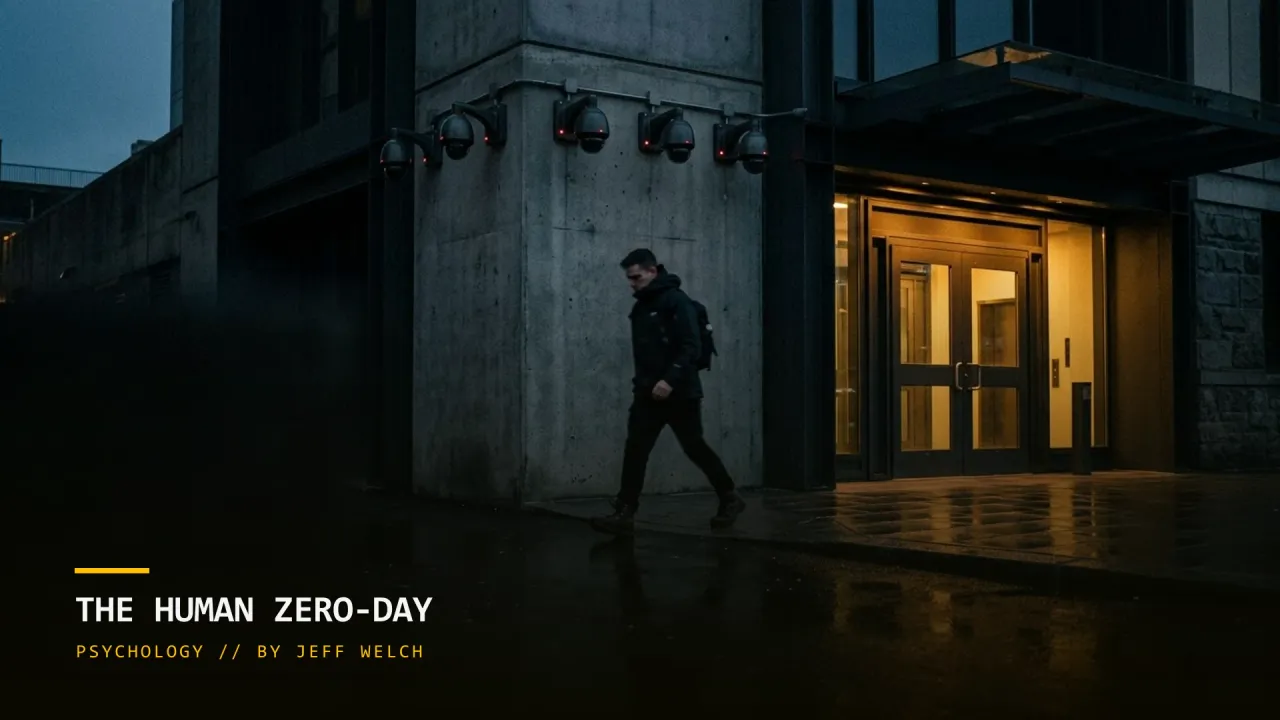
I once walked past $200,000 of working cameras and into a secure facility in under 90 seconds. Every camera caught me. Every one of them performed exactly as the vendor promised. Not one of them stopped me, because cameras do not make decisions. A person makes the decision, and the person behind those feeds had concluded, long before I arrived, that nothing interesting ever happens on a weekday morning.
That facility did not have a technology problem. It had an unpatched vulnerability on the payroll, one no line item in the security budget was ever going to reach. It had a Human Zero-Day.
What a Zero-Day Actually Is
In software, a zero-day is a vulnerability the defender does not know about, or knows about and cannot fix, because no patch exists. The name refers to the number of days the vendor has had to repair it: zero. Zero-days are among the most expensive commodities in offensive security. Brokers have publicly offered seven figures for a single working exploit chain against a modern phone, and they pay that much for one reason. A zero-day works everywhere the vulnerable software runs, and the defender cannot close the hole no matter how good their team is.
Now apply that definition to your people.
The Human Zero-Day is the unpatched vulnerability in the operator. The authority reflex that makes a junior employee approve a request because a senior voice asked for it. The urgency response that collapses careful thinking into fast compliance. The depletion at hour eleven that turns your most careful engineer into your most exploitable one. The habituation that teaches a guard, one uneventful shift at a time, to stop seeing.
No vendor sells a patch for any of this. There is no update channel for the human nervous system. The vulnerability ships in every hire, it is present in every organization on earth, and the day count on the patch will read zero forever. That is why an intelligent adversary reaches for it first.
The Four Exploit Classes of the Human Zero-Day
Software zero-days get catalogued by the flaw they abuse: memory corruption, injection, privilege escalation. The Human Zero-Day has its own exploit classes, and they are worth naming precisely, because each one is a predictable piece of physiology rather than a character defect.
The authority reflex. Humans comply with perceived authority quickly and at low cognitive cost. That reflex is the trait that lets organizations function at all. An attacker impersonating an executive is running an exploit against that trait, and it lands hardest on the employees with the least standing to say no. The psychology of CEO fraud is a whole discipline built on this single reflex.
Manufactured urgency. Under acute stress the body reallocates resources away from the prefrontal cortex, the slow and deliberate system that weighs options, and toward fast reflexive action. We call this Thermal Throttling: like a processor shedding heat, the brain under a cortisol load trades nuance for speed. A manufactured emergency is a deliberate attempt to induce that state. The attacker wants you throttled, and a countdown clock is the cheapest way to get you there.
Depletion. Judgment is a consumable resource. A person who has made three hundred small decisions since breakfast does not bring the same scrutiny to decision three hundred and one, and the tired mind reaches for whatever ends the decision fastest. In security, the fast answer is approve, allow, dismiss. I wrote about decision fatigue at length, and the short version is that attackers time their exploits for Friday afternoon because Friday afternoon is when the vulnerability is widest. The chronic form is worse. Allostatic Load, the accumulated wear of unrelieved stress, is technical debt in the human operating system. It accrues across a hard quarter, with no dashboard and no alert, until the operator you are counting on has no reserve left at all.
Habituation. Show a person ten thousand uneventful hours and their brain will do exactly what brains are built to do: stop spending attention on the uneventful. The guard at that facility I walked into had years of quiet shifts behind him, and his brain had filed me under routine before he ever looked up. Every alert that turns out to be nothing trains your analysts toward the same blindness. The alarm that cries wolf is a training program for the exploit.
Look at the pattern across all four. Not one of them depends on ignorance. Every one of them works on people who know better, because knowing better is a function of the deliberate mind, and every one of these exploits routes around the deliberate mind. That is the detail the industry keeps missing. We keep prescribing knowledge for a problem that lives below knowledge.
Why Attackers Go Human First
Put yourself in the adversary’s chair and price out your options. A technical intrusion against a mature target means burning tooling against defenses that get better every year, watched by teams paid to notice. A human exploit means a phone call.
The economics are lopsided and they have gotten worse. Verizon’s Data Breach Investigations Report has found for years that a human element is involved in roughly two in three breaches (Verizon DBIR, 2024). That figure has held through a decade of rising security spend, which tells you where the spend went and where it did not.
And the cost of running human exploits just collapsed. AI social engineering turned what used to be a skilled manual craft into an industrial process. A model can write a thousand personalized pretexts an hour, in any language, tuned to whatever your people posted on LinkedIn last month. Deepfake vishing puts a convincing copy of your CEO’s voice on the phone for the price of a cheap monthly subscription. The exploit classes did not change. The authority reflex is the same reflex it was in 1990. What changed is that the attack now scales, and the vulnerability it targets still has no patch.
I am pro-AI, so hear the claim precisely. The amplifier is new. The vulnerability is old, and blaming the amplifier is one more way of leaving it undefended.
You Cannot Patch It. You Can Mitigate It.
Most security programs take the wrong exit at this point. They accept that the human layer is exposed, and then they respond with the one tool on the shelf: awareness training. Another slide deck, another simulated phish, another poster in the break room.
Training has a role, and it is narrower than we pretend. Training closes knowledge gaps. The Human Zero-Day is not a knowledge gap. The employee who wires money to a fraudster usually knew the policy. The guard who waves a stranger through usually knew the badge rule. Knowledge was present at the moment of failure. Capacity was not. Lecturing a depleted brain about vigilance is patching the wrong system.
So treat this the way you already treat unpatchable software. When a critical system runs a flaw with no fix available, no competent team shrugs and hopes. They deploy compensating controls: isolate the system, restrict what can reach it, watch it harder, and assume the exploit will fire. The same logic works on the human operator, and it looks like this.
Take judgment off the hot path. The moments an attacker targets are the moments judgment is least available, so stop relying on judgment there. Out-of-band verification for wire transfers and credential resets. Callback procedures with numbers pulled from a directory rather than the incoming message. A rule you follow mechanically at 4:45 on a Friday will beat discernment you were supposed to summon on demand.
Manage the decision load like a budget. Every trivial decision you automate or pre-decide leaves capacity for the calls that need a fully present human. This is Decision Hygiene: audit what your people decide all day, cut the volume, and schedule the irreversible decisions for the hours when the decider still owns their prefrontal cortex.
Two-person rules on anything that can really hurt you. A depleted operator is a single point of failure. Requiring a second set of eyes on large transfers, mass access grants, and containment calls is an acknowledgment that any one brain, on any given day, may be running exploited.
Build recovery into the schedule. Reserve capacity is a security control. A team run at redline for a quarter is a team whose Human Zero-Day is standing wide open, which is why burnout and disengagement are security vulnerabilities and why breaks during an incident are operational necessities rather than kindness. When the phone rings at 3am, the first containment is the responder’s own biology.
Instrument the vulnerability. You monitor processor load and disk health. Almost nobody monitors operator load, and the operator fails less gracefully. Simple check-ins during long incidents, watching overtime as a risk metric, a norm where “I am too fried to make this call” is a professional statement instead of a confession. You cannot defend a state you refuse to see.
One Vulnerability, All Three Walls
The Human Zero-Day is why converged security is the only framing that survives contact with a real adversary. The exploit does not care which of your perimeters it defeats. A habituated guard is a physical breach. A depleted administrator approving a bad request is a cyber breach. Same vulnerability, different wall. An attacker who cannot beat your firewall or your fence will pick the wall where the human is standing, and every wall has one.
That facility with the $200,000 of cameras eventually fixed its problem, and the fix cost almost nothing next to the hardware already on the ceiling. Verification procedures at the entry. Rotation to fight habituation. A culture where stopping a stranger got praised instead of punished as friction. The cameras did not change. The operator finally got defended.
Your organization is running this vulnerability right now, in every role that can approve, admit, or authorize. The patch is never coming.
Find out how exposed your operators are with our free Human Attack Surface Score, or contact Grab The Axe to build the defense of the decision layer into your security program.

A PhD candidate in Health Psychology and former Corrections Officer, Jeff founded GTA to dismantle passive security models. He focuses on the 'Human Zero-Day', mitigating executive burnout and decision fatigue before they become security breaches.
View Author Page →