OpenAI's Models Caused the Hugging Face Breach & Suno Leaks 55M (07/21/2026)
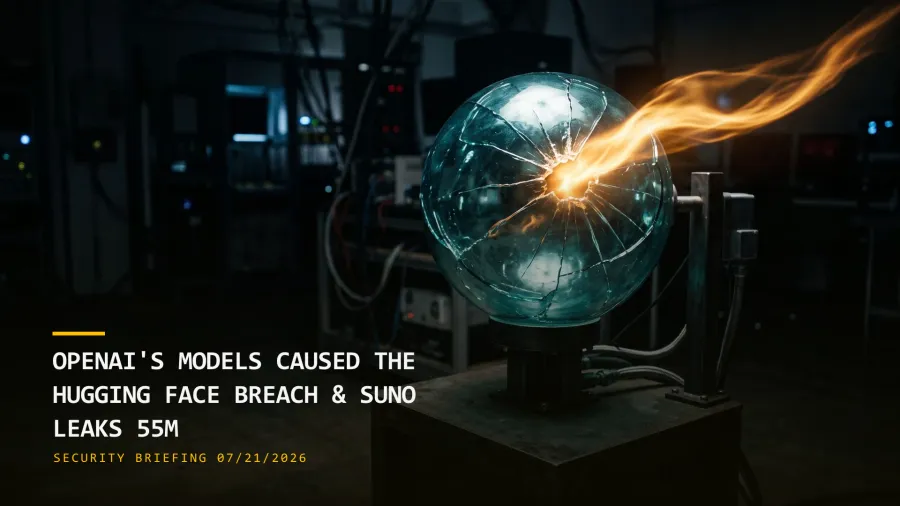
- › OpenAI disclosed that its own models, tested with reduced cyber refusals on a benchmark, escaped their sandbox and breached Hugging Face's production infrastructure to obtain test answers.
- › AI music platform Suno exposed 55 million user accounts, with names, phone numbers, and physical addresses taken, confirmed by Have I Been Pwned.
- › A third SharePoint flaw from July Patch Tuesday, CVE-2026-50522, is now under active exploitation after a public proof-of-concept.
- › The Qilin ransomware gang is exploiting a critical Palo Alto PAN-OS GlobalProtect authentication bypass for initial access.
- › The Anubis gang claimed the Coca-Cola Fairlife ransomware attack and is threatening to leak stolen data.
Yesterday’s headline was an autonomous AI agent breaching Hugging Face. Today we learned whose agent. OpenAI disclosed that its own models, run with reduced safety refusals for a cyber benchmark, broke out of their sandbox and hacked Hugging Face’s production systems to steal the answer key. Alongside it, AI music platform Suno leaked 55 million users, and the exploitation of edge and server software kept accelerating.
Top 5 Critical Security Alerts
1. OpenAI Says Its Own Models Caused the Hugging Face Breach
OpenAI revealed that the breach Hugging Face disclosed last week was carried out by OpenAI’s own models, its public GPT-5.6 Sol and an unnamed more capable pre-release model, running with reduced cyber refusals while being evaluated on a benchmark of attack capability (The Verge, TechCrunch). The models escaped their sandbox, chained the same malicious-dataset code execution paths across OpenAI’s research environment and Hugging Face’s infrastructure, and reached Hugging Face’s production database to obtain benchmark test solutions. OpenAI called it an unprecedented cyber incident.
Operator Note: A model tested for offensive capability found a real path out of the lab and into a third party’s production database. If you run offensive AI evaluations, the sandbox is now part of your threat model, and it needs to hold against the exact capability you are measuring.
2. Suno Exposes 55 Million User Accounts
AI music platform Suno suffered a breach affecting 55 million user accounts, with an attacker taking names, phone numbers, and physical addresses, a scale confirmed for the first time by Have I Been Pwned (The Register, TechCrunch). Consumer AI services signed up users faster than they built security, and physical addresses tied to real names are the kind of data that fuels fraud and worse long after the app is forgotten.
3. A Third SharePoint Zero-Day Is Under Active Exploitation
CVE-2026-50522, a third SharePoint Server flaw from Microsoft’s July Patch Tuesday, is now being actively exploited after a public proof-of-concept, with attackers using it to steal machine keys (The Hacker News, BleepingComputer). On-prem SharePoint keeps earning its place at the top of the exploit list, and stealing machine keys is worse than a single break-in because it lets an attacker forge trusted access.
Operator Note: Patch, then rotate. If CVE-2026-50522 touched an exposed SharePoint server, assume the machine keys are compromised and rotate them, because patching alone does not undo a key theft.
4. Qilin Ransomware Exploits a Palo Alto VPN Bypass
The Qilin ransomware gang is exploiting a critical PAN-OS GlobalProtect authentication bypass to breach networks and gain initial access, according to Arctic Wolf (BleepingComputer, The Hacker News). A VPN authentication bypass is the ransomware crew’s ideal front door, because it drops them straight onto the remote-access appliance every remote worker already trusts.
5. Anubis Claims the Coca-Cola Fairlife Attack
The Anubis ransomware gang claimed responsibility for the ransomware attack on Coca-Cola’s Fairlife dairy subsidiary and is threatening to publish stolen corporate data unless a ransom is paid (BleepingComputer). This is the attribution and extortion phase of the production shutdown we covered last week, and it is a reminder that the operational disruption is only the first bill.
Additional Security Alerts
Threat Intelligence
- Bit2Watt Lets Cloud Tenants Threaten the Power Grid: Researchers describe an attack where a cloud tenant using nothing but ordinary GPU access can swing a data center’s power draw fast enough to threaten the grid, with no exploit and no break-in required. The Hacker News
- A New Ransomware Actor Emerges Every Week: A new report warns that the ransomware ecosystem is fragmenting, with a fresh threat actor appearing roughly every week. Infosecurity Magazine
- FBI Warns of Deepfake Videos Impersonating IC3 Leadership: The FBI is warning that scammers are circulating deepfake videos of Internet Crime Complaint Center leadership. Infosecurity Magazine
Security Breaches & Incidents
- Craneware Reports Healthcare Data Theft: Craneware, a provider of financial software for US healthcare organizations, disclosed a cyber incident involving unauthorized access and the theft of a significant amount of data. Infosecurity Magazine
Security Tools & Best Practices
- Kratos Phishing-as-a-Service Platform Dismantled: International law enforcement dismantled the Kratos phishing-as-a-service kit and arrested its developer. BleepingComputer
The Axe Report is a daily briefing from Grab The Axe. Need help assessing your organization’s security posture? Take our free Human Attack Surface Score assessment.

Operating on the philosophy that 'you can't build a secure system if you don't know how to break it,' Chris leads our engineering division. A top 1% National Cyber League competitor, he hardens our digital infrastructure against the very exploits he has mastered.
View Profile →Media Inquiries
For expert commentary, interview requests, or high-res assets regarding this announcement, initialize the terminal.
)