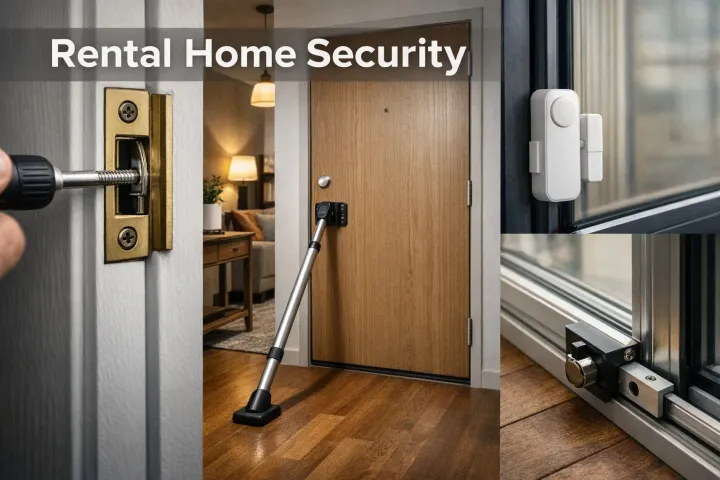
Renters have a unique problem: you’re responsible for your safety, but you’re not allowed to remodel. The good news is you don’t need to. In a rental, you can run a security stack that’s reversible, affordable, and brutally effective.
One line to remember: In a rental, think reversible layers: deter, delay, detect, dispatch.
And another: Your lease is not a suicide pact.
1. The Renter Security Stack: Reversible Layers That Win
When you can’t drill, you layer:
Layer 1: Deter (Make Your Unit a Bad Choice)
- Lighting: Bright entry lighting (request maintenance upgrades if needed). Insurers and safety orgs commonly recommend good lighting as a burglary deterrent.
- Visibility: Don’t advertise packages; use lockers or hold-at-station.
- Noise discipline: Don’t post travel plans in real time.
Layer 2: Delay (Buy Seconds)
- Removable door reinforcement: portable door brace/jamb brace, door wedges.
- Lease-compliant lock upgrades: request management to upgrade strike plate/deadbolt or re-key between tenants.
Layer 3: Detect (Know Early, Not Late)
- Indoor camera pointed at your door from inside.
- Adhesive contact sensors on doors/windows.
- Glass-break/vibration sensors (inside, adhesive).
Layer 4: Dispatch (Get Help Fast)
- Phone charged near bed, address/unit number ready, emergency contacts favorited.
- A “safe room” concept: lock in, call 911, create distance.
- A trusted neighbor: exchange numbers and agree on a “if you hear X, call” plan.
2. The Strike Plate Exploit (and the $2 Fix)
The Problem
Many rentals come with a hollow-core door and a strike plate held by short factory screws. That setup can be cosmetic, not kinetic; it may look fine, but it fails under real force.
The Fix (Cheap, Fast, Usually Invisible)
Replace the short screws with 3-inch wood screws so the strike plate bites into the wall stud, not just the trim/jamb material. Retailers explicitly sell strike plates and kits designed around longer screws for stronger holding power.
What You’ll Need
- #8 or #10 3-inch wood screws (often 2-6 total)
- Screwdriver or drill/driver
- (Optional but smart) a small drill bit for a pilot hole
Step-by-Step (5-10 Minutes)
- Open the door and locate the metal strike plate on the frame.
- Back out the factory screws and keep them in a bag (move-out friendly).
- Pilot hole (recommended): A tiny pilot hole helps prevent splitting and makes driving long screws easier.
- Drive 3-inch screws through the strike plate until snug (don’t over-torque and strip).
- Close the door and test: lock it, push/pull the door, feel the difference.
Renter Notes (Important)
- If your frame is metal, long wood screws may not bite correctly, use landlord-installed reinforcement or purpose-built hardware.
- This is typically minimal and reversible (swap the original screws back later), but check your lease and keep everything tidy.
Extra credit: Do the same upgrade on the hinge screws (one screw per hinge leaf swapped to 3-inch) to reduce frame flex.
Source: Wood Nerds
3. Kinetic Independence (No-Drill Door Resistance)
The Problem
Renters assume: “I can’t install a deadbolt, so I’m stuck.”
The Fix
Use a heavy-duty, adjustable door security bar that braces under the knob and grips the floor, zero drilling. It relies on pure mechanical leverage and friction. Big-box retailers and manufacturers sell adjustable security bars intended for door reinforcement and travel use.
How to Use It Correctly (So It Actually Works)
- Set the length so the bar is under compression when installed.
- Place the top cradle under the door knob/handle (per your model).
- Angle the bar so the rubber foot bites the floor (tile/hardwood works great; on carpet, press hard and test).
- Test with controlled force: push the door inward firmly. If it slips, adjust the length/angle.
Pro Tips
- If you have slick floors, choose a bar with a high-grip foot and keep the floor clean/dry.
- Traveling? This is one of the best “security that moves with you” tools for hotels, dorms, and rentals.
Source: The Outdoor Office
4. Acoustic Shock via Adhesive (Peel-and-Stick Alarms)
The Problem
Wired alarm systems often require drilling, sensors, and permission; renters hit a wall fast.
The Fix
Install battery-operated door/window alarms using adhesive strips. Many models advertise alarms up to 120 dB and tool-free installation.
When a door/window opens and the magnetic contact breaks, you get:
- A violent burst of noise (startle response)
- Immediate attention (neighbors, roommates)
- A clear “something is happening now” signal for you
(Skip the medical claims. The practical value is the loud, immediate startle + attention.)
Placement That Matters
- Entry door: Place high enough that it’s harder to tamper with casually.
- Bedroom window (ground floor): Prioritize sleeping areas.
- Sliding doors/windows: Put sensors where the moving panel separates.
Setup Checklist
- Use “chime mode” for daytime awareness, “alarm mode” for night/away.
- Test monthly.
- Replace batteries on a schedule (don’t wait for the beep of doom).
5. Friction-Based Perimeter Control (Sliders & Windows)
The Problem
Ground-floor sliding windows/doors are often the weakest ingress point: lots of leverage, lots of bad factory latches, and lots of “it’ll probably be fine.”
The Fix
Use adjustable track locks or security bars that deny horizontal movement without permanent installation. Track-lock and security-bar products are widely sold specifically for sliding patio doors and windows.
Two Renter-Friendly Options
- Adjustable security bar (in the track):
- Cut-to-fit or adjustable length
- Fast, cheap, and effective
- Thumbscrew track lock:
- Tightens into the track to prevent sliding
- Great for windows where a long bar is awkward
Install (60 Seconds)
- Clean the track.
- Set the bar/lock tight enough that it cannot rattle loose.
- Try to open the slider with firm force. If it moves, tighten.
Bonus: If you want ventilation, set a bar/lock to allow a small opening while preventing full travel (only if you’re comfortable with that risk).
Source: Prime-Line Products
6. Bonus: Cameras (The Safest Renter Posture is Inside-Only + Smart Angles)
Many properties restrict devices that record common areas (hallways/courtyards) or require written permission for anything mounted outside. The least drama, most compliant approach:
- Indoor camera pointed at your entry door from inside (captures the moment the door opens, not the hallway).
- Avoid audio recording if local rules/comfort make that messy.
- Put a small sign inside your unit (“Premises monitored”) if you want deterrence without exterior hardware.
7. Bonus: Cyber Hygiene for Renters (Because “Smart” Homes Can Be Dumb)
Rental security isn’t just doors and windows. Your Wi-Fi and devices are part of your perimeter.
Quick Wins
- Change router admin password (if you control the router). If it’s building-provided, ask how tenants are isolated.
- Use WPA2/WPA3, long passphrases, and update firmware.
- Put smart devices (TVs, speakers, cheap cameras) on a guest network when possible.
- Don’t reuse passwords. (Yes, it’s boring. So is identity theft.)
Grab The Axe lives in the space where physical and cyber meet, because attackers love the seams.
8. What to Ask Your Landlord (Lease-Safe Upgrades That Help Everyone)
The most renter-friendly “upgrade” is often: make the owner do it.
Ask management to:
- Re-key between tenants (basic hygiene).
- Upgrade/repair entry lighting.
- Install/upgrade deadbolts or a reinforced strike plate (owner-installed = fewer disputes).
- Fix doors that don’t latch cleanly, sloppy frames, or misaligned plates.
Insurers and risk orgs regularly recommend stronger doors/frames and quality locks as burglary countermeasures.
Copy/Paste Request (Short and Polite)
Hi [Manager Name],
I’d like to request a safety upgrade: re-keying the unit (if not already done) and installing/confirming a reinforced strike plate and properly aligned deadbolt. I’m happy to coordinate access and cover reasonable hardware costs if needed.
Thanks!
9. Quick Checklists
Do This in 15 Minutes
- Add a door security bar and test it.
- Install one adhesive door alarm on the entry door.
- Put your phone on a charger near bed; favorite emergency contacts.
Do This in One Weekend
- Upgrade strike plate screws to 3-inch (save originals).
- Add track locks/security bars to sliding doors/windows.
- Set up an indoor camera angle that records inside-only.
Monthly Maintenance
- Test sensors/camera.
- Replace batteries on a schedule.
- Re-check track locks and door bar tension.
FAQ (People Also Ask)
Can I replace strike plate screws in an apartment?
Often yes, because it’s usually reversible and doesn’t change the visible hardware, but leases vary. Keep the original screws and reinstall them at move-out if needed.
Do door security bars really work?
When properly tensioned and used on a compatible floor surface, they add meaningful resistance with no drilling.
Are peel-and-stick door/window alarms worth it?
Yes, many are loud (often marketed up to 120 dB), tool-free, and provide immediate detection and deterrence.
What’s the best way to secure a sliding door in a rental?
A track security bar and/or track lock is fast, cheap, and reversible.

A PhD candidate in Health Psychology and former Corrections Officer, Jeff founded GTA to dismantle passive security models. He focuses on the 'Human Zero-Day', mitigating executive burnout and decision fatigue before they become security breaches.
View Author Page →