- › Five Phoenix-area card shops have been burglarized since last October, and Tempe and Gilbert police both report an uptick in trading card crime.
- › At Game Outpost in north Phoenix a rock came through a corner window at 1:50 a.m. and the thief was gone in under five minutes with an estimated $5,000 to $10,000.
- › He cleared the Pokémon and left the rest, which the owner read as someone who knew exactly what he came for and little else.
- › Sealed trading card product has no serial numbers, sells instantly on a secondary market that does not ask questions, and stacks a lot of value into a backpack.
- › The controls that work here change the time and certainty of the theft rather than the strength of the door.
At about 1:50 in the morning on a Monday in late July, a rock came through a corner window at Game Outpost in north Phoenix. A masked man crawled in behind the counter, dumped merchandise into a cardboard box, and was gone in under five minutes.
Three packs were all that survived of the store’s entire Pokémon collection.
What the owners said afterward is the most useful sentence anyone has produced about this whole pattern. “He came in, he knew exactly where the Pokémon was, completely cleared out all of the Pokémon, and from there you can kind of tell he didn’t really know what else he was going for.”
He was surrounded by inventory and he took one category.
That was not the first Valley shop. Ronin Games in Mesa and The Power Card Shop in Phoenix were both burglarized earlier, in October and December. On May 19 a man with a sledgehammer broke the glass door of a trading card shop near Mill and Southern in Tempe and left with roughly $7,000 in sealed Pokémon. Less than a month later somebody took four boxes of Pokémon out of a smoke shop in Gilbert, and as of early June no suspect had been identified. Tempe and Gilbert police have both said their detectives are seeing an uptick in trading card crime.
Five shops. One metro area. Less than a year.
If you own one of these stores, the useful question is not whether you are unlucky. It is why your inventory specifically, and the answer gets clear once you price the room the way he did.
Run the Adversary’s Numbers
Put yourself on the other side of that door for a minute and price out the options in a strip mall.
Take the register. Most shops keep a few hundred dollars in the drawer, it is often emptied at close, and cash is the one thing every owner already secures. Take the computers. A used point of sale terminal is worth almost nothing and it is bulky, traceable, and useless without the shop’s accounts. Take the display case singles, the graded cards under glass. Those are the highest value items in the building, and they are also the most traceable: a graded card carries a unique certification number, the population reports are public, and the collector community talks.
Now take sealed product off the wall.
A single sealed booster box runs a few hundred dollars at retail and more than that when a set is hot. Cases stack. Nothing has a serial number. There is no registry, no certification, no way to distinguish a box stolen on Tuesday from one bought legitimately on Monday. The secondary market is enormous, it runs through online marketplaces and weekend conventions and parking lot meetups, and the buyer’s only real question is price.
Value density is the part people miss. A backpack holds enough sealed product to clear five figures. Try walking out of a jewelry store or an electronics retailer with that kind of value in a bag you can run with.
That is the whole answer. High value per pound, zero traceability, instant liquidity, and no buyer who needs convincing.
The Game Outpost owner put it more plainly than I can. Asked why the stolen product is so hard to chase down, he said it is “an untraceable business where it’s just cardboard in boxes.” Detectives quoted in the local coverage landed in the same place: cards get taken for their resale value and because they are hard to trace.
The Tool Is Not the Plan
Compare the two Valley entries and you learn something.
Tempe was a sledgehammer, brought to the job, swung at a glass door. North Phoenix was a rock through a corner window. One of those took preparation and the other took whatever was lying in the parking lot, and both produced the same result inside five minutes.
So the entry method tells you almost nothing. It is interchangeable and it is close to free.
What is not interchangeable is knowing which shelf to empty. The Game Outpost thief crawled in behind the counter, went to one category, cleared it, and then visibly ran out of plan. The owner watched it on video and read it correctly: he knew exactly what he came for and he did not know what else was worth taking.
That selection did not happen at 1:50 in the morning. It happened days earlier, somewhere you could have influenced.
The national picture says the same. A Burbank shop lost around $100,000 in Pokémon and sports cards. A store in Cary, North Carolina lost about $45,000 in Pokémon and Magic. Shops in Stockton were hit in what reporting described as an apparent hunt for Pokémon specifically. Nobody wandered past and saw an opportunity. They are working a category.
The Loading Dock Problem
I spent years around freight before I did this work, and there is a version of this every yard manager understands.
Two trailers sit in the same lot. One is a general freight load, mixed pallets, nothing special. The other is consumer electronics. Both have the same seal, the same lock, the same fence around them. The general freight trailer sits there for a week and nothing happens. The electronics trailer gets hit the second night.
Nothing about the security changed between them. What changed was the payout for the same amount of work, and thieves price work exactly like anybody else does. A yard that handles high-value freight cannot use general-freight controls and expect general-freight outcomes, because the people showing up are running different math.
A card shop in 2026 is the electronics trailer. The build-out was designed for a hobby store: glass front, retail hours, a camera or two, a lock rated for a business that sells things nobody wants badly. The inventory quietly became something else. Nobody re-rated the container when the contents changed.
What Actually Changes Their Math
You will notice that none of what follows is about buying a stronger door. One of these guys used a rock he did not have to bring. Anything you can afford to put in a storefront gets defeated by somebody willing to make noise for thirty seconds, and if you spend the budget on glass you will have bought yourself a slightly longer video.
The controls that work on this crime raise the time it takes and lower the certainty of the payout. Both of those are inputs the adversary actually cares about.
Get the sealed product out of the sales floor overnight
This is the single highest-value change and it costs almost nothing. If the wall of boxes goes into a safe or an interior locked room at close, the smash and grab returns a broken door and a handful of singles. The thief’s whole model depends on grabbing bulk fast, and bulk that is not there does not get grabbed. Every hour you save on the rebuild is worth more than the hour it takes to move stock.
Make the window show an empty room
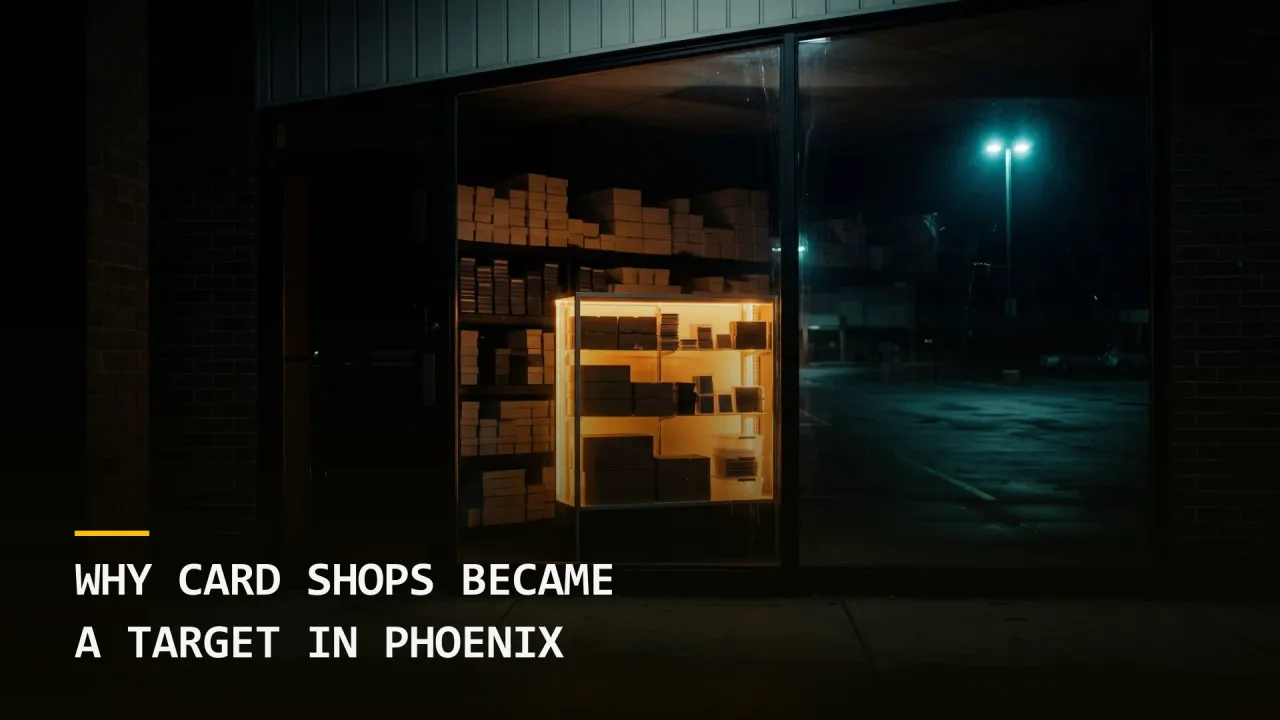
Somebody selected your shop before they came back with a tool. What they saw through the glass is the input to that decision. A storefront that visibly displays a full wall of sealed product after hours is advertising the payout. Move the display back, screen the sightline, or leave the case fronts empty overnight.
Put your cameras where a face is, not where the door is
Most shops aim everything at the entrance, which produces excellent footage of a masked person entering. That has evidentiary value and almost no investigative value. A camera at register height inside the aisle, or covering the approach to the door from outside at an angle, is where you get gait, build, vehicle, and the moment a mask slips. Ask what your footage would let a detective actually do.
Serialize what you can and log what you cannot
Graded slabs already carry certification numbers, so keep a running inventory of them. For sealed product, photograph case markings and lot codes as they arrive. It will not stop the theft. It gives you something to hand police and marketplaces afterward, and it is the only lever that touches traceability, which is the exact property making you a target.
Talk to the shops around you
Four Valley stores hit in under a year means somebody has footage of a person who has now done this repeatedly. Card shop owners in one metro largely know each other. A shared thread with images and timestamps turns four isolated incidents into a pattern a detective can work, and the same person is probably going to try shop number five.
Tell your insurer what the inventory is really worth
Sealed product appreciates and a policy written when you opened may be describing a business that no longer exists. Find out today whether your coverage reflects current replacement value or the value from three years ago, because the gap surfaces at the worst possible moment.
The Part Owners Get Wrong
The instinct after a break-in is to harden the point of entry. It is the visible failure, it is the thing you had to sweep up, and replacing it feels like doing something.
But the entry was never the decision. The decision was made days earlier by somebody looking at your window and doing arithmetic, and every control worth buying operates on that arithmetic rather than on the glass.
If you run a shop in the Valley, go stand outside your own front door after close and look in the way he did. What you can see from the sidewalk is what you are advertising.
Grab The Axe runs adversarial physical security assessments for Phoenix-area retail. We test the way somebody selecting a target would, then rank the fixes by what actually changes their math. We sell no hardware. Take our free Human Attack Surface Score assessment, or contact us for a facility assessment.

Operating on the philosophy that 'you can't build a secure system if you don't know how to break it,' Chris leads our engineering division. A top 1% National Cyber League competitor, he hardens our digital infrastructure against the very exploits he has mastered.
View Author Page →