- › Hundreds of police departments are launching drone-as-first-responder programs, which puts a camera over neighborhoods and facilities that were never previously under routine aerial watch.
- › The FCC opened its first proceeding to revoke a drone maker's equipment authorizations over false US-production claims, making hardware provenance an enforcement matter.
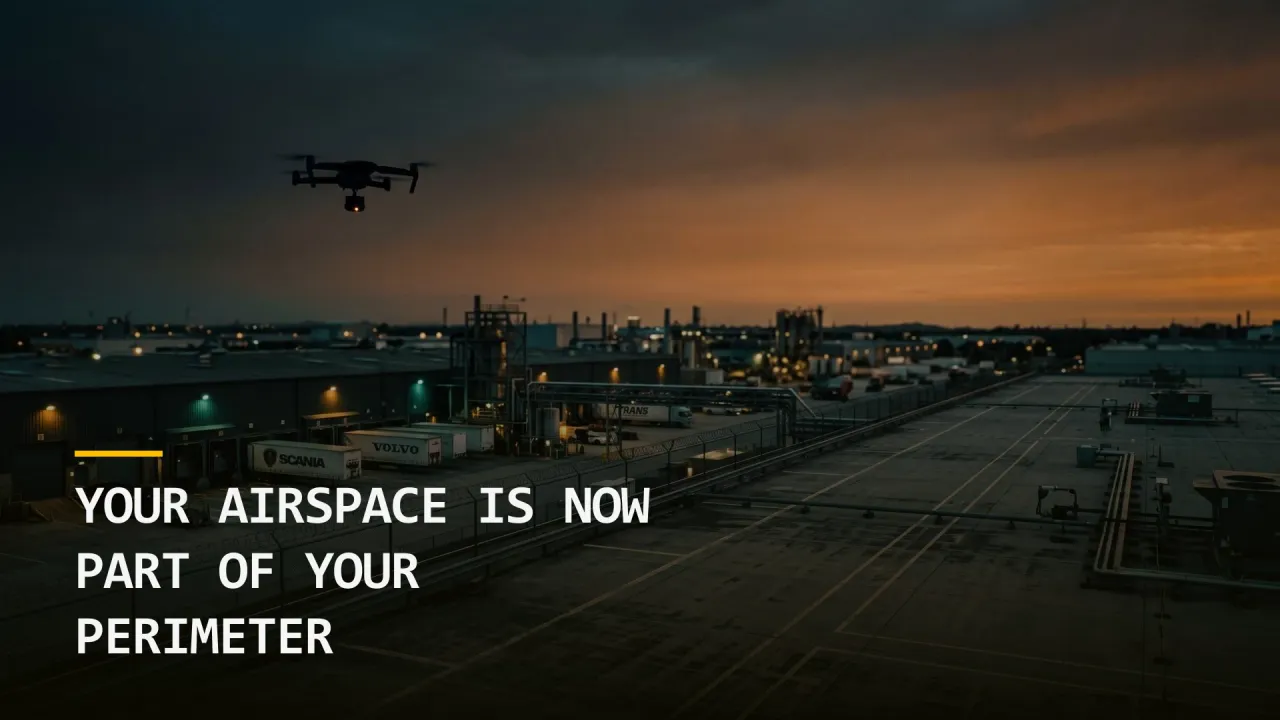
- › For a facility operator, the low airspace overhead is now a live part of the security picture on three fronts: surveillance of your site, drones used as a threat, and your own drone and counter-drone gear.
- › You have far less legal authority to act against a drone over your property than instinct suggests. Detection and documentation come first, and most active mitigation is off the table for private operators.
- › Add the vertical to your physical security assessment, vet drone vendors for real country-of-origin and authorization, and know your legal envelope before you buy anything that promises to stop a drone.
For most of the history of physical security, the perimeter was a flat idea. You thought about the fence line, the doors, the loading dock, the parking lot. Threats arrived on the ground, and the plan was built to meet them there. The sky was somebody else’s problem, mostly the FAA’s, and the odd helicopter overhead was not something a facility manager had to account for.
That assumption is quietly expiring. Two stories this week point at the same shift from different directions. Police departments across the country are lining up to launch drone-as-first-responder programs, hundreds of them clearing a key regulatory hurdle, which means a camera dispatched to calls over neighborhoods and businesses that were never routinely watched from above. And the FCC opened its first proceeding to revoke a drone maker’s equipment authorizations over false claims about where the hardware was actually built. One story is about who is flying overhead. The other is about whether you can trust the drone you bought. Together they say the low airspace above your facility has become something you have to plan for.
The Vertical Is a Real Part of Your Perimeter Now
Start with the mental model, because the fix begins there. The airspace from your rooftop up to a few hundred feet is now trafficked and contested in a way it was not five years ago, and it touches your security on three separate fronts. Most programs address none of them because most physical security assessments still stop at the roofline.
Surveillance of your site from above. A drone-as-first-responder program sends an aircraft to incidents, and on the way there and back it records whatever is below it, including your property. Add hobbyist drones, news drones, and the occasional competitor or adversary running reconnaissance, and the result is that your site is now imaged from angles your camera plan never considered. The loading dock schedule, the roof access points, the layout of your yard, the cars in the executive lot on a given day are all visible from overhead. None of that is illegal to capture, and all of it is useful to someone planning a ground approach.
Drones used as the threat itself. A drone is a delivery platform. It can carry contraband over a wall, drop a device on a roof, or simply loiter and film the pattern of your guard rotation for a later breach on the ground. This is not exotic anymore. It shows up in prison contraband cases, in critical infrastructure scares, and in industrial espionage. The point for an operator is that the drone does not have to land to be a problem, because reconnaissance from the air is often the first step of an attack that finishes at ground level.
Your own drones and the gear that counters them. If you run drones for site inspection or security patrol, they are now part of your supply chain, and this week made clear that their provenance is an enforcement matter. If you are looking at counter-drone technology, that is a legal minefield most vendors will not walk you through honestly. Both of these deserve their own attention, and I will take them in turn.
The Hard Truth About Fighting Back
Here is where instinct leads people wrong, and it is worth being blunt so nobody spends money on a fantasy.
When a drone is hovering over your property, filming your people, the natural reaction is to want to stop it. Jam it, hack it, net it, or in the worst instinct, shoot it down. Almost all of that is illegal for a private operator in the United States, and the law is not close or ambiguous. A drone is legally an aircraft, and interfering with it can run you into federal statutes that were written for exactly that reason. Jamming its signal violates FCC rules. Taking it over touches computer-fraud law. Bringing it down is treated as destroying an aircraft. The authority to actively counter drones is held by a short list of federal agencies, and it does not extend to you because the thing is over your parking lot.
We wrote the full breakdown of this in our guide to counter-drone legalities for corporations, and the short version is that the gap between what the technology can do and what you are allowed to do with it is enormous. A vendor selling you a slick box that promises to knock drones out of the sky is usually selling you a lawsuit or a federal charge. Before you buy anything with the word counter in its name, you need to know which narrow, mostly passive actions are actually available to you, and the honest answer for most private facilities is detection and documentation, not active defense.
What You Can Actually Do
The absence of a legal off switch does not leave you helpless. It changes the work from mitigation to detection, assessment, and hardening, which is the same discipline that runs the rest of a mature physical program.
Add the vertical to your physical security assessment. The cheapest move is a change in thinking. When you walk your site for vulnerabilities, look up. What is visible from two hundred feet that you would not want a stranger to see? Which sensitive areas, staging zones, or access points are exposed from above, and can they be screened, covered, or relocated? Treat overhead observation as a real collection method in your threat model, the same way you already treat a person with a camera at the fence line.
Detect before you think about anything else. Passive drone detection, systems that spot and log the presence of a drone without touching it, is legal and is the foundation. Knowing that a drone is present, when, and how often it returns turns a vague unease into a documented pattern. That record is what lets you call law enforcement with something concrete, brief your guard force, and decide whether a recurring visitor is a hobbyist or a scout. Detection is the part you are allowed to own, so it is where the investment belongs.
Harden against what the drone is doing, not the drone. You cannot stop the aircraft, and you can defeat its purpose. If the concern is filming, screening and covered staging deny the camera its shot. If the concern is a payload delivered to a roof or yard, then roof access control, secured intakes, and the same layered thinking behind our ransomware and incident work apply to the physical drop the same way they apply to a digital one. The drone is a delivery method, and you defend the target.
Write the response before you need it. Your guard force and your front desk should know what to do when a drone is spotted: who to notify, what to record, when to call police, and how to document it. A drone over the property at 2 a.m. is a security event, and it should trigger a procedure your people have practiced, not a scramble to figure out who to wake up.
The Provenance Problem You Now Own
The FCC action this week is the part most facility operators will overlook, and it is the one that can cost you money you already spent.
If drones are in your security stack, whether for inspection, patrol, or event coverage, they are hardware with a country of origin and a set of authorizations that let them operate legally in the US. This week the FCC signaled that it will revoke authorizations when a manufacturer lied about where a device was built. That means a drone you bought and deployed in good faith can become equipment you are no longer cleared to operate, grounded not because it failed but because its maker misrepresented it. The same reasoning already drives the federal restrictions on drones from certain foreign manufacturers over data-security concerns.
This is a vendor-risk problem, and it is the same one we point to again and again, because the entity you trusted to supply your gear becomes your exposure when they turn out to have cut a corner. Confirm the country-of-origin and authorization claims your drone vendors make, in writing. Understand whether the platform you are standardizing on is on a federal covered list or is likely to land on one. The cost of getting this wrong is a fleet you cannot fly and data you should not have been routing through that hardware in the first place.
The Sky Stopped Being Someone Else’s Problem
None of this means panic, and it does not mean rushing out to buy a drone-defense system that you will not be allowed to use. It means the perimeter is no longer flat. The airspace over your facility has quietly filled with cameras you do not control, delivery platforms that do not respect your fence, and hardware whose origins you now have to verify, and the discipline that answers all three is the same one you already run on the ground: assess the exposure, detect what you can, harden the target, and write the procedure before the incident.
The organizations that get caught flat-footed will be the ones still treating the roofline as the top of their world. This is exactly the kind of exposure a converged security program is built to catch, because a drone overhead is a physical event carrying a digital payload of data, and it does not fit neatly in either the cyber or the physical box on an org chart.
If you want to understand what your site looks like from above and what your real options are for the airspace over it, that is the work we do. Start with our free Human Attack Surface Score, or contact Grab The Axe and we will assess the perimeter that includes the sky.

A leader defined by a 'bias for action,' Dusten specializes in physical security assessments that impact profitability. He leverages high-logic strategies to pinpoint high-ROI vulnerabilities, ensuring defense measures actually scale with the business.
View Author Page →